20 Surprising Facts About Indian Independence Day You Probably Didn’t Know
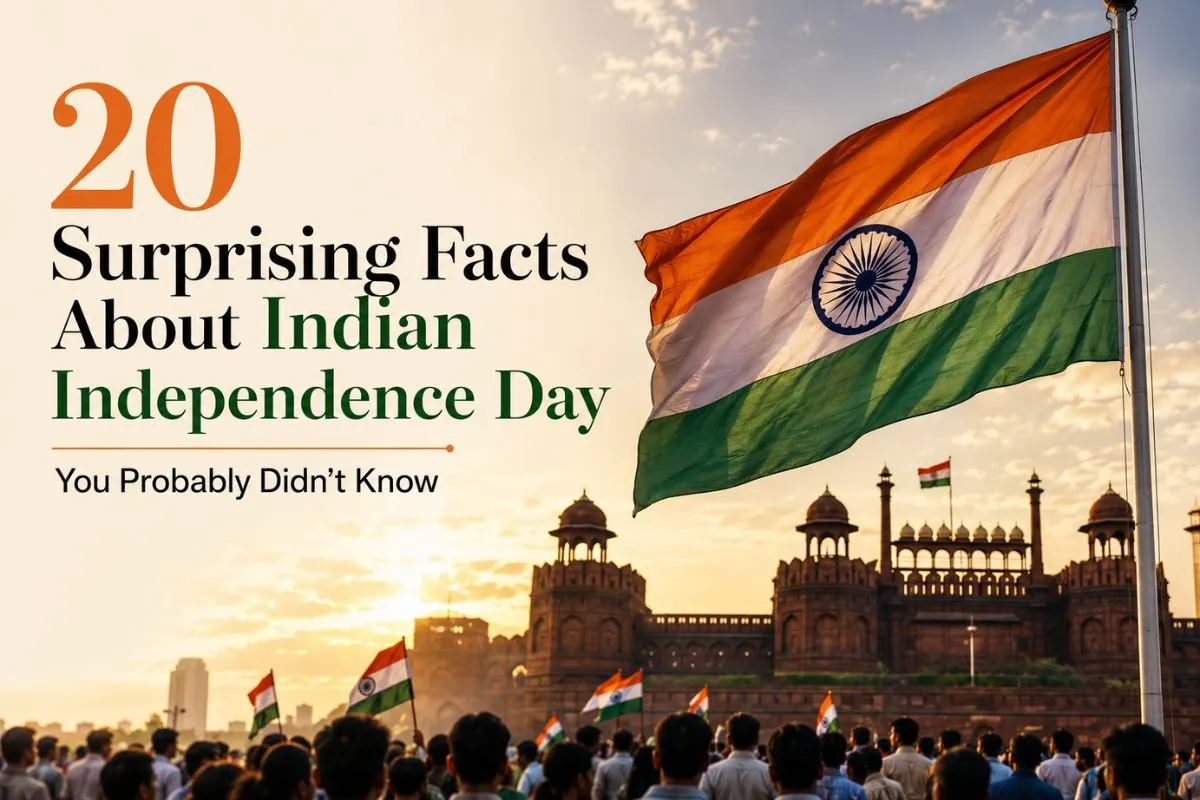
Every year on August 15th, the nation comes together to honor the triumph of freedom. While everyone knows about the grand celebrations at the Red Fort and the historical speeches, there are dozens of fascinating, obscure historical details behind the making of modern India.
Here are20 trivia factsabout India’s Independence Day that will change how you look at the history books.
1–5: The Date & The Flag
1. August 15 was originally NOT the intended date.
The British Parliament originally scheduled the transfer of power forJune 30, 1948. However, Lord Mountbatten sped up the timeline by almost a year to prevent escalating political volatility.
2. Why August 15? WWII nostalgia.
Mountbatten personally chose August 15 because it marked thesecond anniversary of Japan’s surrenderto Allied forces in World War II.
3. The flag once featured a spinning wheel.
Early official designs of theTirangacarried Gandhiji’scharkha(spinning wheel) at the center to signify self-reliance before it was formally replaced by theAshoka Chakrarepresenting law and motion.
4. Only ONE licensed supplier can manufacture the national flag.
By official regulation, the national flag must be hand-spun, hand-woven khadi bunting produced by theKarnataka Khadi Gramodyog Samyukta Sanghain Bengeri, Hubballi.
5. Citizens couldn’t legally fly the flag year-round until 2002.
Before 2002, everyday citizens were restricted from hoisting the national flag on private property on non-national holidays. A decades-long legal battle by industrialist Naveen Jindal led to the amendment of the Flag Code of India.
6–10: Ceremonies & Historical Quirks
6.Jana Gana Manawasn’t the official anthem on August 15, 1947.
When India gained freedom, it technically had no official national anthem. Written by Rabindranath Tagore in 1911 asBharoto Bhagyo Bidhata, it was officially adopted as the anthem onJanuary 24, 1950.
7. Borders were announced TWO days late.
Though India became independent on August 15, theRadcliffe Line—which drew the borders between India and Pakistan—was publicly announced onAugust 17, 1947.
8. 5 other nations share August 15 as their Independence Day.
India shares its date of liberation withSouth Korea, North Korea, Liechtenstein, Bahrain, and the Republic of the Congo.
9. Mahatma Gandhi missed the midnight speech.
While Nehru gave his famous “Tryst with Destiny” address in New Delhi, Gandhi was over 1,400 km away in Kolkata, fasting and praying for communal peace.
10. Chief Ministers couldn’t unfurl the flag on August 15 until 1974.
Until 1974, only State Governors raised the flag on Independence Day. DMK leader M. Karunanidhi campaigned to change the rule so state Chief Ministers could lead local celebrations.
11–15: Unsung Heroes & Bold Movements
11. The INA had an all-women combat unit.
Netaji Subhas Chandra Bose established theRani of Jhansi Regimentwithin the Indian National Army in 1943—one of the world’s first all-female combat infantry units.
12. The 1946 Naval Mutiny accelerated Britain’s exit.
A massive strike by 20,000 Royal Indian Navy sailors across 78 ships in February 1946 shattered the colonial power’s faith in controlling the military forces.
13. Rabindranath Tagore wrote the anthem for TWO nations.
Tagore not only composed India’s national anthem but also pennedAmar Sonar Bangla, which Bangladesh later adopted as its national anthem in 1971.
14. Secret radios outsmarted British censorship.
During the Quit India Movement in 1942, Congress Radio—an underground radio transmitter operated byUsha Mehta—broadcasted news across Mumbai to evade British authorities.
15. Goa did NOT become free in 1947.
While the rest of the country celebrated freedom from the British in 1947, Goa remained underPortuguese colonial rulefor another 14 years untilOperation Vijayliberated it in December 1961.
16–20: Currency, Postage & Modern Legacies
16. India’s first stamps featured the Tricolour.
The very first postage stamp issued by Independent India on November 21, 1947, featured the national flag with the sloganJai Hind.
17. Rupee parity at independence is a myth.
A common urban legend states ₹1 was equal to $1 USD in 1947. In reality, the Rupee was pegged to the British Pound (£1 = ₹13.33).
18. Partition required temporary currency Overprints.
Following the split in 1947, the Reserve Bank of India printed temporary currency notes stamped with “Government of Pakistan” for use in the new territory until Pakistan’s central bank was established.
19. The Princely State of Hyderabad remained unintegrated for a year.
The Nizam of Hyderabad initially refused to accede to either India or Pakistan. Integration was achieved only afterOperation Poloin September 1948.
20. Princess Amrit Kaur was the first female Cabinet Minister.
India’s first Health Minister, Rajkumari Amrit Kaur, was a freedom fighter who went on to establish the All India Institute of Medical Sciences (AIIMS).
Suggested Reading
Marking 80 Years of Independence
Six pieces on the history, the facts, the flavours, and the moments that shaped this year’s Independence Day, from the Prime Minister’s address to the operation that once defended the skies.
- 01 80th Independence Day: Honoring Our Roots→ Reflection
- 02 20 Facts About Indian Independence Day→ History
- 03 How India Celebrates Independence Day→ Traditions
- 04 PM Modi’s 80th Independence Day Address→ This Year
- 05 Operation Safed Sagar→ Defence History
- 06 Celebrate With A Layered Tricolour Panna Cotta→ Recipe