How India Celebrates Independence Day, State By State, And What You Can Actually Do Today
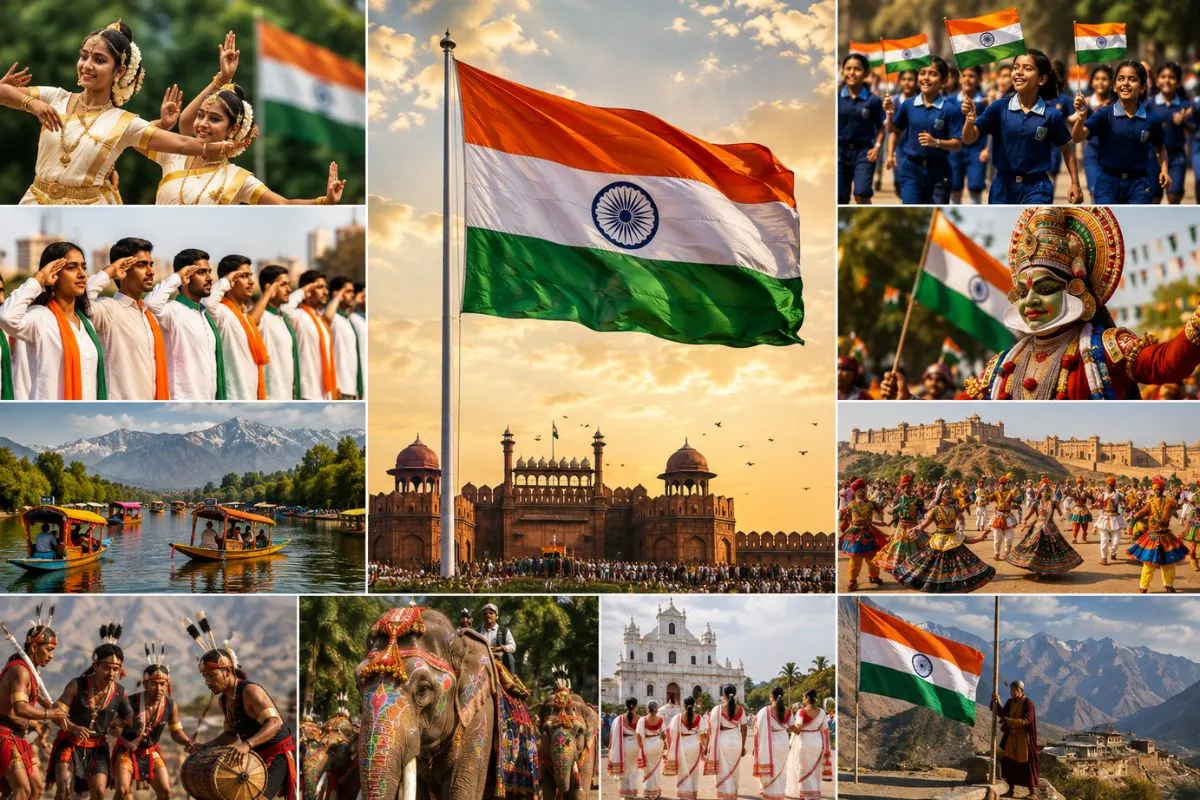
Today marks eighty years since Jawaharlal Nehru raised the tricolour above the Lahori Gate of the Red Fort and spoke of a tryst with destiny. Every year the day gets treated as one single national moment, flag hoisting, a speech, the national anthem, but the truth on the ground is more textured than that. Independence Day in India has never really been one celebration. It is dozens of regional ones that happen to fall on the same date, shaped by local history, local weather, and what freedom actually meant to that particular part of the country in 1947. Worth knowing what is happening beyond your own rooftop today, and worth doing something with the people around you before the day slips by unmarked.
Delhi: Where The Day Officially Begins
Every Independence Day starts, symbolically, in the same place it started in 1947. The Prime Minister hoists the flag at the Red Fort and addresses the nation, a tradition that has run unbroken since Nehru’s first speech. Government buildings across the capital stay lit through the night regardless of the holiday, and the ceremony is broadcast into homes across the country, the one piece of the day that genuinely is shared nationwide rather than regional.
But Delhi’s other Independence Day tradition happens far from the cameras, in the narrow lanes of Old Delhi, where rooftops fill with families flying kites from morning until dusk. The tradition traces back to 1927, when freedom fighters flew kites carrying the slogan “Go Back Simon” as a form of protest against the Simon Commission. Kite flying stuck as a symbol of the day itself, and Old Delhi still treats it as seriously as any competitive sport, with kite runners chasing down cut strings through the gullies and shops that have sold nothing but kites for generations doing their busiest trade of the year.
Punjab: A Border Ceremony Unlike Anywhere Else
Nowhere in India does Independence Day carry quite the same weight as it does in Amritsar, at the Attari Wagah border. The Beating Retreat ceremony, held daily but treated with special intensity on August 15, brings together Indian Border Security Force jawans and their Pakistani counterparts in a synchronised, high stepping display that ends with the ceremonial lowering of both flags. Crowds gather on grandstands on both sides of the border to watch, and the atmosphere is somewhere between a sporting event and a solemn tribute, patriotic chanting one moment, quiet respect the next. For a state that bore the sharpest edge of Partition, the ceremony functions as something closer to communal memory than tourist spectacle.
Gujarat And Rajasthan: The Kites Take Over Completely
If Delhi treats kite flying as one tradition among several, Gujarat treats it as close to the entire day. Ahmedabad’s skies fill with kites from early morning, and the cry of “Kai Po Che,” meaning “I have cut it,” rings out across rooftops as competitors try to sever each other’s strings mid air. Gujarat’s connection to kite flying runs deeper than Independence Day alone, the state is also home to the Patang Kite Museum, and its Uttarayan festival built around kite flying is a major cultural event in its own right. Independence Day simply borrows the same skill and enthusiasm for a different occasion.
Rajasthan follows a similar pattern, with families flying kites from rooftops in cities like Jaipur alongside the more conventional flag hoisting ceremonies at schools and government buildings. Jaipur’s own layered relationship with tradition and spectacle,covered in an earlier guide to the Pink City, makes it easy to see why a festival built on colour, height, and a bit of competitive theatre would take root there so naturally.
Maharashtra: A Freedom Movement Still Close To The Surface
Mumbai carries a particular weight on this day that other cities do not, because the city was the site of the August Kranti Maidan, the ground where the Quit India Movement was formally launched in 1942. Local commemorations often draw a direct line back to that history, with processions and cultural programs that treat the day less as an abstract celebration and more as a continuation of a specific, local chapter of the independence struggle. Homes and sweet shops across the state prepare tricolour themed treats for the day, and community associations organise flag hoisting ceremonies with genuine local participation rather than only official protocol.
West Bengal: Processions, Culture, And Street Theatre
Kolkata’s Independence Day tends to spill into the streets rather than stay confined to formal ceremonies. Cultural processions, patriotic street plays, and community performances are common across the city, alongside the more standard flag hoisting at government buildings and schools. Kite flying has a presence here too, though smaller in scale than in Delhi or Gujarat, part of a broader Bengali tradition of marking major occasions with public performance and collective participation rather than private, at home ritual alone.
Kerala And The Coast: A Naval Tribute
Kerala’s Independence Day carries a distinctly maritime character, given the state’s long naval and coastal history. Wreath laying ceremonies at war memorials, reviewed parades at naval installations, and formal tributes to servicemen mark the morning in cities like Kochi, a reminder that the armed forces, and specifically the navy given the coastline, occupy a particular place in how the state marks the occasion. It is a quieter, more formal register than the kite filled rooftops further north, shaped by the specific institutions that define the region.
The Northeast: Local Leadership, National Occasion
States across the Northeast mark the day with their own state level ceremonies led by local leadership, flag hoistings presided over by chief ministers at prominent grounds in state capitals, from Agartala to Itanagar, each paired with cultural performances specific to the region’s own traditions rather than a single national template. It is a useful reminder that “how India celebrates Independence Day” was never going to be one script performed identically from Kashmir to Kanyakumari. The occasion is shared. The expression of it is deliberately, proudly local.
What You Can Actually Do Today, With Your Family
None of the above requires a plane ticket or a grand gesture to translate into something meaningful at home. A few genuinely doable ideas for the rest of today.
Watch the flag hoisting and address together, without the phone in the other hand. It sounds small, but giving even fifteen minutes of full attention to the ceremony, and talking about it afterward with kids or parents in the room, does more than having it play in the background while everyone scrolls separately.
Tell one real story instead of a generic one. Skip the textbook summary and pick a single person whose story actually lands. Captain Lakshmi Sahgal led an all female regiment into the Burma front and later spent her postwar years running a free clinic for Partition refugees,a story worth telling in full rather than in outline. Names like Aruna Asaf Ali and Kamaladevi Chattopadhyay rarely make it into a standard textbook chapter despite the size of what they actually did, anda short list of underrecognised women from the independence movementis a good five minute read to share with kids over breakfast before the flag even goes up.
Cook something tricolour, on purpose, together rather than buying it pre made. It does not need to be elaborate. A simple layered dessert, or even fruit sorted into saffron, white, and green on a single plate, gives kids something to actually make with their hands rather than just watch.
If you live somewhere with a kite flying tradition, actually go up on the roof. Even a cheap kite from a roadside stall, flown badly, does more for a family afternoon than most planned activities, and there is a real history behind the string in your hand that is worth mentioning while you are up there.
Visit a local war memorial or heritage site if one exists near you, even a small one. A wreath, a plaque, five quiet minutes standing in front of a name most passersby never stop to read, teaches a different kind of attention than any classroom lesson.
Sing the national anthem as a family, not performatively, just once, standing together in your own living room. It is a small ritual, but it is one that costs nothing and asks for nothing beyond a minute of shared attention.
Whatever the specific activity, the through line worth keeping in mind is simple. Independence Day was never handed down as a finished, uniform script. It was built, region by region, out of whatever each part of the country had, a border, a kite, a coastline, a maidan with a name people still remember. What you do with your own few hours today can follow the exact same logic. Small, local, and genuinely yours.
Suggested Reading
Marking 80 Years of Independence
Six pieces on the history, the facts, the flavours, and the moments that shaped this year’s Independence Day, from the Prime Minister’s address to the operation that once defended the skies.
- 01 80th Independence Day: Honoring Our Roots→ Reflection
- 02 20 Facts About Indian Independence Day→ History
- 03 How India Celebrates Independence Day→ Traditions
- 04 PM Modi’s 80th Independence Day Address→ This Year
- 05 Operation Safed Sagar→ Defence History
- 06 Celebrate With A Layered Tricolour Panna Cotta→ Recipe