Household First: India Rations Industrial Gas Amid Gulf Energy Crisis
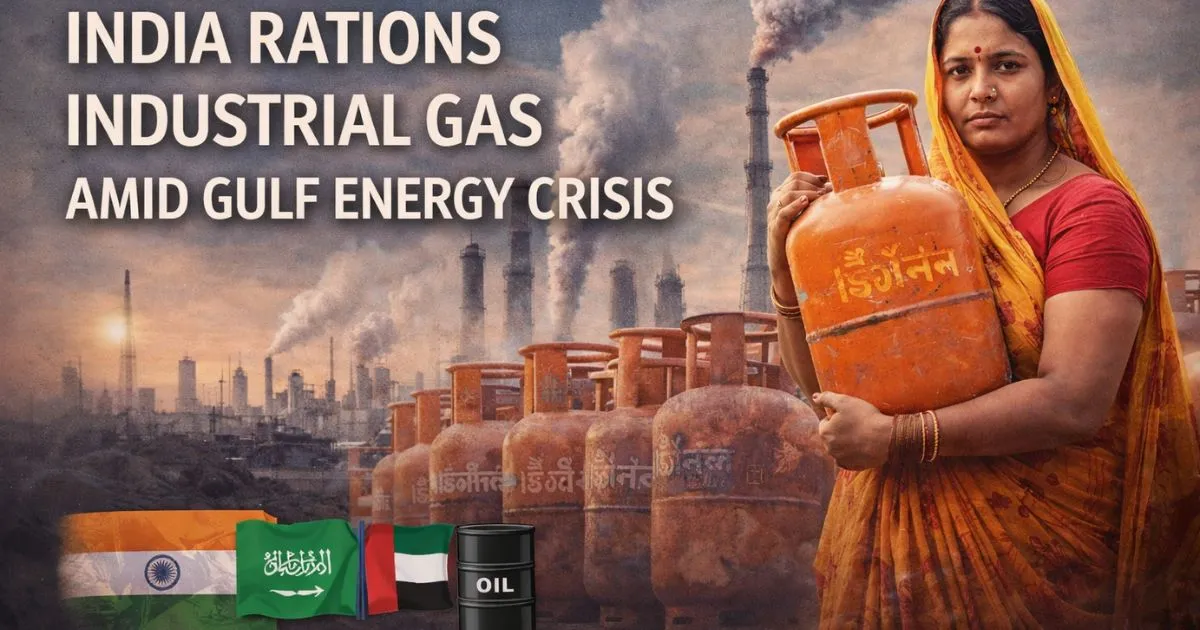
New Delhi | March 10, 2026 — The Indian government has officially invoked emergency powers under the Essential Commodities Act (ECA), 1955, to prioritize domestic cooking gas (LPG) over industrial and commercial use. This “Household First” strategy comes as the escalating conflict in West Asia and the closure of the Strait of Hormuz have choked nearly 60% of India’s LPG and LNG import routes.
While the Ministry of Petroleum and Natural Gas maintains that there is no “systemic shortage,” the rationing is hitting the country’s industrial hubs with brutal force.
The Rationing Roadmap
To prevent panic-buying and hoarding, the government and Oil Marketing Companies (OMCs) have introduced strict “lock-in” periods for domestic consumers, while simultaneously slashing supplies to the secondary sector.
- Domestic Constraints: Households can now only book a refill once every 25 days. This replaces the previous 15-day window to ensure equitable distribution across India’s 33 crore connections.
- Industrial Cutbacks: Major gas distributors like Gujarat Gas and Adani Total Gas have invoked Force Majeure, reducing supply to industrial clusters to as low as 40–50% of contracted volumes.
- Production Pivot: Refineries have been ordered to divert all propane and butane streams usually used for making plastics and petrochemicals toward the production of domestic LPG.
Ground Zero: Impact on Punjab and Gujarat
The rationing is creating a “liquidity and production crisis” in India’s manufacturing heartlands, where natural gas is the primary fuel for kilns, furnaces, and boilers.
Gujarat: The Ceramic and Chemical Crisis
In Morbi, the world’s second-largest ceramic cluster, and the Vatva industrial estate (home to over 250 chemical units), production has effectively halved.
- Double Pricing: Units attempting to consume gas beyond their restricted 40% quota are being hit with “penalty rates” nearly double the standard price making continued operation economically unviable.
- Order Backlogs: Textile and food processing units in Surat are warning of massive delays in export orders as they struggle to maintain even single-shift operations.
Punjab: The Plastic and Polymer “Meltdown”
In Ludhiana, the impact is being felt through the petrochemical supply chain. Since the government has barred refiners from using propane and butane for plastics, raw material prices have skyrocketed.
- Price Surge: The cost of key polyethylene polymers has jumped from ₹80/kg to ₹160/kg in just two weeks.
- MSME Vulnerability: Small and medium enterprises (SMEs) operating on fixed-price B2B contracts are unable to pass these costs to clients, leading to fears of widespread business collapses by the end of the fiscal year.
The Global Backdrop
The crisis was triggered by a “perfect storm” in the Persian Gulf:
- Qatar’s Production Halt: India’s largest LNG supplier, QatarEnergy, declared Force Majeure following drone strikes on its Ras Laffan facility.
- Maritime Chokehold: Insurers have pulled coverage for the Strait of Hormuz, stranding Indian vessels like the Nanda Devi away from the conflict zone.
- The “US Bridge”: While India has begun receiving LPG from a new 2.2 million-tonne contract with the US Gulf Coast, this only covers about 10% of national demand, leaving a massive gap that domestic rationing must now fill.
Continue reading: How Operation Epic Fury Is Rippling Through the Global Economy