The Living Fortresses of the Parvati Valley: A 2026 Guide to Kath-Kuni Architecture and High-Altitude Survival
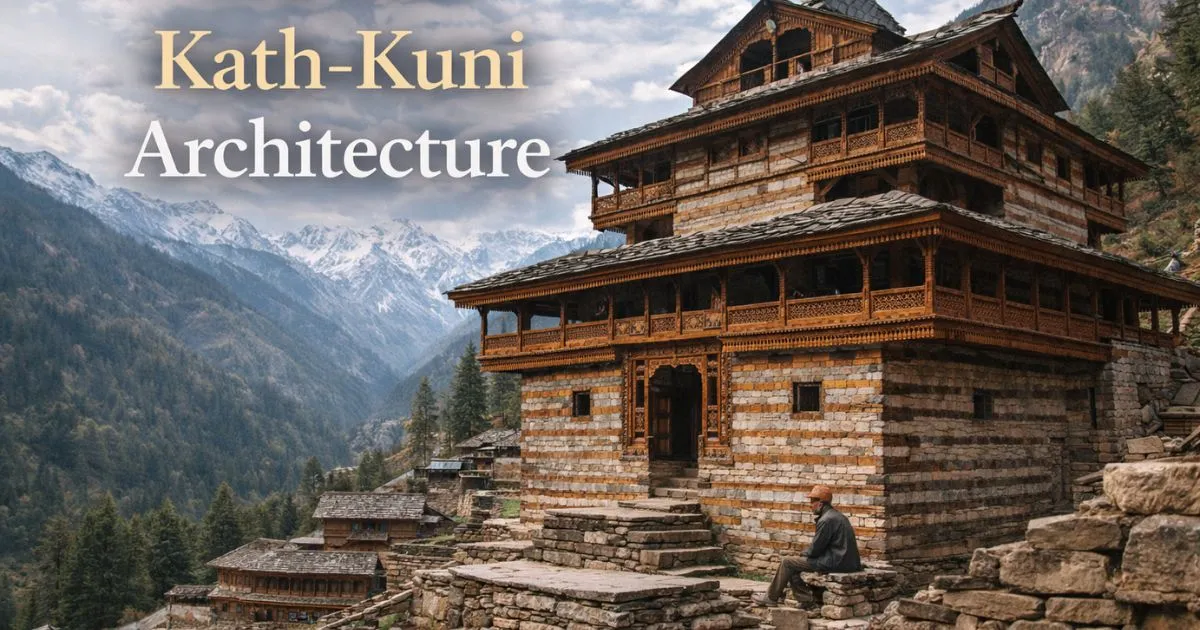
In the high-altitude reaches of the Parvati Valley—specifically in the “Honey Village” of Grahan—modern concrete is viewed with suspicion. While the rest of the world builds with rigid steel and cement, the villagers here live within an ancient, flexible, and thermally intelligent system known as Kath-Kuni.
The name itself is a blueprint: Kath (wood) and Kuni (corner). In an era of climate uncertainty and seismic instability, these structures are no longer just “traditional homes”; they are masterclasses in sustainable engineering that have outlasted modern buildings in every major Himalayan earthquake of the last century.
1. The Seismic Dance: Engineering for a Moving Earth
The Himalayas sit atop one of the most active tectonic boundaries on the planet. Most modern construction fails here because it tries to resist the earth’s movement. Kath-Kuni succeeds because it embraces it.
The Dry-Masonry Principle
A Kath-Kuni wall is built without a drop of mortar. Instead, it uses a dual-layered system of locally quarried stone and seasoned Deodar wood.
- The “Lego” Effect: The absence of cement allows the stones to shift and settle during a tremor. This dissipates the kinetic energy of an earthquake rather than letting it crack the structure.
- Corner Interlocking: At every corner, the wooden beams are notched and interlocked. These joints act like biological hinges, allowing the building to sway up to several degrees and then “snap” back into its original shape once the shaking stops.
2. The Thermal Battery: Survival at -10°C
In Grahan, where winter temperatures frequently drop into the negatives, insulation isn’t something you buy; it’s something you build into the walls.
| Material | Engineering Function |
| Stone Layers | High Thermal Mass. Acts as a “battery” that absorbs sun heat all day and releases it at night. |
| Deodar Wood | Low Thermal Conductivity. Acts as a “break,” preventing cold external stone temperatures from reaching the interior. |
| Air Gaps | The dry-stack method leaves millions of microscopic air pockets between stones, providing better insulation than modern glass wool. |
The “Animal Heater”
The layout of a Kath-Kuni house is a functional vertical ecosystem. The ground floor, known as the Obra, is reserved for livestock. The rising body heat from the cattle acts as a natural underfloor heating system for the family living on the upper floors.
3. The Deodar Legacy: Building for Centuries
The primary wood used is Deodar (Cedrus deodara), the “Timber of the Gods.” Its natural resins make it waterproof, termite-resistant, and capable of lasting over 500 years without chemical treatment. In the 2026 season, as we look toward carbon-neutral construction, Kath-Kuni stands as a 100% biodegradable and locally sourced alternative to the energy-intensive concrete industry.
4. Why This Matters for 2026
As travel to the Parvati Valley increases, the demand for “homestays” is rising. For the content strategist or the traveler, staying in a Kath-Kuni house in Grahan is not just about the “vibe”—it is an act of cultural preservation. Every night spent in a traditional house supports the local artisans (Mishris) who still hold the secret knowledge of these interlocking joints.
Final Note: When you visit Grahan, look at the walls. You aren’t just looking at a house; you are looking at a living, breathing fortress that has negotiated with the mountains for generations.