Why Indian Women Keep the Good Things “For Later”
- Many Indian women grow up learning that the best things in a house are meant for guests, not residents
- Trousseau sarees are bought for a 24-year-old and often assigned to future life events
- Scarcity research (Mullainathan and Shafir) shows the saving reflex can outlast the shortage that created it
- Loewenstein’s 1980s experiment found people often value anticipation more than the immediate thing
- An unopened item stays a possibility, and a used one becomes ordinary
- Occasions get rejected one by one, so the item waits until it no longer fits or suits
- Common phrases behind the habit: “kisi function mein,” “gift hai,” “abhi nahi”
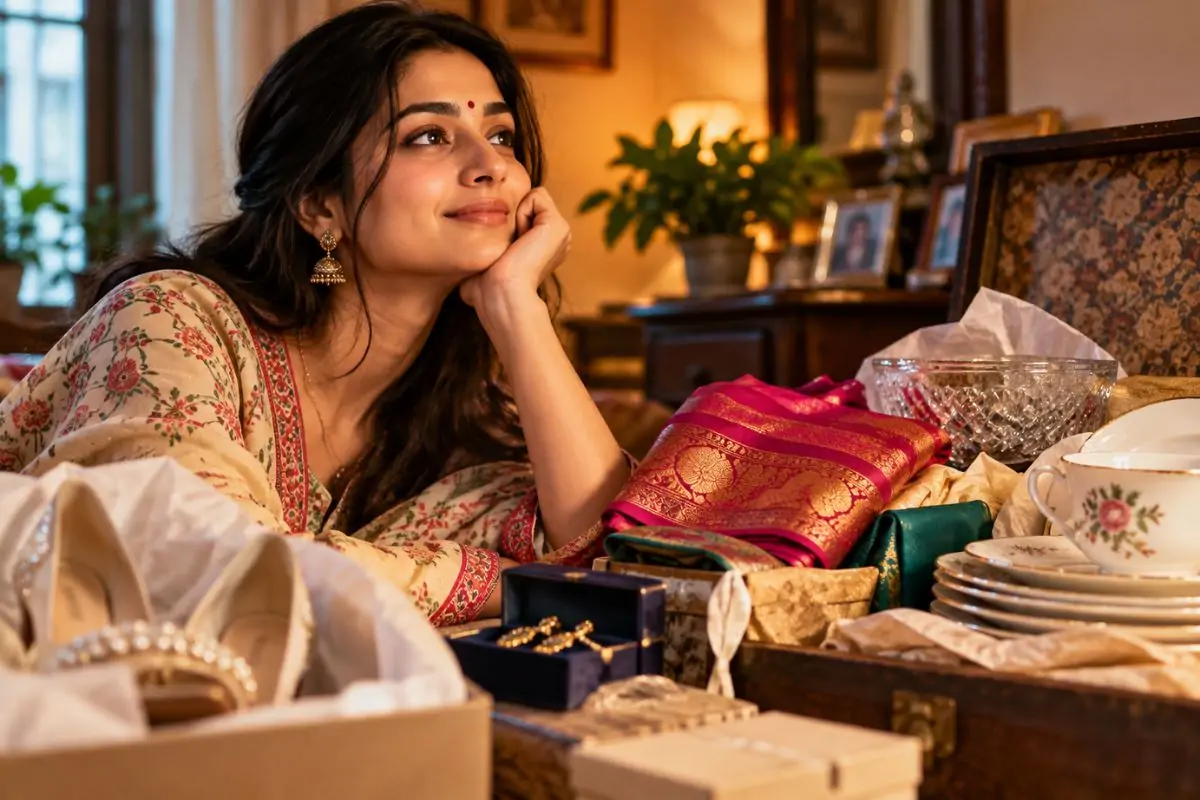
Open the almirah in almost any Indian home and there’s a shelf nobody touches. A Kanjeevaram folded in muslin, the creases gone soft. A perfume someone carried back from Dubai in 2016, box still sealed. The dinner set in the top cabinet, the one that comes down only when a rishta walks in.
Ask why, and you’ll get the same sentence in whichever language the house speaks.
“Kisi function mein pehnungi.”I’ll wear it to some function.
The function comes. She wears the other saree.
The shelf has a name
Nobody calls it the mehmaan shelf, but everyone knows what it is. The good cups come out for guests. The family drinks from steel tumblers with a dent in one side, and nobody has ever felt deprived by this. It’s just the arrangement.
A girl who grows up watching this learns the ranking without anyone teaching it. The best things exist, they are in the house, and they are not for the people who live in it. They’re for people who are coming. Someone else’s opinion of you is worth more than your own tea.
Years later she’s forty-one, standing in her own kitchen with a perfectly good cup in her hand and choosing the chipped one. She couldn’t tell you why. Her hand just went there.
The trousseau was bought for a 24-year-old
A lot of these sarees arrive in one rush. A wedding needs twenty-odd of them, bought over a few frantic weeks, and they’re bought for a specific woman: 24, about to become someone’s wife, being looked at by rooms full of people.
Some are assigned a future on the spot.This one for the first pregnancy. This one for when your daughter gets married. This one for your fiftieth.Now the saree isn’t clothing. It’s an appointment, and it sits in the almirah waiting for a date that was set by someone else.
Plenty of them do get worn eventually, at the daughter’s wedding, thirty years on, with the zari gone a shade duller. Some never do. They just get passed down, still folded the way they arrived.
What people say when you ask
If you sit with a group of women and ask what they’re saving, the answers come fast, like they’ve been waiting.
- “It’s too nice for daily use.”
- “I’ll wear it when I lose a few kilos.”
- “It was a gift. I don’t want to spoil it.”
- “There’s no occasion good enough yet.”
- “My mother kept hers too.”
That last one closes the conversation more often than you’d expect.
Scarcity leaves a habit behind
Economists Sendhil Mullainathan and Eldar Shafir spent years studying what it does to a mind to feel it doesn’t have enough. One of their findings: scarcity makes you hold on tighter, even after the shortage is over.
A lot of us were raised by people who lived through actual shortage. Ration cards, one good outfit a year, a single pressure cooker that had to last two decades. Those parents didn’t save things out of fear exactly. They saved because things were hard to replace. Then their daughters grew up in a world with a mall on every corner and kept the reflex anyway. The habit outlived the reason.
Unopened is better than opened
There’s an old experiment, from the 1980s, by the economist George Loewenstein. He asked students how much they’d pay for a kiss from their favourite movie star, and the timing varied: right now, in an hour, tomorrow, in three days, in a year. Many people valued the kiss most when it was a few days away, not immediate.
The wait was the good part. The imagining was worth more than the thing.
That’s the sealed perfume. Unopened, it can be anything. It’s the version of you who wears it to dinner on a rooftop, laughing at something. Opened, it becomes a scent you wear on a Tuesday to the dentist, and it fades to nothing by month three. A possibility is a more valuable object than a possession, and the sealed box is pure possibility.
No occasion is ever quite big enough
Here’s the trap. You’re saving the saree for something special, so you hold it up against your life and check.
Your cousin’s wedding? Forty aunts with phones. What if someone spills chai. Wear the mid-range one. Diwali? Too much cooking, too much smoke. Your best friend’s engagement? It’s her day, you shouldn’t outshine her. The saree sits, and every occasion gets rejected on some small technicality.
By the time an event finally feels big enough, the blouse doesn’t fit, or the border looks a bit dated, or you’ve decided the moment has already passed. A body changes over twenty years. Fashion moves. The saree, meanwhile, hasn’t moved at all.
The smell of the almirah
If you grew up in a house like this, you know the smell. Naphthalene balls tucked into every fold, sharp and slightly chemical, mixing with old silk and sandalwood soap. You open the door and it’s the smell of your mother’s things, your grandmother’s things, a whole storage system that saysnot now.
Somewhere inside that cupboard is a saree in a plastic cover with a small window in the front, so you can see the colour but not touch the cloth. It’s been there for years, and it’s still the most beautiful thing in the house.