Kamala Sohonie: The Woman Who Made C.V. Raman Change His Rules
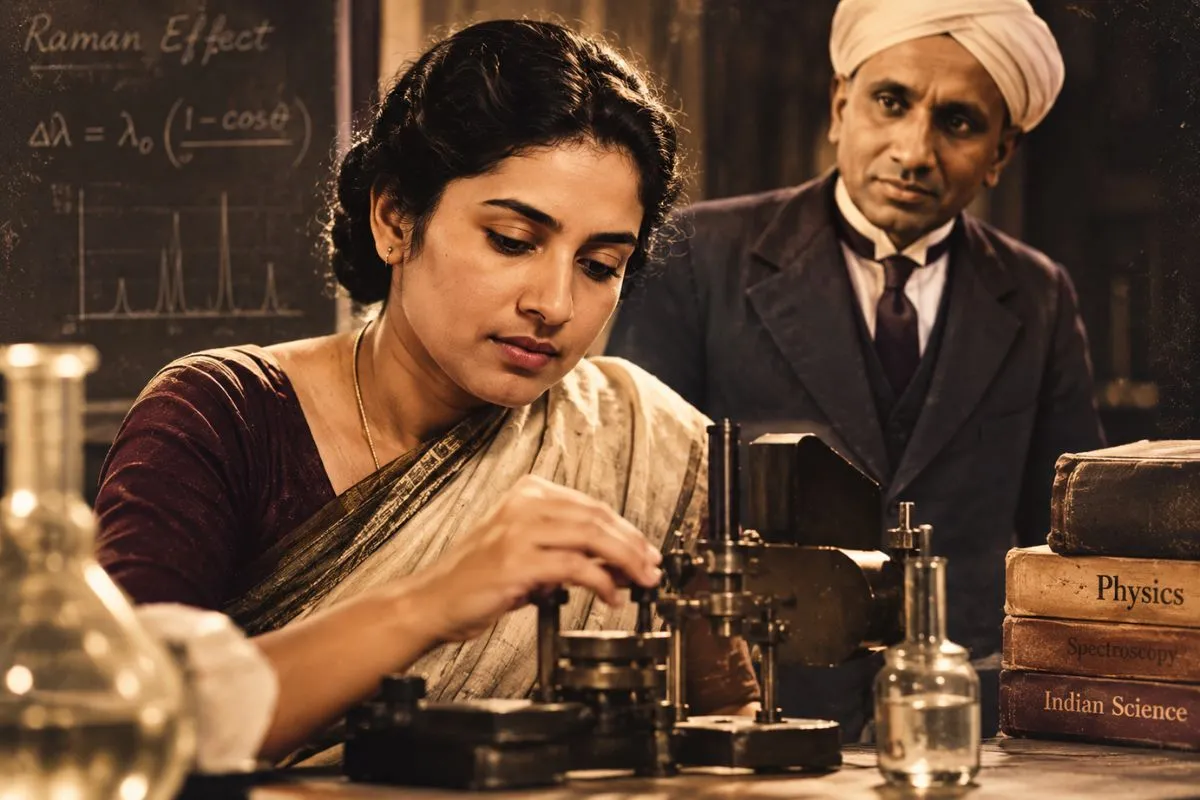
In 1933, a twenty two year old chemistry graduate stood in front of Nobel laureate C.V. Raman, the director of the Indian Institute of Science and one of the most celebrated physicists India had ever produced, and asked him directly why women were not allowed to study at his institution. Raman had already rejected her application once, on no stated grounds beyond her gender. Kamala Sohonie did not walk away after the rejection. She pushed, repeatedly, until Raman agreed to admit her on a set of conditions designed to make the point that he was doing her a favour rather than correcting an injustice, terms she accepted anyway, because accepting them was the only door actually open to her. Six years later, she became the first Indian woman ever to earn a PhD in a scientific discipline, and the institution that had once refused to let her through the gate never went back to excluding women again.
A Family Built On Chemistry, In A Country That Wasn’t Yet Built For Women In It
Sohonie was born in 1911 or 1912 in Indore, into a family already deeply rooted in science. Both her father, Narayanrao Bhagwat, and her uncle, Madhavrao Bhagwat, had trained as chemists at the Indian Institute of Science, giving her an early, direct exposure to a scientific career most Indian women of her generation would never have encountered at all. She followed the same path academically, graduating at the top of her class in physics and chemistry from Bombay University in 1933, a genuinely outstanding academic record by any measure. That record was precisely what made Raman’s rejection sting as much as it did. She had not been denied for lack of merit. She had been denied on the explicit grounds that women, in Raman’s own reasoning, would prove too distracting to the male researchers around them and were not considered competent enough for serious research work.
The Conditions She Accepted To Get In The Door
Sohonie’s confrontation with Raman is one of the more remarkable, well documented moments in the history of Indian science, not because she won outright, but because of exactly how narrow and conditional her victory actually was. Raman eventually agreed to admit her, but only on humiliating terms, she would spend her entire first year on probation, her work would not be considered officially valid until Raman himself was personally satisfied with its quality, and she was expected not to “distract” her male colleagues simply by being present in the lab. She accepted every condition. Decades later, she described the experience with unusual bluntness for someone discussing a Nobel laureate publicly, saying she could never forget how he treated her purely because she was a woman, and that even a scientist of Raman’s stature had displayed a strikingly narrow mind on the subject. What mattered beyond the insult, though, was the outcome. Sohonie’s work at the institute proved good enough that within a year, IISc began admitting other women as regular students, a policy shift her own performance had directly forced open.
From Bangalore To Cambridge, And A Discovery Written In Forty Pages
Working under mentor Sri Srinivasayya, Sohonie completed research on the proteins present in food items, earning a master’s degree in biochemistry, work strong enough to secure her an invitation to Cambridge University, where she joined the laboratory of Nobel laureate Frederick G. Hopkins under researcher Derek Richter, and later worked directly with Robin Hill. There, she conducted research that identified the presence of the enzyme cytochrome c in plant cells, and specifically demonstrated its role in the oxidation process within every living plant cell, a genuinely significant contribution to biochemistry at the time. Her completed thesis ran to a remarkably compact forty pages, and it earned her a Cambridge PhD in 1939, making her the first Indian woman in history to hold a doctorate in any scientific field. Richter himself later remarked that she had made history simply by being the first woman to do so, a rare, direct acknowledgement from within the same academic establishment that had spent her entire career treating her presence as an exception to be managed rather than a scientist to be judged on her work alone.
Choosing India Over American Pharmaceutical Offers
By the time she completed her doctorate, Sohonie had genuinely lucrative offers from American pharmaceutical companies waiting for her. She turned them down and returned to India in 1939 instead, driven by her admiration for Mahatma Gandhi and a desire to contribute directly to the nationalist movement and the country’s development rather than build a career abroad. She took on the role of Professor and Head of Biochemistry at Lady Hardinge Medical College in New Delhi, later moving to the Nutrition Research Laboratory in Coonoor to study the role of vitamins in human nutrition, work that shifted her research focus decisively from pure biochemistry toward problems with direct, tangible relevance to India’s poorest communities.
Neera, And Science Aimed Directly At Malnutrition
After marrying M.V. Sohonie, an actuary, in 1947, she moved to Mumbai and took up a position as Professor of Biochemistry at the newly established department at the Royal Institute of Science. It was here that her research took its most distinctly public turn. At the direct suggestion of India’s first President, Dr Rajendra Prasad, who was searching for ways to make productive use of the country’s substantial palm tree population, Sohonie and her students studied neera, a sweet palm nectar traditionally consumed in parts of India, alongside pulse and legume proteins and paddy flour, three food sources genuinely relevant to the nutritional needs of India’s rural poor. Her research established that neera carried meaningful amounts of vitamins A and C along with iron, and, crucially, that its vitamin C content survived the process of concentrating it into palm jaggery and molasses, findings with direct implications for addressing malnutrition at scale rather than remaining confined to a laboratory paper. The work eventually earned her the Rashtrapati Award, presented directly by President Prasad in recognition of research built specifically around what ordinary Indians actually needed rather than what would earn the most academic prestige.
Why Her Story Deserves To Sit Alongside The Names Better Remembered Today
Sohonie’s career, unlike some of the more widely celebrated names in Indian science, was built less around a single dramatic breakthrough and more around a sustained refusal to accept exclusion as a final answer, first at the gates of IISc, later in choosing to return to a country that could offer her considerably less financial reward than the offers waiting abroad, and throughout in choosing research questions that served ordinary Indian nutrition needs rather than chasing prestige for its own sake. She died in 1998, just months after receiving a lifetime achievement award from the Indian Council of Medical Research, having spent her final public honour, fittingly, collapsing at the ceremony itself shortly after accepting it, a life spent almost entirely in service of the work rather than its recognition.
Her story sits naturally alongside Real Shee Power’s broader coverage of the women who built India’s scientific institutions from the ground up, includingthe twenty five Indian women in STEM whose breakthroughs defined 2025and theongoing gap between India’s growing number of female STEM graduates and the still small number who reach senior leadership. Sohonie’s own career is, in many ways, the origin point of that entire ongoing story, a woman who did not wait for an institution to decide she belonged there, and instead simply made herself impossible to keep out.