How to use AI prompt engineering: Structuring prompts for specific outputs like creative copywriting, trivia sets, or video scripts.
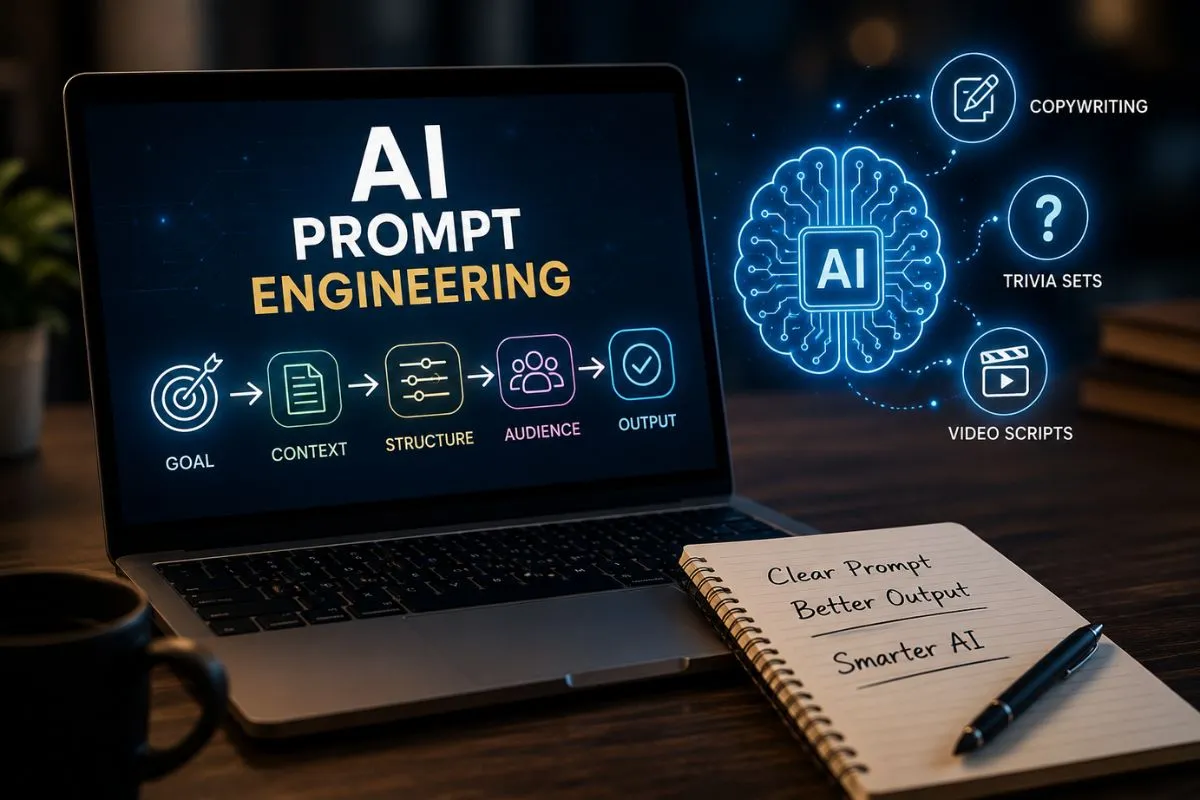
In digital publishing, content creation, and media production, the difference between a mediocre AI response and a publication-ready deliverable comes down to one skill:prompt engineering.
If you treat AI as a search engine, it returns generic summaries. But if you treat AI as an expert collaborator with clear structural constraints, it produces polished scripts, high-converting copy, and structured data sets in seconds.
Here is a practical guide to engineering prompts for specific editorial outputs.
The Master Framework: C-R-E-A-T-O-R
To eliminate vague responses, every professional prompt should follow theC-R-E-A-T-O-Rstructure:
┌────────────────────────────────────────────────────────┐
│ C - Context         (Background & target domain)      │
│ R - Role & Audience (Expert persona & reader profile)  │
│ E - Explicit Task   (The exact asset to build)        │
│ A - Constraints     (Banned terms, limits, rules)     │
│ T - Tone & Style    (Voice, rhythm, energy level)     │
│ O - Output Format   (Markdown, tables, JSON schema)   │
│ R - Reference       (1–2 examples of ideal style)     │
└────────────────────────────────────────────────────────┘
1. Creative Copywriting & Social Hooks
The biggest failure in AI copywriting is “AI fluff”—overused buzzwords likedelve, game-changer, unlock,andtapestry. The key is forcing the model into active voice, strict word limits, and clear psychological angles.
Execution Strategy
- Banned word lists (negative constraints)
- Categorized variations (Curiosity vs. Contrarian vs. Direct)
- Short, punchy sentence limits
Master Prompt Template
Role: You are an elite direct-response copywriter and short-form content strategist.
Context: We are launching a digital editorial campaign on modern handloom fusion streetwear.
Target Audience: Gen-Z and millennial urban professionals interested in fashion and heritage textiles.

Task: Write 5 high-converting hooks and a 3-paragraph caption.

Constraints:
- BANNED WORDS: "game-changer," "unleash," "delve," "tapestry," "revolutionize."
- Sentences must be under 12 words.
- Use active voice only. No passive phrasing.

Output Format:
- Section 1: 5 Hooks (Categorized: 2 Curiosity, 2 Contrarian, 1 Metric-driven)
- Section 2: Main Body Copy (Max 2 sentences per paragraph)
- Section 3: Call to Action (CTA)
2. High-Retention Vertical Video Scripts
AI models default to continuous narrative paragraphs when asked for video scripts. However, video editors and creators require synchronized audio, visual B-roll cues, and precise timing.
Execution Strategy
- Force a multi-column table format
- Specify pattern-interrupt opening hooks
- Include audio/SFX cues alongside voiceover dialogue
Master Prompt Template
Role: You are a vertical video scriptwriter specializing in high-retention Instagram Reels and Shorts.
Task: Write a 30-second script explaining how traditional Indian block printing works.

Pacing: High-energy, fast-paced, pattern-interrupt within the first 2 seconds.

Output Format: Present the output as a 3-column table with the following headers:
1. Timecode (e.g., 0:00 - 0:03)
2. Visual Cues & B-Roll (Camera angles, on-screen text overlays, editing cuts)
3. Voiceover & Audio (Exact spoken dialogue, ASMR cues, sound effects)

Constraint: The opening spoken line MUST NOT be "Hey guys" or "Did you know?". Start directly with an intriguing action statement.
3. Structured Trivia Sets & Interactive Content
When generating trivia, AI often returns predictable questions with obvious answers. To build engaging, publishable quizzes, you must enforce difficulty tiers, distractors (plausible wrong choices), and schema formatting.
Execution Strategy
- Explicit difficulty distributions (Easy, Medium, Hard)
- Plausible incorrect options (no obviously absurd choices)
- Standardized text schemas for easy copy-pasting or database import
Master Prompt Template
Role: You are a lead pop-culture and history quizmaster.
Task: Generate a 6-question trivia set on classic 1990s world cinema.

Difficulty Tier Distribution: 2 Easy, 2 Medium, 2 Hard.

Constraints:
- All incorrect options (distractors) must be realistic historical films or directors.
- Verify all facts internally before formatting output.

Output Format per Question:
---
Question [Number] | Category: [Sub-topic] | Difficulty: [Tier]
Q: [Question text]
A) [Option 1]
B) [Option 2]
C) [Option 3]
D) [Option 4]
Correct Answer: [Letter]
Context: [1 sentence explaining the background behind the correct answer]
---
Quick-Reference Summary
| Use Case | Core Challenge | Key Prompt Engineering Fix |
| Copywriting | Generic, robotic AI buzzwords | Add explicit negative constraints (Banned Words List) |
| Video Scripts | Unformatted text blocks | Force a 3-Column Table (Timecode, Visuals, Voiceover) |
| Trivia Sets | Predictable answers and bad choices | Enforce difficulty tiers and plausible distractors |
By structuring prompts as functional engineering specifications rather than open-ended conversations, you turn AI into a reliable engine for scalable, high-quality content production.