Alternative Credit Scoring Methods Explained
Traditional credit scores (like CIBIL, Experian, or FICO) mainly look at your past loans, credit cards, repayment history, and credit utilisation. This works well for people with a long formal credit history.
However, hundreds of millions of people especially in India and other emerging markets are “new-to-credit” or “thin-file.” They have little or no formal borrowing record, even if they manage money responsibly.
Alternative credit scoringsolves this problem by using non-traditional data sources and advanced technology (especially AI and machine learning) to assess creditworthiness.
Why Alternative Credit Scoring Matters
Traditional scores exclude many creditworthy people (students, gig workers, small business owners, rural customers, first-time borrowers).
In India, estimates suggest 300–350 million+ adults lack a meaningful credit history.
Digital payments (especially UPI), smartphones, and the Account Aggregator framework have created rich new data trails.
NBFCs and fintech lenders use these methods to approve more loans faster while controlling risk.
Major Alternative Credit Scoring Methods
Here are the most widely used approaches in 2025–2026:
1. Bank Cash-Flow / Open Banking Analysis
Lenders look at actual money movement in your bank account (with your consent).
They analyse income stability, expense patterns, balance trends, and ability to repay.
In India, this is powered by theAccount Aggregator (AA)framework — a consent-based system regulated by the RBI.
This is currently one of the strongest and most reliable alternative methods.
2. UPI & Digital Payment Data
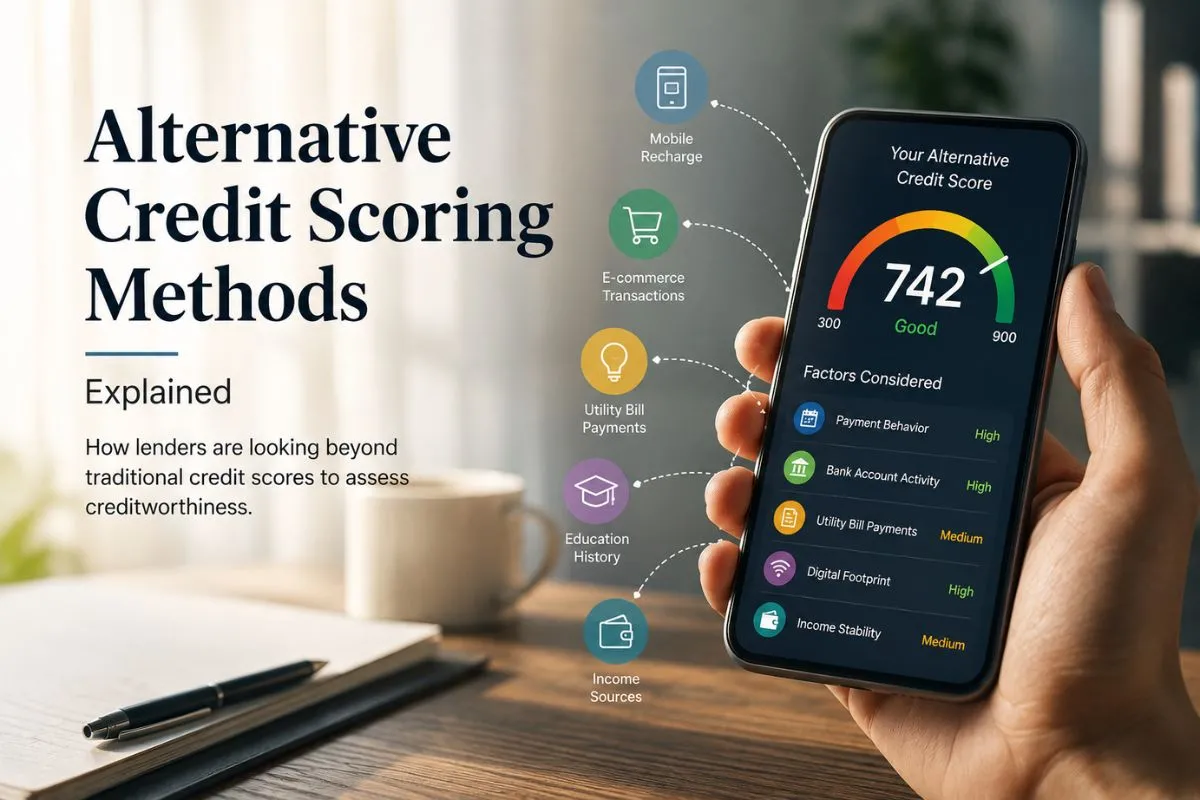
Your UPI transaction history reveals spending habits, merchant payments, peer-to-peer transfers, and regularity.
Consistent bill payments or business inflows through UPI QR codes are strong positive signals.
Many NBFCs and merchant lenders (especially for small shops) heavily rely on this.
3. Utility, Telecom & Rent Payment History
Timely payment of electricity, water, mobile recharges, broadband, and rent shows financial discipline.
Even without loans, consistent payment of these essential bills is highly predictive of future repayment behaviour.
4. Mobile & Device Behaviour Data
- Recharge frequency and amount
- App usage patterns
- Device information and stability
- SMS patterns (with consent and privacy safeguards)
These behavioural signals help score people who have limited formal records.
5. GST, EPFO & Business Data (for MSMEs)
For small businesses: GST filings, sales turnover, supplier payments, and Employee Provident Fund contributions provide a clear picture of business health and cash flow.
6. Psychometric & Behavioural Assessments
Short digital questionnaires or game-like tests measure traits such as honesty, risk appetite, perseverance, and financial attitude.
These are especially useful in microfinance and first-time borrower segments.
7. E-commerce & Lifestyle Data
Purchase patterns, return behaviour, and spending categories from online shopping platforms can indicate lifestyle stability and income levels.
8. AI / Machine Learning Hybrid Models
Modern systems combine traditional bureau data (when available) with multiple alternative sources.
Techniques like XGBoost, neural networks, and explainable AI (SHAP values) find complex patterns that older scorecards miss.
These models continuously learn from actual repayment outcomes.
How It Works in Practice (Especially in India)
- Customer gives explicit consent (via Account Aggregator or app).
- Data is securely fetched (bank statements, UPI history, utilities, etc.).
- AI model processes hundreds of features in seconds.
- A risk score or decision is generated (approve / reject / offer custom terms).
- The model is monitored and retrained regularly with real repayment data.
Many digital NBFCs and fintech platforms now use hybrid models (traditional score + alternative data) for better accuracy and higher approval rates (often 20–30% more first-time borrowers without increasing defaults).
Benefits
- Greater financial inclusion
- Faster loan decisions (minutes instead of days)
- Better risk prediction for thin-file customers
- Lower cost of underwriting
- More competitive loan offers for responsible customers
Challenges & Risks
- Privacy & Consent: Data must be collected only with clear, purpose-specific consent.
- Bias & Fairness: Models must be carefully tested so they do not discriminate against certain groups.
- Explainability: Regulators increasingly require lenders to explain why a loan was rejected.
- Data Quality & Fraud: Alternative data can be manipulated; strong fraud checks are essential.
- Regulatory Oversight: In India, RBI closely watches how NBFCs and fintechs use such data.
The Future Outlook
Alternative credit scoring is no longer experimental — it is becoming mainstream.
India’s digital public infrastructure (UPI + Account Aggregator + Aadhaar + DigiLocker) gives the country a unique advantage.
We are moving toward continuous, real-time credit assessment rather than one-time static scores. Lenders will increasingly monitor cash flows and behaviour throughout the life of a loan, not just at the application stage.
In simple terms:
Traditional credit scoring asks, “Have you borrowed and repaid before?”
Alternative credit scoring asks, “How do you manage money in daily life?”
This shift is helping millions of previously “invisible” customers access formal credit while giving NBFCs and fintech lenders powerful new tools to grow responsibly.
Suggested Reading
NBFCs, Fintech & the Shape of Credit in India
Six pieces on how lending outside traditional banks actually works, who the players are, and what the Jio–Bank of America deal signals about where it’s headed.
- 01 Jio Financial–Bank of America Deal: What It Means for Jio Credit→ Deal Explainer
- 02 What Is an NBFC? Explained→ Fundamentals
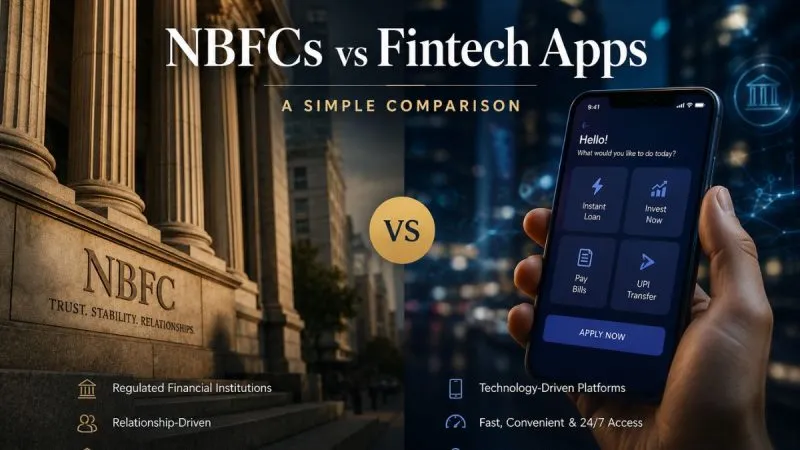
- 03 NBFCs vs Fintech Apps: A Simple Comparison→ Comparison
- 04 Alternative Credit Scoring Methods, Explained→ Fundamentals
- 05 Top 10 NBFCs in India as of Mid-2026→ Market Landscape
- 06 NBFC vs Bank Lending Rates in India 2026→ Comparison