
NBFC vs Bank Lending Rates in India (2026)
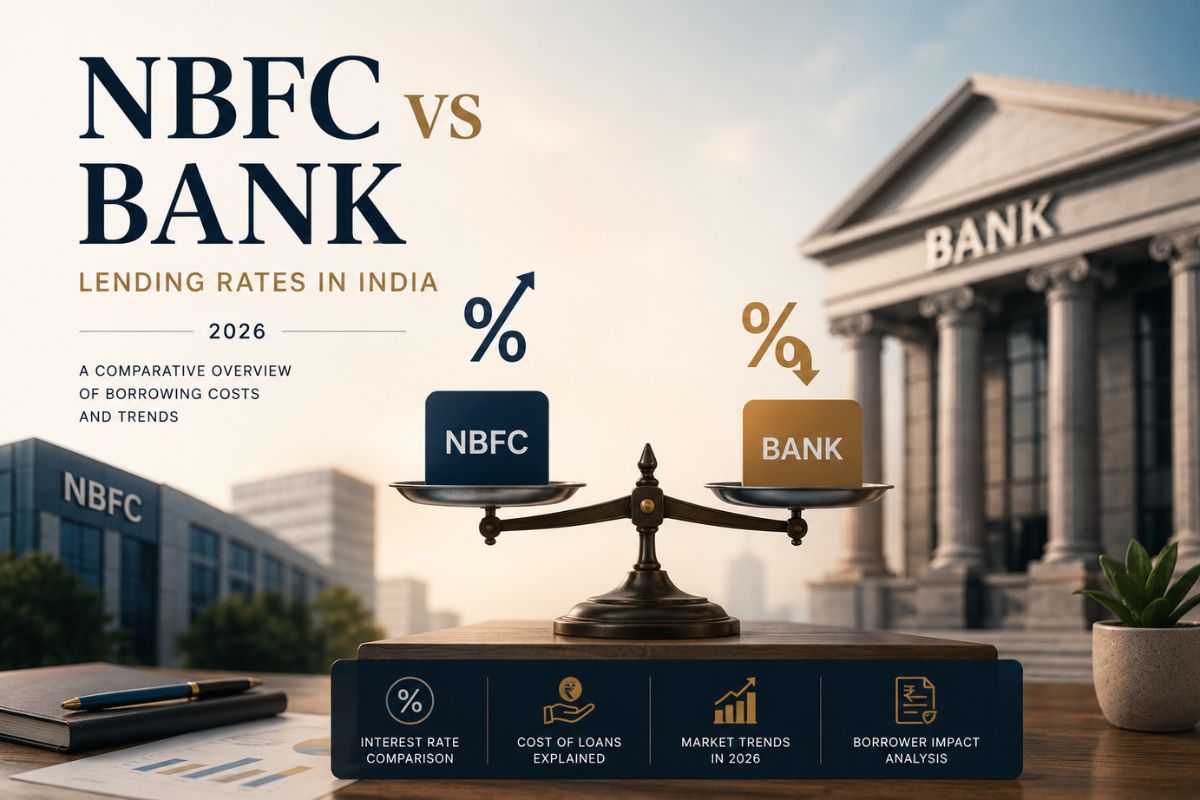
Banks generally offer lower interest rates than NBFCs. This is one of the biggest differences between the two.
Why Banks Charge Lower Rates
- Banks collect low-cost deposits (savings and current accounts).
- They have access to cheaper wholesale funding.
- They usually lend to lower-risk, well-documented borrowers.
- Stronger balance sheets allow them to operate on thinner margins.
Why NBFCs Charge Higher Rates
- NBFCs cannot accept demand deposits like banks.
- They borrow money from banks, mutual funds, and bond markets at higher costs.
- They often serve riskier or underserved customers (self-employed, lower credit scores, informal income, smaller towns).
- Higher operating costs and credit risk premiums are passed on to borrowers.
Typical Interest Rate Ranges (Indicative – 2026)
| Loan Type | Banks (Approx.) | NBFCs (Approx.) | Difference |
|---|---|---|---|
| Home Loan | 7.10% – 8.50% | 7.50% – 10.50%+ | NBFCs 0.5–2% higher |
| Personal Loan | 9.99% – 16% | 11% – 24%+ (sometimes up to 36%) | NBFCs clearly higher |
| Vehicle / Auto Loan | 8.5% – 12% | 10% – 16% | NBFCs higher |
| Business / MSME Loan | 9.5% – 14% | 12% – 20%+ | NBFCs higher |
| Gold Loan | 8% – 12% | 9% – 15% | Closer, but NBFCs often higher |
Notes:
- These are starting/indicative rates for good credit profiles. Actual rates depend heavily on your CIBIL score, income stability, loan amount, and lender assessment.
- Top private banks (HDFC, ICICI, Axis) and public sector banks (SBI, Bank of India, etc.) usually offer the lowest rates for strong applicants.
- Large NBFCs like Bajaj Finance, Tata Capital, or Muthoot can sometimes compete closer to bank rates for prime customers, but the gap remains for most borrowers.
- Housing Finance Companies (a type of NBFC) often price home loans only slightly higher than banks.
Other Cost Differences
- Processing fees: Banks 0.25–1.5% | NBFCs 1–3% (or higher)
- Approval speed: Banks slower (days to weeks) | NBFCs much faster (hours to 2–3 days)
- Eligibility: Banks stricter (prefer CIBIL 700–750+) | NBFCs more flexible (can go lower)
- Rate transmission: Bank floating rates (especially repo-linked) respond faster to RBI rate cuts. Many NBFC rates are linked to internal benchmarks and adjust more slowly.
Which Should You Choose?
Choose a Bank if:
- You have a good credit score (700+)
- Stable salaried income
- You can wait a bit longer for approval
- You want the lowest possible EMI and total interest cost
Choose an NBFC if:
- You need money urgently
- Your credit score is moderate or you are self-employed
- Banks have rejected your application
- You value speed and flexibility over the absolute lowest rate
Tip: Always compare the total cost (interest + processing fees + any other charges) and not just the headline interest rate. Use EMI calculators and check prepayment rules.
Rates change frequently with RBI policy and market conditions. For the most accurate quote, check with specific lenders or use comparison platforms, as your individual profile decides the final rate.
Suggested Reading
NBFCs, Fintech & the Shape of Credit in India
Six pieces on how lending outside traditional banks actually works, who the players are, and what the Jio–Bank of America deal signals about where it’s headed.
- 01 Jio Financial–Bank of America Deal: What It Means for Jio Credit→ Deal Explainer
- 02 What Is an NBFC? Explained→ Fundamentals
- 03 NBFCs vs Fintech Apps: A Simple Comparison→ Comparison
- 04 Alternative Credit Scoring Methods, Explained→ Fundamentals
- 05 Top 10 NBFCs in India as of Mid-2026→ Market Landscape
- 06 NBFC vs Bank Lending Rates in India 2026→ Comparison






)