Advaita vs Dvaita Vedanta: Two Answers To The Same Ancient Question
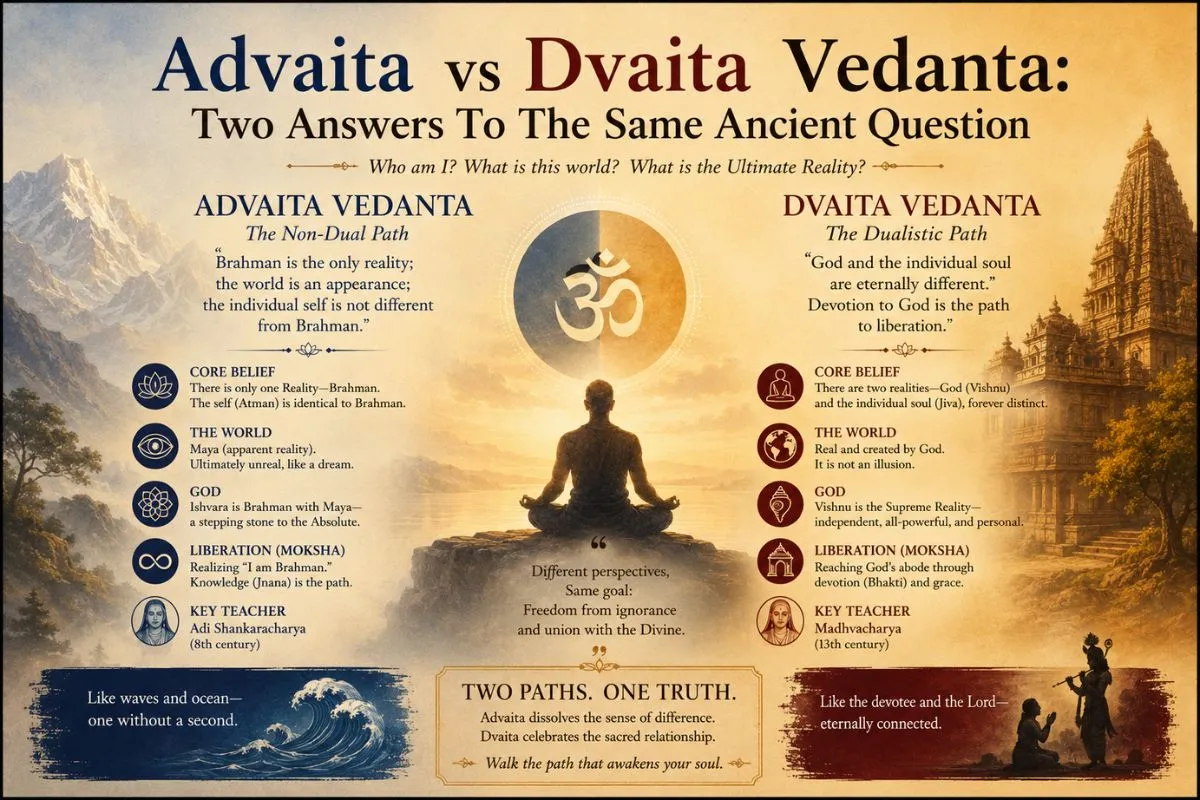
Every major school of Vedanta is trying to answer one question. What is the actual relationship between an individual soul and the ultimate reality Hindu philosophy calls Brahman. Advaita Vedanta and Dvaita Vedanta arrive at two very different answers, and the gap between them is not a minor technicality. It shapes how each tradition approaches meditation, devotion, ethics, and what liberation itself is even supposed to feel like.
The Shared Starting Point
Both schools trace themselves back to the same source material, the Prasthanatrayi, the three foundational texts of Vedanta: the Upanishads, the Bhagavad Gita, and the Brahma Sutras. Both accept the authority of the Vedas. Both are aiming at moksha, liberation from the cycle of birth and death. Where they split is over a single, deceptively simple question. Is the individual self ultimately identical to Brahman, or eternally distinct from it.
Advaita: The Answer Is “Not Two”
Advaita literally means “not two,” and the philosophy most associated with the name is Adi Shankaracharya, an eighth century scholar and monk whose commentaries on the Upanishads, the Gita, and the Brahma Sutras became the backbone of the tradition. Advaita’s central claim is that the individual soul, atman, and the ultimate reality, Brahman, are not two separate things that need to be united. They are already one, and the sense of separation is a product of ignorance, avidya, rather than an actual fact about reality.
The most famous line associated with this view comes from the Chandogya Upanishad: “Tat Tvam Asi,” meaning “Thou art That.” It is not a goal to be achieved through effort so much as a truth to be recognized once ignorance clears away, the way a rope mistaken for a snake in dim light does not become a rope. It was a rope the entire time.
This has real consequences for practice. In Advaita, the primary path to liberation is jnana yoga, the path of knowledge and direct self inquiry, examining and eventually dissolving the false sense of a separate, limited self. This is the tradition most closely associated with Ramana Maharshi, whose entire teaching centred on a single, repeated question turned inward: who am I.His life and method of self inquiryoffer one of the clearest modern demonstrations of what Advaita actually looks like in practice, stripped of academic language and reduced to a single sustained question a person asks themselves until the usual answers stop holding up.
Dvaita: The Answer Is “Eternally Two”
Dvaita means “two,” or duality, and the philosophy is most closely associated with Madhvacharya, a thirteenth century philosopher who argued directly against the Advaita position. In Dvaita Vedanta, the individual soul and Brahman, generally understood in this tradition as a personal, supreme God, usually identified with Vishnu, are eternally and fundamentally distinct. The soul does not become God upon liberation, and it was never secretly identical to God in the first place. Liberation instead means the soul reaching a state of eternal, blissful closeness to God while still retaining its own individual identity.
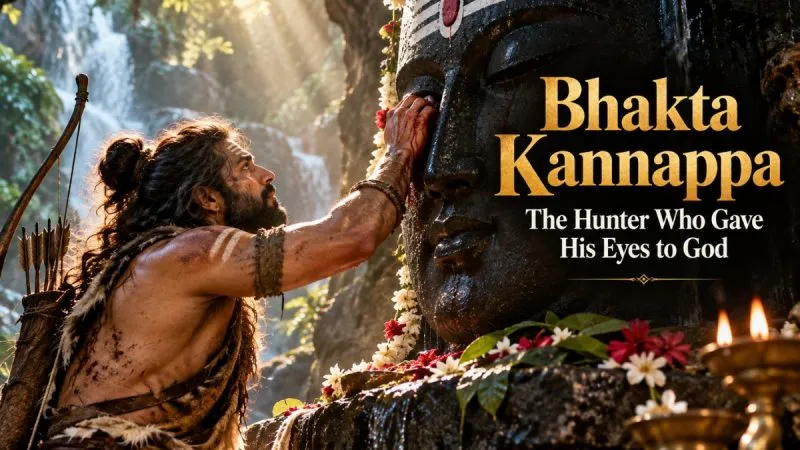
Where Advaita treats the sense of separateness as an illusion to be dissolved, Dvaita treats it as a permanent and meaningful feature of reality, one that makes devotion possible in the first place. If the soul and God were ultimately identical, the argument goes, devotion, love, and service would not make coherent sense, since there is no real “other” to love or serve. Dvaita keeps that distinction intact specifically so bhakti, devotional practice, has somewhere real to go.
This is why Dvaita philosophy leans heavily on bhakti yoga, the path of devotion, worship, and surrender to a personal God, rather than on the more introspective self inquiry that defines Advaita practice. The emotional register is different too. Advaita’s language tends toward stillness and recognition. Dvaita’s language tends toward longing, service, and relationship.
Where This Shows Up In Everyday Tradition
These are not just positions debated in old commentaries. They quietly shape how different strands of Hindu practice actually feel on the ground. A temple built around intense, personal devotion to a specific deity, where the relationship between devotee and god is described in the language of love, service, and longing, is operating much closer to a Dvaita sensibility, whether or not anyone there has ever used that word. A meditation practice built around dissolving the sense of a separate self is operating much closer to Advaita, again usually without naming it directly.
The question of how a specific divine form relates to a larger, formless ultimate reality also runs directly through this debate. A recent piece exploringwhether Kali and Krishna are ultimately the sametouches this exact fault line, describing how Advaita treats every deity as an expression of one underlying Brahman, while more devotional, dualistic traditions hold onto the specific, personal, relatable form of a particular god or goddess as meaningful in its own right, not simply as a stepping stone toward an abstract oneness.
The Upanishads themselves, the shared root text for both schools, are full of open, unresolved inquiry rather than a single settled answer, which is part of why two such different schools could grow from the same soil. The philosopher Gargi Vachaknavi, whose sharp, fearless questioning appears in the Brihadaranyaka Upanishad,never simply accepted an answer because an authority offered it. That spirit of pushing a question until it either breaks or holds is exactly the spirit that eventually produced both Shankara’s non dualism and Madhva’s dualism centuries later, two very different conclusions drawn from the habit of taking the same old questions seriously rather than inherited without examination.
Neither Side Is “More Correct”
It is tempting, especially from outside the tradition, to want a single right answer. Vedanta itself has never worked that way. Alongside Advaita and Dvaita sits a third major school, Vishishtadvaita, qualified non dualism, associated with Ramanujacharya, which argues for something in between, a soul that is both one with Brahman and meaningfully distinct within that unity at the same time. The existence of a serious middle position is itself a clue that this was never meant to be settled by argument alone.
What actually distinguishes the schools in daily life is less about who wins a metaphysical debate and more about which practice a person’s temperament is suited to. Someone drawn to quiet, sustained self inquiry, stripping away assumption after assumption until only bare awareness remains, will likely find more traction in Advaita. Someone whose spiritual life runs on relationship, longing, and devotion to something they experience as genuinely other than themselves will likely find Dvaita’s framework more honest to their actual experience. Sanskrit philosophical texts,often reduced to decorative chanting rather than engaged with as living argument, preserved both positions in full, precisely because the tradition never expected every seeker to need the same answer.
The Real Takeaway
Advaita and Dvaita are not really arguing about whether God exists or whether liberation is real. Both take those things as given. They are arguing about something closer to the architecture of relationship itself, whether ultimate closeness means merging entirely into what you love, or whether it means standing close enough to love it fully while still remaining someone capable of loving. Fourteen centuries after Shankara and Madhva, Indian philosophy still has not forced every seeker to pick a single side, and that refusal to flatten the question into one tidy answer may be the most honest thing either school has to offer.