Kannappa: The Devotee Who Plucked Out His Own Eyes for Shiva
In the temple town of Srikalahasti, on the banks of the Swarnamukhi river in present-day Andhra Pradesh, there is a tradition still followed every single day. Before the elaborate rituals begin, before the priests offer anything to Lord Srikalahasteeswara, the first naivedya of the day is offered to a hunter. Not a sage. Not a king. A tribal hunter who could not read a single Vedic verse, and who once tore out his own eyes as an act of worship.
This is the story of Kannappa Nayanar, counted among the 63 Nayanars, the great Shaiva saints of Tamil bhakti tradition, and remembered as one of the purest examples of devotion the Shaiva canon has ever produced.
- Kannappa was born Thinnan, a tribal hunter chieftain, believed to be Arjuna reborn
- He discovered a forgotten Shiva Linga in the forest and worshipped it his own way, with meat, water carried in his mouth, and flowers from his hair
- When the Linga’s eyes appeared to bleed, he gave his own eyes, one after the other, without hesitation
- Shiva appeared, restored his sight, and named him Kannappa, “he who gave his eyes”
- He is revered as one of the 63 Nayanars, and is still honoured first at the Srikalahasti temple today
- His story is central to Bhakti tradition’s teaching that sincere devotion outweighs ritual form
A Warrior Reborn as a Hunter
The story begins, fittingly, with Arjuna. During his exile, Arjuna once meditated fiercely to obtain the Pashupatastra from Shiva. To test the depth of his resolve, Shiva appeared before him disguised as a Kirata, a wild tribal hunter, accompanied by Parvati and his ganas. When both Arjuna and the Kirata shot arrows at the same wild boar, a fierce quarrel broke out over whose arrow had struck first, and it soon escalated into a duel. Arjuna fought valiantly, but was eventually overpowered, and only then did he realize that the hunter before him was Mahadev himself.
Moved by Arjuna’s tenacity and devotion, Shiva granted him the Pashupatastra, and blessed him with a promise: in a future birth, he would return not as a warrior, but as one of Shiva’s greatest devotees. That devotee was Thinnan, later known to the world as Kannappa.
The Boy Called Thinnan
Thinnan was born to Naga, the chieftain of a hunting tribe, in a settlement called Uduppur near Srikalahasti. His name itself meant “strong” in Tamil, and he lived up to it, mastering archery and the martial skills of his tribe under his father’s guidance. In time, the tribe’s elders recognized his strength and discipline, and Thinnan was anointed as their next chieftain, a role he carried out with quiet competence, leading successful hunting expeditions and earning the loyalty of his people.
He was, by every worldly measure, an ordinary tribal warrior. There was nothing in his upbringing that pointed toward sainthood. And that is precisely what makes what follows so extraordinary.
The Linga in the Forest
One day, while chasing a wild boar deep into the forest, Thinnan lost his prey and found himself somewhere he did not expect: standing before a Shiva Linga, largely forgotten, in what had once been a consecrated shrine before the surrounding wilderness reclaimed it. Something in him stirred. He did not know the Sanskrit hymns or the Agamic rites that priests used in temples. He knew only what devotion felt like in his own body, and so he began to worship the Linga in the only language he had, the language of a hunter’s life.
Every day, he brought the choicest game he had hunted as an offering. He carried water for abhisheka not in a sacred vessel, but in his own mouth, having no purer container to give. He gathered flowers however he could find them, sometimes tucking them in his own hair before placing them on the Linga. To a temple priest trained in ritual purity, this would have looked like defilement. To Shiva, it was devotion in its rawest, most unguarded form.
The Test
Elsewhere, a Brahmin priest named Shivagochariar had also been tending to this same forgotten Linga in a more conventional manner, performing his rites early each morning. Each day, he arrived to find the previous day’s meat offerings and disturbed flowers left behind by an unknown visitor, and he was troubled, believing the sanctity of the shrine had been violated. Unable to understand who was doing this, he prayed to Shiva for an answer, and was told in a vision to hide and watch what happened the next day.
What he witnessed changed everything. He saw a tribal hunter arrive, weep with love at the sight of the Linga, and offer meat and water with a devotion so pure it moved Shiva to want to test it. As the priest watched, blood began to seep from one eye of the Linga, as if it had been wounded.
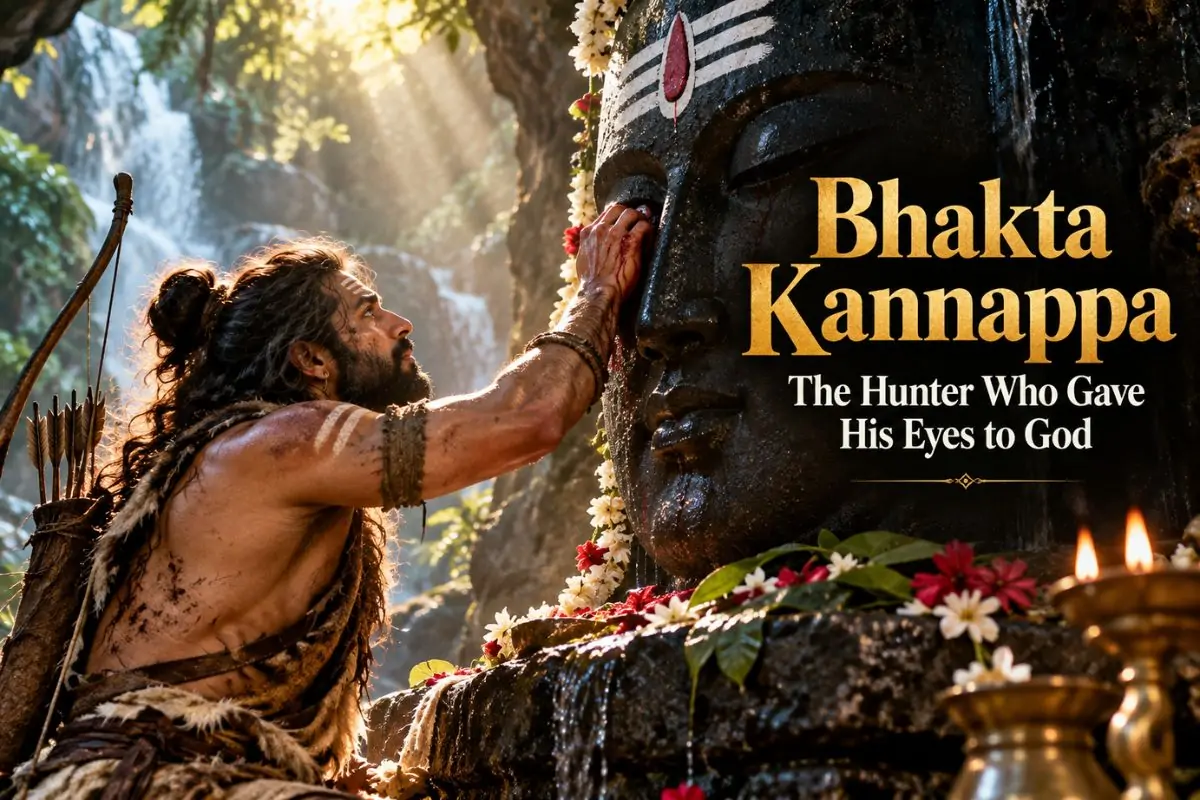
The hunter’s hands could not fix it with medicine he did not have. So, without a moment’s hesitation, Kannappa plucked out one of his own eyes and pressed it onto the Linga to stop the bleeding.
Then blood began to trickle from the second eye.
The Final Offering
This is the moment the story is remembered for, above all others. Kannappa did not stop to reason, did not weigh the cost. As one eye had already been given, he knew that removing the second would leave him blind, unable even to see where to place it correctly on the Linga. So he raised his foot, pressed it against the spot on the Linga near the bleeding eye to mark the place, and then gouged out his second eye and set it in position by feel alone.
According to the temple’s own retelling, when Thinnan noticed one of the Linga’s eyes bleeding, he plucked his own eye and kept in its place. It was this second offering, complete blindness accepted without hesitation, that Shiva could not let pass unanswered.
Overwhelmed by such love, Shiva appeared before him in his true form. He restored Kannappa’s eyesight instantly, revealed himself to the astonished priest hiding nearby, and blessed the hunter with a new name, one that would be remembered for centuries: Kannappa, meaning “he who gave his eyes.”
Why This Story Still Matters
The tale of Kannappa is treasured for reasons that go beyond the drama of its climax. It sits at the very heart of the Bhakti movement’s most radical idea, that devotion is measured by the heart’s sincerity, not by ritual correctness, caste, or scriptural learning. Kannappa broke every rule of orthodox temple worship, offering meat to a deity, touching the Linga with unwashed hands, using his mouth in place of a sacred vessel, and yet his devotion was judged purer than that of a learned Brahmin priest performing every rite correctly.
As one retelling puts it, it is worth reliving the story not only during Shivarathri but at any time of the year, precisely because its message about the primacy of love over form remains timeless. Even today, at the Srikalahasteeswara Temple, this history is honoured in practice: naivedya is offered to Kannappa before it is offered to the Lord himself, a living acknowledgment that the hunter’s place in this shrine’s story has never faded.
The legend has travelled well beyond scripture and temple lore. It became the subject of the Kannada classic film Bedara Kannappa, and continues to be told to children across Tamil Nadu, Andhra Pradesh, and Karnataka as a bedtime story, a rare legend that has survived equally in temple ritual, cinema, and oral tradition.