Rjukan: The Norwegian Town That Built Its Own Sun
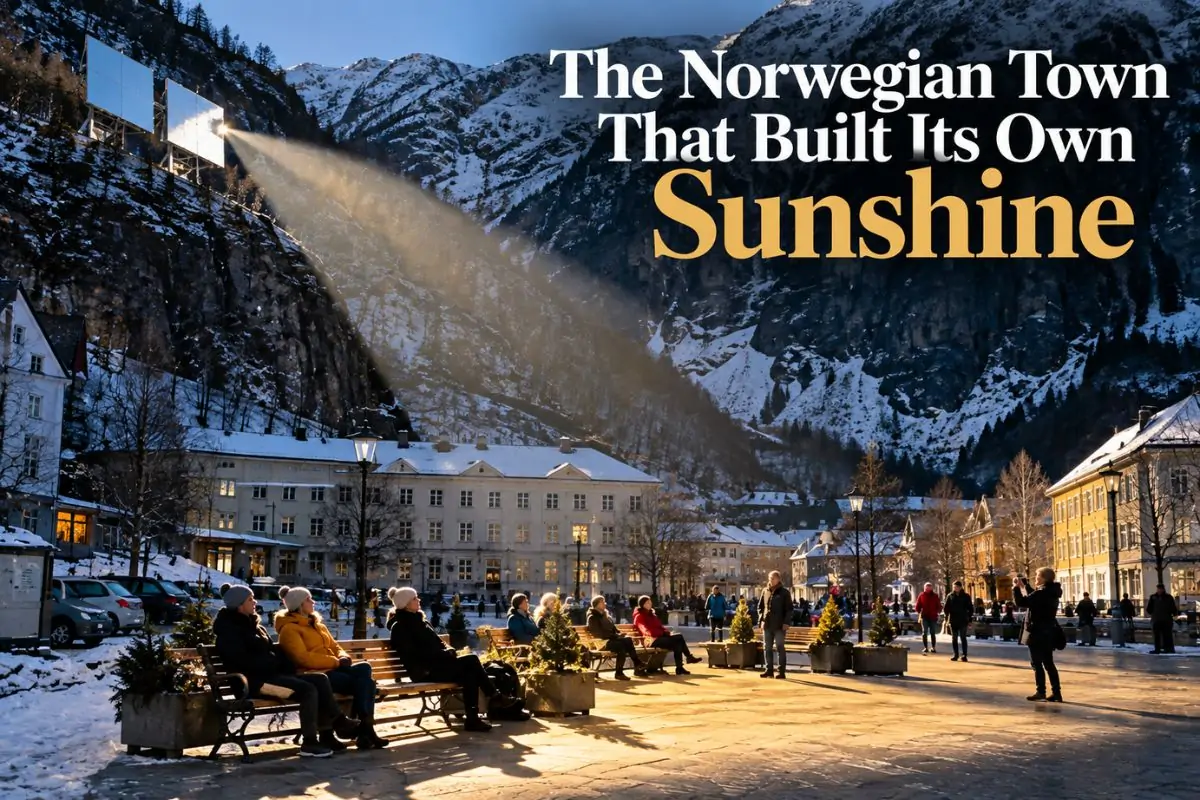
There’s a town in Norway that spends nearly half the year without a single direct ray of sunlight touching its streets, and for a century, its 3,500 residents simply lived with it. Then, in 2013, they did something almost nobody else on earth had tried, they engineered their way out of the darkness entirely, using three enormous mirrors bolted to a mountainside.
- Rjukan, Norway, sits so deep in a valley that it receives no direct sunlight for about six months a year
- Founder Sam Eyde first proposed a “sun mirror” in 1913, but lacked the technology, and built a cable car instead in 1928
- Artist Martin Andersen revived the idea in 2005, inspired by a similar successful project in Viganella, Italy in 2006
- After years of debate, Rjukan’s council approved roughly £544,000 to build three computer-controlled heliostat mirrors
- The mirrors, installed 450 metres above the town, redirect sunlight onto a 500 to 600 square metre patch of the town square
- The project switched on in 2013, exactly 100 years after Eyde’s original idea
- The lit square was designed as a year-round community gathering space, and has since become a genuine tourist draw
This is the story of Rjukan, and it’s one of the strangest, most quietly moving engineering projects most people have never heard of.
A Town Built at the Bottom of a Shadow
Rjukan sits deep inside the narrow Vestfjord valley in Telemark county, roughly 170 kilometres west of Oslo, hemmed in on all sides by steep mountains at the foot of the imposing Gaustatoppen peak. The geography is spectacular to look at and brutal to live under. Between September and March, the sun simply never climbs high enough in the sky to clear the surrounding mountain walls. Southern Norway still gets its share of winter daylight during these months, but Rjukan, sitting at the very bottom of its valley, gets none of it directly. Locals describe the town as completely cut off from sunlight for up to six months of the year.
“Rjukan is home to a thriving little community which manages without the sun for almost six months of the year.”
That’s not hyperbole or a tourist tagline. It’s simply how the town has functioned since it was founded.
The Man Who Couldn’t Solve It, So He Built a Cable Car Instead
The idea of fixing this problem is surprisingly old, older than the town’s current residents by generations. Rjukan was founded around a hydroelectric plant, and its founder, the celebrated Norwegian engineer and industrialist Sam Eyde, was troubled by how little sunlight his own workers were getting through the long winter months. As early as 1913, Eyde floated the idea of a “solspeil,” a sun mirror, to be mounted above the town.
He simply didn’t have the technology to make it work. As Rjukan’s town manager Rune Loedoeen later put it:
“At that time, he couldn’t manage it because there was no technology. So he built a cable car to bring people up to the sunlight.”
That cable car, called the Krossobanen, opened in 1928 and is still one of the town’s defining landmarks. For over eighty years, if residents of Rjukan wanted to feel actual sun on their skin in winter, their only option was to ride a gondola straight up the mountainside and stand there in it, then ride back down into the shadow.
An Idea Borrowed From Italy
Eyde’s original mirror idea sat dormant for almost a century until a local artist named Martin Andersen picked it back up in 2005. Around the same time, word reached Rjukan of a nearly identical problem being solved elsewhere. In 2006, the small Italian village of Viganella, which suffered from the exact same seasonal darkness, successfully installed its own version of a sun mirror.
A delegation from Rjukan travelled to Viganella to see the results firsthand, and came back convinced. Still, turning the idea into an actual funded project took years of local debate. It wasn’t until the town council finally agreed to commit roughly 5 million Norwegian kroner, about £544,000 at the time, that construction genuinely began.
Building a Sun
The engineering itself is elegantly simple, even if the execution required helicopters. Three enormous heliostats, computer-controlled mirrors that continuously track the sun’s position across the sky, were installed on the mountainside roughly 450 metres above the town, at an elevation of 742 metres. Each mirror measures about 17 square metres, adding up to just over 51 square metres of reflective surface combined.
Together, they redirect sunlight down into an elliptical patch of the town square measuring around 500 to 600 square metres, delivering between 80 and 100 percent of the light’s original strength by the time it reaches the ground. Solar-powered equipment automatically keeps the mirrors clean and correctly angled throughout the day, requiring almost no manual maintenance.
The mirrors were finally switched on in 2013, exactly one hundred years after Sam Eyde first proposed the idea.
“It’s for the Pale Little Children of Rjukan”
Perhaps the most human detail in the entire story comes from Martin Andersen himself, the artist who had spent years quietly campaigning to make this happen. Explaining the entire point of the project, he said simply:
“The idea was just to make a place in Rjukan where people will come to have a bit of sun. It’s for the pale little children of Rjukan.”
He also described precisely what the experience of standing in that reflected light would feel like, noting that the beam would be strongest right in the centre of the square and gradually weaker toward the edges. “You will have the sensation of sun when you are in the middle,” he said. “You will feel the heat and you will see shadows.”
What the Mirrors Actually Changed
The town square that the mirrors illuminate wasn’t even much of a gathering space before the project, having functioned largely as a parking lot. The hope, shared by residents and the town council alike, was that a genuinely sunlit square could become a year-round community space, somewhere people would actually want to sit, meet, and linger through the winter rather than rushing indoors.
There was also a quieter, more practical hope behind the project: tourism. A century-old engineering dream finally realised, using mirrors to manufacture sunlight in a town that had gone without it for so long, turned out to be exactly the kind of story that draws visitors, something Rjukan has leaned into ever since the mirrors were switched on.