The Rise of “Analog Maximalism”: Why We’re Trading Touchscreens for Typewriters in 2026
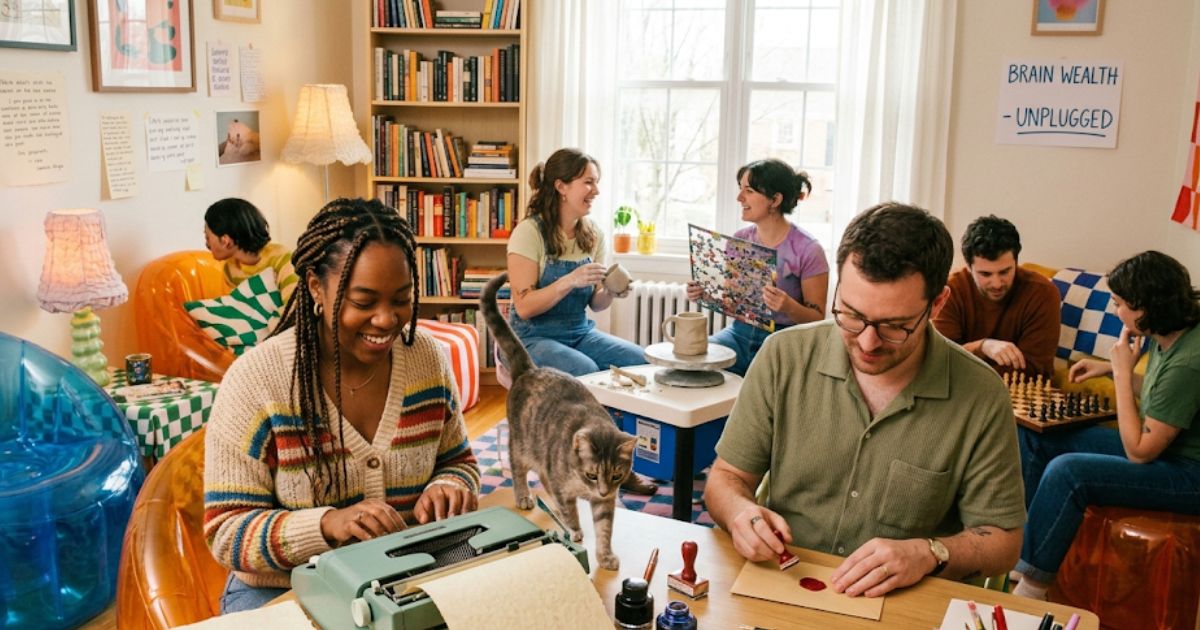
The Great “Unplugging” of 2026
If 2024 was about AI integration and 2025 was about digital efficiency, 2026 is officially the year we all decided to put our phones in a drawer and leave them there. A new movement, dubbed “Analog Maximalism,” has taken over our social feeds (ironically) and our living rooms.
It’s not just a digital detox; it’s a full-throttle embrace of everything tangible, textured, and delightfully slow. From the resurgence of “Poetcore” fashion to the skyrocketing sales of fountain pen ink, the vibe of 2026 is decidedly low-tech and high-touch.
Table of Contents
1. Beyond the Screen: Tactile Hobbies are the New Flex
In 2026, showing off your high score in a mobile game is out. Showing off the slightly lopsided ceramic mug you threw on a pottery wheel? That is the ultimate flex.
- The Pen-Pal Renaissance: Stationery is having a massive moment. “Snail mail” isn’t a chore; it’s a ritual. People are investing in custom wax seals and vintage stamps to send long-form updates to friends across the globe.
- Pottery and “Dirty” Hobbies: There is a collective craving for activities that prevent you from touching a screen. Pottery, woodworking, and gardening are trending because they require “messy hands,” making it physically impossible to doomscroll.
2. “Slowcations” and the Death of the Bucket List
The frantic “five countries in seven days” travel style has been replaced by the Slowcation. In 2026, travelers are booking one month in a single village in the Scottish Highlands or the Faroe Islands (the current “it” destinations).
Trend Note: The goal isn’t to see everything; it’s to see one thing deeply. Travelers are engaging in “Forest Immersion” and local craft workshops, prioritizing “Glowcations” holidays designed for a mental and physical reset—over Instagrammable landmarks.
3. Brain Wealth vs. Brain Health
We’ve moved past simple “mental health” awareness into the era of Brain Wealth. This trend treats our cognitive focus as a limited, precious currency.
In 2026, people are “investing” in their brains by engaging in deep-work hobbies like chess, complex puzzles, and learning dead languages. The goal is to build cognitive resilience against the “brain rot” of short-form video content. If it takes a long time to learn and requires deep concentration, it’s officially “Brain Wealth.”
4. The “Gummy” Aesthetic and FunHaus Decor
On the lighter side of design, 2026 has rejected the “sad beige” minimalism of the early 2020s. Enter FunHaus and the Gummy Aesthetic.
- The Look: Think inflatable furniture, jelly-textured lamps, and “circus-core” stripes.
- The Why: After years of global seriousness, our homes are becoming playgrounds. Bright, “glacier blue” accents and tactile, squishy materials are being used to create environments that feel joyful and unpretentious.
5. “Nervous System” Comedy: The Relatable Content of 2026
Our humor has shifted, too. The biggest viral trends in 2026 involve “Nervous System” comedy—creators filming themselves in a total trance because they got distracted by a “comfort show” while trying to clean their kitchen. It’s a collective, lighthearted admission that we are all just humans trying to regulate our stress levels in a high-tech world.
Analog Maximalism isn’t about hating technology; it’s about reclaiming the physical world. In 2026, we’ve realized that while AI can write our emails, it can’t feel the weight of a heavy book or the smell of a niche, “scent-stacked” perfume. The future isn’t just digital—it’s delightfully, messily human.