A Definitive Guide to the Kaal Bhairav and Batuk Bhairav Temples of Varanasi
Varanasi, or Kashi, is a city that defies the linear passage of time. It is a dense, pulsating tapestry of life and death, where the scent of burning pyres on the Manikarnika Ghat mingles with the fragrance of fresh marigolds and incense. But beneath the surface chaos of its labyrinthine alleys lies an ancient, invisible administrative structure. In the spiritual hierarchy of Kashi, while Lord Shiva (Vishweshwar) is the King, the city is governed day-to-day by a fierce and formidable guardian.
To enter Kashi without acknowledging its “Kotwal” or Police Chief is, according to local legend, a spiritual oversight of the highest order. This guardian is Kaal Bhairav. As we navigate the 2026 pilgrimage season, understanding the duality of the Bhairav energy—the fierce protector and the compassionate child—is essential for any traveler seeking the true soul of the world’s oldest living city.
The Legend of the Kotwal: Why Kaal Bhairav Comes First
The origin of Kaal Bhairav is rooted in a cosmic confrontation between the Hindu trinity. Legend tells of a moment when Lord Brahma, the creator, displayed a flicker of ego, prompting Lord Shiva to manifest his most terrifying form: Bhairav. This form severed Brahma’s fifth head, but the act of “Brahma-hatya” (the killing of a Brahmin) left the head stuck to Bhairav’s hand.
Bhairav wandered the world as a mendicant, seeking a place where the sin could be washed away. The moment he stepped into the sacred geography of Kashi, the head fell to the ground at a spot now known as Kapal Mochan Ghat. Shiva then commanded Bhairav to stay in Kashi forever, acting as the city’s inspector, ensuring that no one with impure intentions could reside within its borders.
In 2026, this legend remains the bedrock of the city’s social fabric. Even the administrative officials of Varanasi are known to pay their respects at the Kaal Bhairav temple before taking office, acknowledging that in Kashi, the true law is spiritual.
Navigating the Kaal Bhairav Temple in 2026
Located in the Vishweshwarganj area, the Kaal Bhairav Temple is a stark departure from the gold-plated grandeur of the Kashi Vishwanath corridor. It is raw, intense, and deeply atmospheric.
The Entry and the “Ganda”
As you navigate the narrow lanes leading to the temple, the shops are filled with unique offerings: mustard oil, black sesame, and the “Ganda” a black silk thread. In 2026, the tradition of the Ganda remains a central part of the experience. Devotees have these threads consecrated by the priests and tied around their wrists or necks. It is believed to act as a shield, protecting the wearer from the “evil eye” and negative cosmic influences.
The Ritual of Jharai (Peacock Feather Dusting)
One of the most striking visual elements of the temple is the Jharai ritual. Priests stand outside the inner sanctum holding large fans made of peacock feathers. As devotees pass, the priests “dust” them with the feathers while chanting mantras. This is an ancient form of energy cleansing, intended to brush away spiritual impurities. In an era where “wellness” and “energy healing” have become global trends, witnessing this primal, centuries-old version in the heart of Varanasi is a profound experience for the modern traveler.
The Inner Sanctum
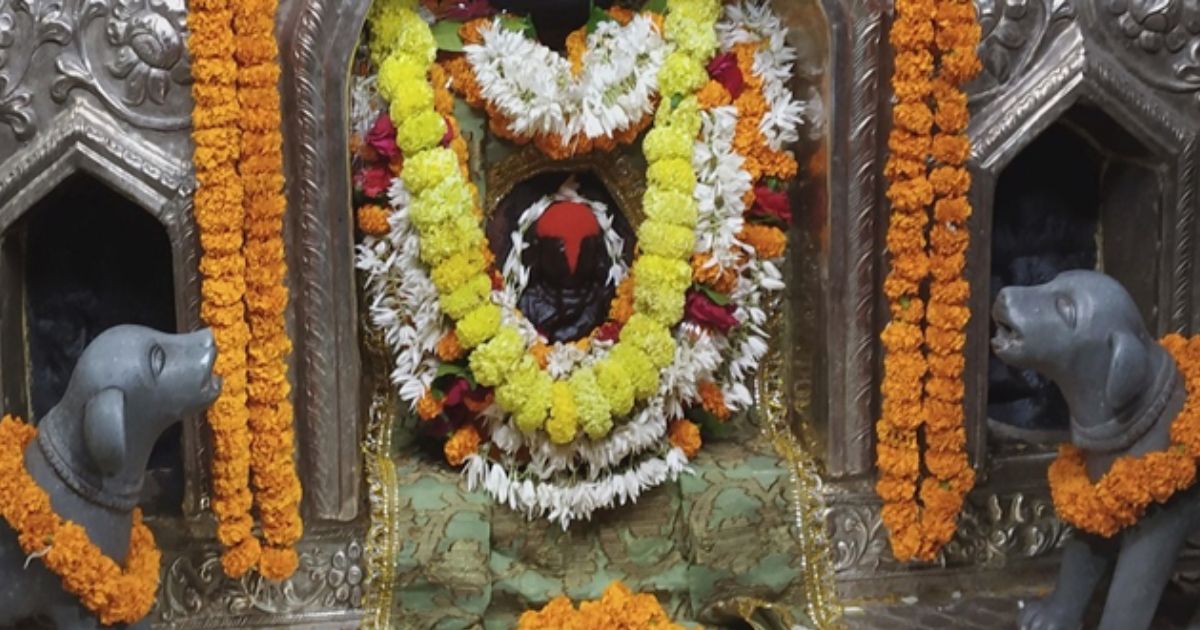
The deity of Kaal Bhairav is visible only as a silver face, heavily garlanded with marigolds. The rest of the idol is traditionally draped in cloth. Behind the idol stands his Vahana (vehicle), the dog. The atmosphere inside is thick with the smoke of oil lamps and the rhythmic chanting of the Bhairav Ashtakam.
The Gentle Guardian: Batuk Bhairav Temple
While Kaal Bhairav represents the fierce Ugra form of Shiva, a short distance away in the Kamachha area lies a completely different energy: Batuk Bhairav.
Batuk translates to “young boy” or “child.” Here, the deity is worshipped in a pre-adolescent form. If Kaal Bhairav is the strict disciplinarian, Batuk Bhairav is the indulgent protector who grants boons with a child’s innocence.
The Akhand Dhuni (The Eternal Flame)
The Batuk Bhairav temple is famous for its Akhand Dhuni, a sacred fire that has been kept burning for generations. This fire is central to the Tantric traditions associated with the temple. Devotees often take the sacred ash (Bhasma) from this fire, believing it to have curative properties.
Varanasi’s Sacred Canines
In 2026, the Batuk Bhairav temple has become a sanctuary for the city’s street dogs. Because the dog is the vehicle of Bhairav, they are treated with immense respect here. It is common to see devotees feeding milk and biscuits to the dogs surrounding the temple complex. For the “Experience Marketer” or the conscious traveler, this intersection of ancient mythology and modern animal welfare provides a unique narrative on how traditional spaces can foster community care.
Practical Tips for the 2026 Pilgrim
| Feature | Kaal Bhairav (Vishweshwarganj) | Batuk Bhairav (Kamachha) |
| Primary Energy | Fierce, Protective, Disciplined | Gentle, Compassionate, Child-like |
| Key Offering | Mustard Oil, Black Cloth, Black Sesame | Curd Rice, Sweets, Milk for Dogs |
| Best Time to Visit | Sundays and Tuesdays (Full Moon) | Any evening during the Sandhya Aarti |
| Crowd Level | Very High; narrow access lanes | Moderate; spacious temple courtyard |
| Photography | Strictly prohibited inside the sanctum | Generally allowed in the courtyard |
Logistics and the “Smart City” Impact
Varanasi in 2026 is a blend of the ancient and the futuristic. The Varanasi Ropeway Project has now become the preferred mode of transport for pilgrims.
- Bypassing the Traffic: The ropeway connects the Varanasi Junction railway station to Godowlia, the gateway to the temples. This allows you to soar over the congested streets, offering a bird’s-eye view of the city’s rooftops and shrines before descending into the historic core.
- Safety and Navigation: The “Kashi Smart App” now provides real-time updates on queue timings at the Kaal Bhairav temple. It is highly recommended to check the “Aarti” timings on the app, as the temple often closes for short intervals during the day for cleaning and deity decoration (Shringar).
The Spiritual Sequence: A Traveler’s Itinerary
To follow the traditional path of a Kashi pilgrimage in 2026, one should ideally follow this sequence:
- Ganga Snan: Begin with a dip in the Ganges at Dashashwamedh or Assi Ghat at dawn.
- Kaal Bhairav: Visit the Kotwal first to seek “permission” to be in the city.
- Kashi Vishwanath: Proceed to the main Jyotirlinga through the renovated corridor.
- Annapurna Devi: Visit the Goddess of Nourishment, located adjacent to Vishwanath.
- Batuk Bhairav: End the day at the Kamachha temple for a quieter, more meditative experience.
Conclusion: The Duality of the Divine
Varanasi is a city that requires you to surrender your expectations. In the fierce eyes of Kaal Bhairav, one finds the strength to face life’s inevitable transitions. In the quiet courtyard of Batuk Bhairav, one finds the comfort of a guardian who watches over the city with a child’s heart.
As you document your journey through Kashi in 2026, remember that these temples are not just historical monuments; they are living institutions. They are the psychological and spiritual anchors for millions. Whether you are there to untie the knots of your own karma or simply to witness the vibrant pulse of Indian tradition, the Bhairavs of Kashi ensure that no one leaves the city quite the same as they arrived.
Next in the Series: The Hidden Power of the Matrikas: A Guide to the Maa Varahi Shrines of the Deccan and Beyond.