
BrahMos Missiles vs. Spice 2000 Bombs: Analyzing India’s Advanced Weaponry Evolution

BrahMos Missiles: A Strategic Leap
BrahMos missiles, developed by India and Russia, are supersonic cruise missiles known for their speed, reaching up to Mach 2.8, or about 3,400 km/h. They have a range of up to 290 km, with plans for extended ranges, and can be launched from land, sea, air, and submarines, making them highly versatile. Their precision and ability to evade defenses make them crucial for strategic strikes, enhancing India’s deterrence against regional threats.
Spice 2000 Bombs: Precision in Action
Spice 2000, from Israel’s Rafael, is a guidance kit turning unguided bombs into precision-guided munitions. It offers a 60 km glide range and accuracy within 3 meters, ideal for tactical air operations. Used in the 2019 Balakot airstrike, it allows aircraft to strike from a safe distance, minimizing risks and collateral damage, thus strengthening India’s air force capabilities.
Comparative Impact on India’s Defense
BrahMos excels in long-range, high-speed strikes, while Spice 2000 focuses on close, precise engagements. Together, they cover strategic and tactical needs, reflecting India’s move toward advanced, technology-driven warfare, enhancing both deterrence and operational flexibility.
Researching BrahMos Missiles and Spice 2000 Bombs for India’s Weaponry Advancements
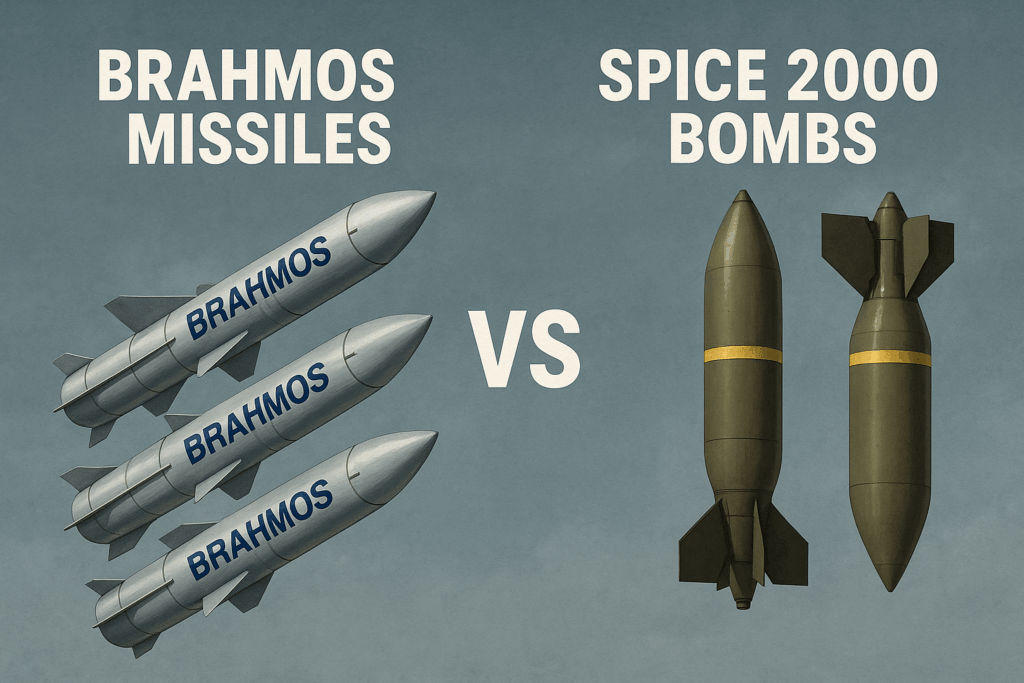
India’s defense landscape has undergone significant transformation with the integration of advanced weaponry, notably the BrahMos supersonic cruise missile and the Spice 2000 precision-guided bomb. This survey note provides a detailed, fact-based analysis of these systems, exploring their specifications, capabilities, and strategic roles, while contextualizing their impact on India’s military strategy. The analysis draws from extensive research into official sources, defense publications, and expert opinions, ensuring a comprehensive understanding of India’s weaponry advancements.
The Evolution of India’s Defense Capabilities
India’s commitment to modernizing its defense forces is evident in its adoption of cutting-edge technologies, such as the BrahMos missile and Spice 2000 bomb. These systems represent a shift toward precision, speed, and versatility, enhancing India’s ability to address both conventional and asymmetric threats in a nuclear-armed region. This note examines their technical specifications, operational use, and strategic implications, offering insights into how they shape India’s military doctrine.
BrahMos Supersonic Cruise Missile: Technical Specifications and Capabilities
The BrahMos missile, a joint venture between India and Russia under BrahMos Aerospace, is one of the world’s fastest supersonic cruise missiles, with speeds reaching Mach 2.8, or approximately 3,400 km/h. Its development began in 1998, following the formation of BrahMos Aerospace by India’s Defence Research and Development Organisation (DRDO) and Russia’s NPO Mashinostroyeniya.
Specifications:
- Speed: Mach 2.8, making it difficult to intercept due to its high velocity.
- Range: Currently up to 290 km, with plans for extended range versions, potentially reaching 600 km or more, following India’s entry into the Missile Technology Control Regime (MTCR) in 2016 .
- Weight: Approximately 2,500 kg, with a warhead weight of 200–300 kg, depending on the variant.
- Warhead: Conventional high-explosive, suitable for anti-ship and land-attack roles.
- Guidance: Inertial navigation system with terminal active radar homing, ensuring pinpoint accuracy.
- Propulsion: Two-stage system, with a solid-propellant rocket booster for initial acceleration and a liquid ramjet for sustained supersonic flight, as detailed on the official BrahMos website .
Capabilities:
- Multi-platform Launch: BrahMos is designed for versatility, capable of being launched from submarines, ships, aircraft, and land-based mobile autonomous launchers (MAL). For instance, the ship-based version can hit targets beyond radar horizons, while the air-launched variant is integrated with the Sukhoi Su-30MKI .
- Supersonic Speed: Its high speed reduces flight time, ensuring quicker engagement and lower dispersion, enhancing its effectiveness against moving targets.
- Precision Strike: Advanced guidance systems, including GPS and scene-matching algorithms, allow for precise hits, minimizing collateral damage, as noted in recent tests .
- Stealth Features: Low radar cross-section and advanced maneuvering capabilities, such as steep dives and multiple flight paths, make it harder for enemy air defenses to detect and engage.
Variants and Future Developments:
- BrahMos-A: Air-launched, integrated with Su-30MKI, entered service in 2019, enhancing India’s air strike capabilities.
- BrahMos-N: Naval variant, deployed on Indian Navy ships and submarines, with launches possible from depths of 40-50 meters BrahMos.com.
- BrahMos-L: Land-based, used by the Indian Army, with mobile launchers for rapid deployment.
- BrahMos-II: Under development, a hypersonic version expected to reach Mach 8, with a range over 600 km, potentially revolutionizing India’s strategic reach .
Operational Use: BrahMos has been inducted into all three branches of the Indian Armed Forces, with significant deployments in operations like Operation Sindoor in 2025, where it was used to strike Pakistani air bases with precision . Its export to the Philippines, under a $375 million deal in 2022, highlights India’s growing role as a defense exporter, particularly in countering China’s influence in Southeast Asia .
Spice 2000 Precision-Guided Bomb: Technical Specifications and Capabilities
The Spice 2000, developed by Rafael Advanced Defense Systems of Israel, is not a bomb itself but a guidance kit that converts unguided bombs into precision-guided munitions (PGMs). It has been a critical component of the Indian Air Force’s arsenal, particularly for tactical air operations.
Specifications:
- Guidance: Combines GPS and electro-optical guidance, ensuring accuracy in all weather conditions Spice (bomb) – Wikipedia).
- Range: Up to 60 km glide range, allowing aircraft to release the bomb from a safe distance outside enemy air defenses .
- Accuracy: Circular Error Probable (CEP) of less than 3 meters, enabling precise targeting .
- Compatible Warheads: Designed for 2000-pound class bombs, such as the Mk-84, with a weight of approximately 1,000 kg for the guided bomb .
- Control Surfaces: Features 12 control surfaces in three groups (fore, mid-body, and tail), enhancing its glide and maneuverability Spice (bomb) – Wikipedia).
Capabilities:
- Standoff Capability: The 60 km glide range allows aircraft to engage targets without entering the threat envelope of short- and medium-range air defense systems, saving costs compared to propelled munitions .
- Precision Targeting: Electro-optical guidance with scene-matching algorithms ensures the bomb hits within 3 meters of the intended target, reducing collateral damage.
- All-Weather Operation: GPS guidance enables use in adverse weather, while mid-course corrections enhance accuracy against GPS jamming.
- Integration with Fighter Jets: Compatible with Indian Air Force platforms like Mirage 2000 and Sukhoi Su-30MKI, with ongoing efforts to equip more aircraft .
Operational Use: The Spice 2000 gained prominence during the 2019 Balakot airstrike, where Indian Air Force Mirage 2000 jets used it to target a Jaish-e-Mohammed terrorist camp in Pakistan, demonstrating its precision in surgical strikes . The Indian Air Force has since signed deals for additional Spice bombs, with Hyderabad-based Kalyani Rafael Advanced Systems delivering over 200 units, 80% for Indian forces .
Comparative Analysis: BrahMos vs. Spice 2000
| Aspect | BrahMos Missile | Spice 2000 Bomb |
|---|---|---|
| Type | Supersonic cruise missile | Precision-guided bomb (guidance kit) |
| Speed | Mach 2.8 (approx. 3,400 km/h) | Glides, no propulsion (subsonic) |
| Range | Up to 290 km (extendable to 600 km) | Up to 60 km glide range |
| Launch Platform | Land, sea, air, submarine | Aircraft (e.g., Mirage 2000, Su-30 MKI) |
| Guidance | Inertial, GPS, active radar homing | GPS, electro-optical, scene-matching |
| Accuracy | High, with terminal guidance | CEP < 3 meters |
| Role | Strategic, long-range strikes | Tactical, close air support |
| Operational Use | Operation Sindoor (2025), anti-ship roles | Balakot airstrike (2019), surgical strikes |
Synergy: BrahMos provides deep strike capabilities for strategic deterrence, while Spice 2000 enhances tactical precision for air operations, together covering India’s needs in both conventional and asymmetric warfare.
Strategic Implications and Expert Analysis
The integration of BrahMos and Spice 2000 into India’s arsenal has significant strategic implications, as noted by defense experts. The BrahMos missile, with its supersonic speed and long range, offers a credible second-strike capability, essential in a nuclear-armed neighborhood like South Asia. Its export to the Philippines, under a $375 million deal in 2022, positions India as a key player in the global arms market, particularly in countering China’s influence in Southeast Asia .
Spice 2000’s precision and standoff capability have been pivotal in operations like Balakot, allowing India to conduct surgical strikes with minimal escalation risks, crucial for managing conflicts with non-state actors . However, the 2022 accidental firing of a BrahMos missile into Pakistan, which caused damage but no casualties, raised concerns about safety mechanisms and command and control systems, prompting calls for improved protocols . This incident, acknowledged by the Indian Defense Ministry on March 11, 2022, led to the termination of three Air Force officers for procedural lapses .
Future Developments and India’s Defense Modernization
India’s focus on self-reliance in defense production, under initiatives like “Make in India,” is evident in the development of next-generation weapons. BrahMos-II, a hypersonic missile under development, is expected to reach Mach 8 with a range over 600 km, potentially revolutionizing India’s strategic reach . Similarly, the integration of Spice 2000 with more aircraft, such as the Su-30MKI, and potential acquisitions of advanced PGMs, reflect India’s commitment to enhancing air strike capabilities .
These advancements are part of India’s broader strategy to project power in the region, deter adversaries, and maintain regional stability, particularly in the context of ongoing tensions with Pakistan and China.
Conclusion
The BrahMos missile and Spice 2000 bomb exemplify India’s advancements in military technology, offering precision, speed, and versatility across strategic and tactical domains. Their integration into the Armed Forces enhances operational effectiveness, strengthens deterrence, and supports India’s geopolitical ambitions. As India continues to invest in defense modernization, these systems will remain central to its strategy for maintaining security and influence in a complex geopolitical landscape.
Key References
- BrahMos missile specifications and capabilities
- BrahMos missile Wikipedia page
- BrahMos-II hypersonic missile development
- Spice bomb Wikipedia page
- Spice 2000 used in Balakot airstrike
- Spice 2000 bomb details and usage
- BrahMos export to Philippines and strategic implications
- BrahMos strategic role in Southeast Asia
- BrahMos misfiring incident analysis
- 2022 India-Pakistan missile incident details
- Spice 2000 bombs and Indian Air Force integration
- BrahMos supersonic cruise missile superlative weapon
- Spice 2000 smart bombs used in Balakot strikes
- Spice 2000 bomb news and updates
- Maker of Spice bombs used in Balakot airstrike