Understanding Your People-Pleasing Triggers: From Survival to Self-Trust

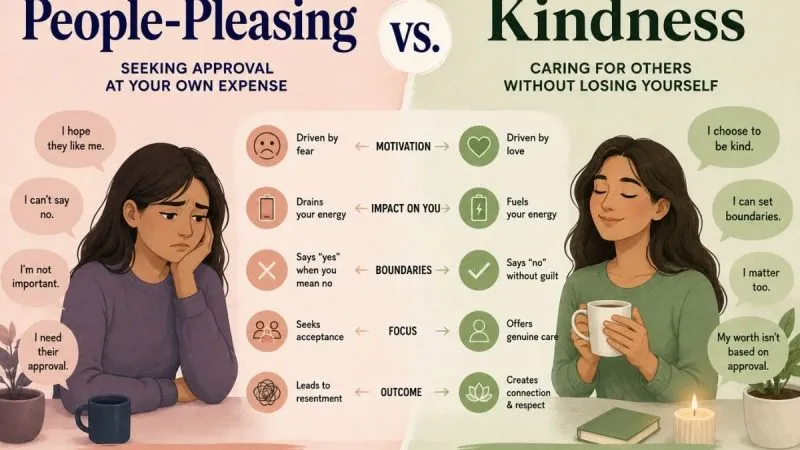
People-pleasing isn’t a personality trait; it is a survival strategy typically learned in environments where your safety or belonging depended on the emotional state of others.
Identifying your triggers in real-time requires moving your focus from the external person (their face, their tone) to your internal sensations (your heart rate, your muscle tension).
1. Common People-Pleasing Triggers
Triggers are the specific scenarios that flip your “compliance switch” before you even realize it’s happening.
| Trigger Category | The Scenario | The Subconscious Thought |
| The Silence | A conversation dies down or a room gets quiet. | “I have to entertain them or they’ll be bored/upset with me.” |
| The Disappointment | A partner or boss expresses a minor frustration. | “If they are unhappy, I am unsafe/unworthy.” |
| The “Asker” | Someone asks for a favor they could easily do themselves. | “Saying no is an act of aggression.” |
| The Conflict | Two people in the room are disagreeing. | “I must fix the vibe immediately so I can relax.” |
| The Compliment | Someone praises you for being “so helpful” or “easygoing.” | “I must maintain this persona to keep their approval.” |
2. Identifying Your Triggers in Real-Time
To catch yourself in the act, you need to recognize the Physiological Prelude. Your body knows you are about to people-please before your brain does.
- Scan for the ‘Internal Clench’
Focus on the chest and throat
The moment someone makes a request, pause. Do you feel a sudden tightening in your solar plexus or a “lump” in your throat? This is your nervous system entering a fawn response (a subset of fight-or-flight).
2. The ‘Inhale Test’
Watch your breathing
People-pleasers often hold their breath when asked for something. If you find yourself inhaling sharply and holding it while waiting to answer, you are likely operating from a place of fear rather than choice.
3. Check for ‘Mental Scanning’
Observe your thoughts
Are you thinking about what you want, or are you mentally scanning the other person’s face for signs of anger? If your brain is 100% focused on their reaction, you have been triggered.
4. The 5-Second Gap
The ‘I’ll get back to you’ rule
Force a 5-second silence. If that silence feels physically painful or induces panic, that is the confirmation of your trigger. Use the phrase: “Let me check my schedule/thoughts and get back to you.”
The Expert’s Nuance: People-pleasing is often a “high-functioning” anxiety. You might be praised for your kindness, but if that kindness leaves you feeling resentful or exhausted later, it wasn’t a gift—it was a transaction to buy safety.