
Sulabha: The Philosopher Who Walked Into a King’s Court and Walked Out Untouched
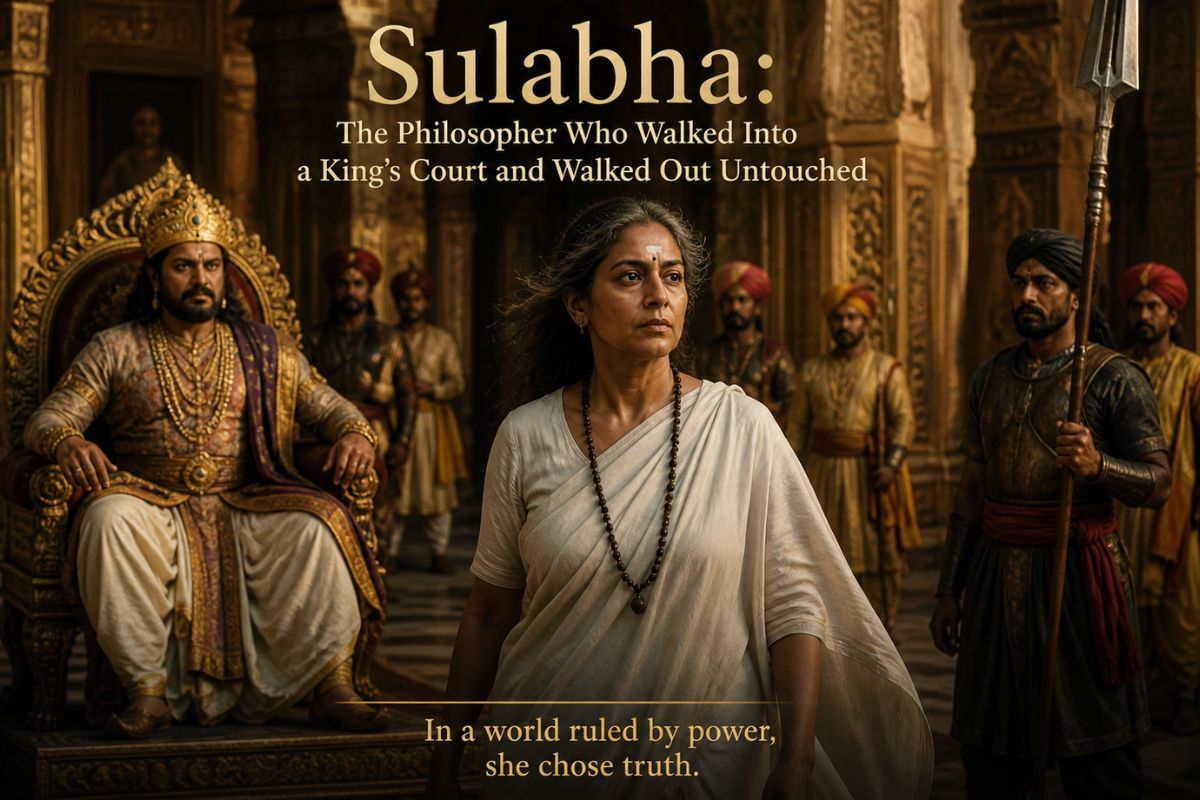
Not all wisdom arrives with authority. Some of it walks in quietly, asks nothing, claims nothing, and yet leaves behind a shift so deep that it changes the way we understand freedom itself.
In the layered narrative of the Mahabharata, one such presence appears in the form of Sulabha, a woman philosopher whose clarity of thought and independence of being stand apart even in a text filled with extraordinary minds.
Her story is not long. It is not dramatic. But it is precise. And that precision is what makes it powerful.
The Setting: A King Known for Wisdom
The dialogue involving Sulabha takes place with King Janaka, a ruler often associated with knowledge, detachment, and philosophical depth. His court is not just political. It is intellectual. It attracts thinkers, seekers, and philosophers.
Janaka is widely regarded as someone who has achieved inner freedom while still being engaged in worldly life. This reputation is important, because it sets the stage for what follows.
Sulabha enters this space, not as a challenger seeking attention, but as a thinker seeking clarity.
Who Was Sulabha
Sulabha is described as a learned woman, a Brahmavadini, one who has deeply studied and realized the nature of the self. She is not defined by family, position, or social role. Her identity is rooted in awareness.
Unlike many narratives where women are introduced through relationships, Sulabha stands independently. She arrives, engages, questions, and leaves.
Her presence is brief, but her impact is lasting.
The Encounter: A Dialogue Without Conflict
Sulabha approaches King Janaka and initiates a philosophical exchange. There is no aggression in her tone, no attempt to overpower. Instead, there is clarity.
Through her words, she begins to examine Janaka’s understanding of detachment. She questions whether his sense of freedom is complete, or whether it still carries subtle forms of identification.
Her inquiry is not superficial. It is deeply psychological and philosophical. She explores the idea of self, asking what it truly means to be free.
The Core Question: What Is True Freedom
At the heart of Sulabha’s dialogue lies a simple but profound question.
What does it mean to be truly free
Is freedom the absence of external bondage, or is it the absence of internal identification
Through her reasoning, she suggests that as long as one identifies with roles, positions, or even the idea of being free, there remains a subtle limitation.
True freedom, in her understanding, is not something that can be claimed. It is something that exists when all claims dissolve.
A Mind That Could Not Be Contained
One of the most striking aspects of Sulabha’s presence is her independence.
She is not attached to validation. She does not seek approval. Her words are not shaped by the need to be accepted.
This gives her a rare clarity. She is able to speak without distortion.
In her exchange with Janaka, she does not dismiss him. She refines the conversation. She moves it deeper.
The Philosophy of Non Identification
Sulabha’s insight centers on the idea of non identification.
She suggests that the self is not defined by the body, the mind, or social roles. These are layers, not essence.
As long as one confuses these layers with the self, there is limitation.
When this confusion ends, what remains is awareness, unbound and complete.
This perspective aligns with the deeper currents of Indian philosophy, where the ultimate aim is not to become something new, but to recognize what already is.
A Quiet but Radical Presence
Sulabha does not establish a school of thought. She does not gather followers. She does not leave behind a system.
Her presence is momentary, but it is complete.
She enters a space, speaks with clarity, and leaves without attachment.
In many ways, this reflects the very philosophy she expresses.
Reading Sulabha Today
Sulabha’s voice feels surprisingly modern.
In a world where identity is constantly shaped by external validation, her perspective offers a different approach.
She suggests that freedom is not something granted by society. It is not dependent on status or recognition. It is an inner state that arises when identification drops.
Her story also expands the understanding of women in ancient Indian thought. She is not confined to domestic or symbolic roles. She participates directly in philosophical discourse, with confidence and depth.
Conclusion: The Strength of Clarity
Sulabha’s legacy is subtle. It does not demand attention. It does not rely on repetition.
It exists in the clarity of her thought and the precision of her words.
She reminds us that true freedom is not something we declare. It is something we understand.
And that understanding begins when we start questioning what we believe we are.
FAQs
Who was Sulabha
Sulabha was a woman philosopher mentioned in the Mahabharata, known for her dialogue with King Janaka on selfhood and freedom.
What is Sulabha known for
She is known for questioning the concept of detachment and explaining the idea of true freedom beyond identity.
What does Sulabha’s philosophy teach
Her philosophy teaches non identification, inner freedom, and the understanding of the self beyond roles and labels.
Why is Sulabha important
She represents intellectual independence and shows that women actively participated in philosophical discourse in ancient India.