The 1958 Donut Shop St. Petersburg Refused to Let Die: Inside Pyshechnaya on Bolshaya Konyushennaya
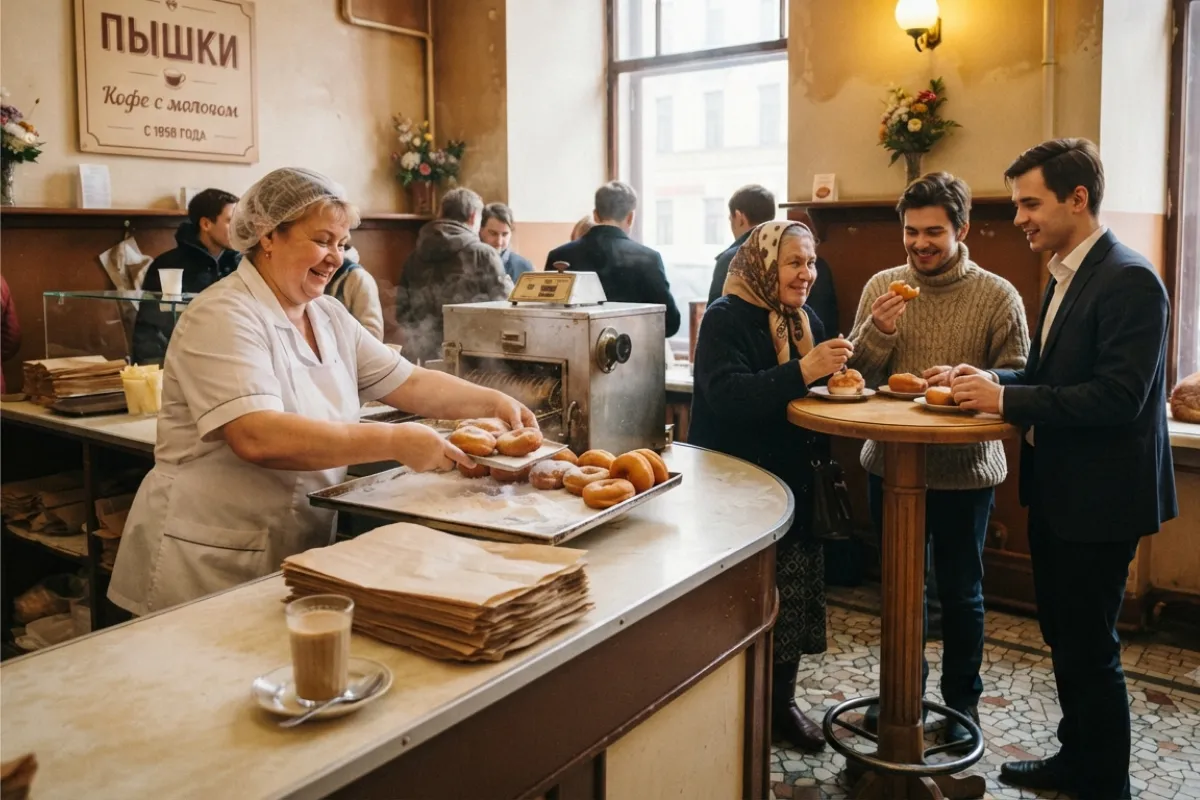
Step off the grand, imperial sweep of Nevsky Prospekt ontoBolshaya Konyushennaya Streetin St.Petersburg, and you will likely spot a line spilling out onto the sidewalk—even in the biting Baltic winter. They aren’t waiting for Michelin-starred tasting menus or artisanal sourdough. They are queuing outside25 Bolshaya Konyushennaya, inside the historic 18th-century building of the French-German Church of St.Paul, for a humble ring of fried yeast dough dusted in powdered sugar and a glass of sweet, milky coffee.
Known affectionately by locals simply asPyshechnaya(officially registered asZhelyabova 25, after the street’s Soviet-era name), this unassuming café has been frying the exact same recipe since1958. In a city famous for aristocratic palaces and opulent dining rooms, this surviving relic of Soviet public catering has become St. Petersburg’s most beloved culinary institution.
While ourguide to traditional Russian foodexplores the country’s hearty soups, dumplings and iconic dining institutions, Pyshechnaya reveals a different side of Russian culinary culture, one shaped by everyday affordability, collective memory and enduring local traditions.
The Story Behind the Ring: Military Factories and a 1958 Recipe
The story of thepyshka(derived from the Russian verbpykhat, meaning “to radiate heat”) is inseparable from Leningrad’s mid-century history. While fried buns had existed in Russian cookbooks since the 19th century, the ring-shapedpyshkawas perfected by food technologists at theLeningrad Trust of Canteens and Cafésin 1958.
The secret to its distinct texture—a crisp, golden exterior that seals instantly in hot oil while keeping the interior feather-light—wasn’t just the dough; it was the machinery. During the 1950s Soviet industrial conversion program, military plants were tasked with building civilian equipment, producing the first automatedpyshkifryers (production later shifted to a factory in Kyiv). Every morning at 7:00 AM, bakers still knead the dough using that closely guarded 1958 formula, letting it rest before the vintage machines drop and fry 50 rings every ten minutes, each finished with roughly four grams of powdered sugar.
When the Soviet Union collapsed in 1991, production of these specialized machines ceased forever, and dozens of Leningrad’spyshechnayasvanished during the turbulent 1990s. Only the Bolshaya Konyushennaya counter endured—protected fiercely by local devotion as a living monument to the city’s everyday memory.
Thousands of kilometres away, a similar story unfolds atDelhi’s historic Old Famous Jalebi Wala, where generations of customers have returned for a signature fried sweet. Different countries, different recipes, but the same enduring relationship between food, memory and neighbourhood identity.
What Makes the Experience Unmistakable
Walking through the doors feels like stepping into a time capsule where etiquette follows its own charmingly functional rules:
- The “Barrel” Coffee:You don’t order an oat-milk flat white here. Coffee is brewed with condensed milk and sugar in large heated tanks—nicknamed “barrel” or “bucket” coffee by regulars—and ladled straight into simple glasses.
- Squares of Wrapping Paper:Instead of standard paper serviettes, every table holds stacks of neatly cut squares of rough brown wrapping paper. Longtime patrons know this is the only practical way to hold a piping-hot, sugar-dustedpyshkawithout coating your fingers in glaze.
- The Resident Ginger Cat:For years, a plump ginger cat named Ryzhik (and his successors) has held court on the window ledges and chairs, treated like minor royalty by both staff and guests.
Why People Still Make the Pilgrimage Today
In an era of curated luxury, people visit Pyshechnaya on Bolshaya Konyushennaya because it remains radically egalitarian and stubbornly unchanged.
- A Leveling Social Space:From its earliest days in Leningrad, university professors, shipyard workers, students, and celebrated Russian actors—including longtime St. Petersburg residents like Mikhail Boyarsky and Elizaveta Boyarskaya—have stood shoulder-to-shoulder at the same standing tables.
- Radical Affordability:Even in the heart of St. Petersburg’s prime shopping district, apyshkacosts roughly 30 to 40 rubles (less than $0.50 USD), making a plate of three rings and a glass of coffee one of the most accessible comforts in the city.
- Taste of Nostalgia:For older generations, the smell of frying dough and condensed milk is an immediate sensory bridge to their youth; for younger travelers and locals, it is the single most authentic bite of St. Petersburg’s living history—proof that sometimes, the soul of a city lives in a simple ring of sugared dough.
Pyshechnaya is a reminder ofhow food tells the story of a place. Sometimes, the most meaningful encounters with a city’s history happen not inside its grand museums or palaces, but around the humble tables where generations of residents have gathered.
Visitor Note:Located at25 Bolshaya Konyushennaya Street(a short walk from Nevsky Prospekt metro station), the bakery opens at9:00 AM on weekdaysand10:00 AM on weekends. Bring cash or a local card, order at least threepyshkiper person (two is never enough), and grab a stack of cut brown paper before finding a spot by the window.