Black July 1983: A Dark Chapter in Sri Lanka’s History
The events of Black July 1983 remain one of the most harrowing episodes in Sri Lanka’s modern history, marking a brutal escalation in ethnic tensions between the Sinhalese majority and the Tamil minority. The anti-Tamil pogrom, which erupted in late July 1983, was a week-long spree of violence that left thousands dead, displaced countless others, and deepened the ethnic divide that fueled a 26-year civil war. Among the many atrocities committed during this period, allegations of extreme violence, including claims of Sinhala Buddhist monks participating in heinous acts such as the gang rape of Tamil girls, have surfaced in certain narratives. These claims, while not universally corroborated in primary sources, reflect the profound trauma and polarized discourse surrounding Black July.
This article explores the context, events, and aftermath of Black July, critically examining the allegations of monastic involvement in violence, the broader socio-political dynamics, and the lasting impact on Sri Lanka’s ethnic relations.
Historical Context: A Century of Ethnic Tensions
To understand Black July, one must first grasp the historical roots of Sinhala-Tamil tensions. Sri Lanka, a multi-ethnic island nation, has long been shaped by its diverse communities: the Sinhalese (predominantly Buddhist), Tamils (mostly Hindu), Muslims, and others. The Sinhalese form the majority, constituting about 75% of the population, while Tamils make up roughly 15%. The colonial era under British rule (1796–1948) exacerbated ethnic divisions by favoring Tamils in education and civil service roles, fostering resentment among Sinhalese elites. Upon independence in 1948, Sinhala nationalist leaders sought to reverse these perceived imbalances, often at the expense of Tamil rights.
Key policies fueled Tamil grievances. The 1956 “Sinhala Only” Act made Sinhala the sole official language, marginalizing Tamil speakers in education and government. The 1972 Constitution enshrined Buddhism as the state’s foremost religion, alienating non-Buddhist minorities. Tamils faced discriminatory quotas in university admissions and limited access to public sector jobs. These policies, combined with periodic anti-Tamil riots (notably in 1956, 1958, and 1977), created a sense of systemic exclusion among Tamils, particularly in the northern and eastern regions, where they formed a majority.
By the late 1970s, Tamil youth, frustrated by peaceful advocacy’s failure, turned to militancy. The Liberation Tigers of Tamil Eelam (LTTE), formed in 1976, sought a separate Tamil state, Eelam, through armed struggle. The LTTE’s attacks on Sri Lankan security forces escalated tensions, culminating in a pivotal event on July 23, 1983, when the LTTE ambushed a military patrol in Jaffna, killing 13 Sinhalese soldiers. This attack, known as the Thirunelveli ambush, was the immediate trigger for Black July.
Black July: The Pogrom Unfolds
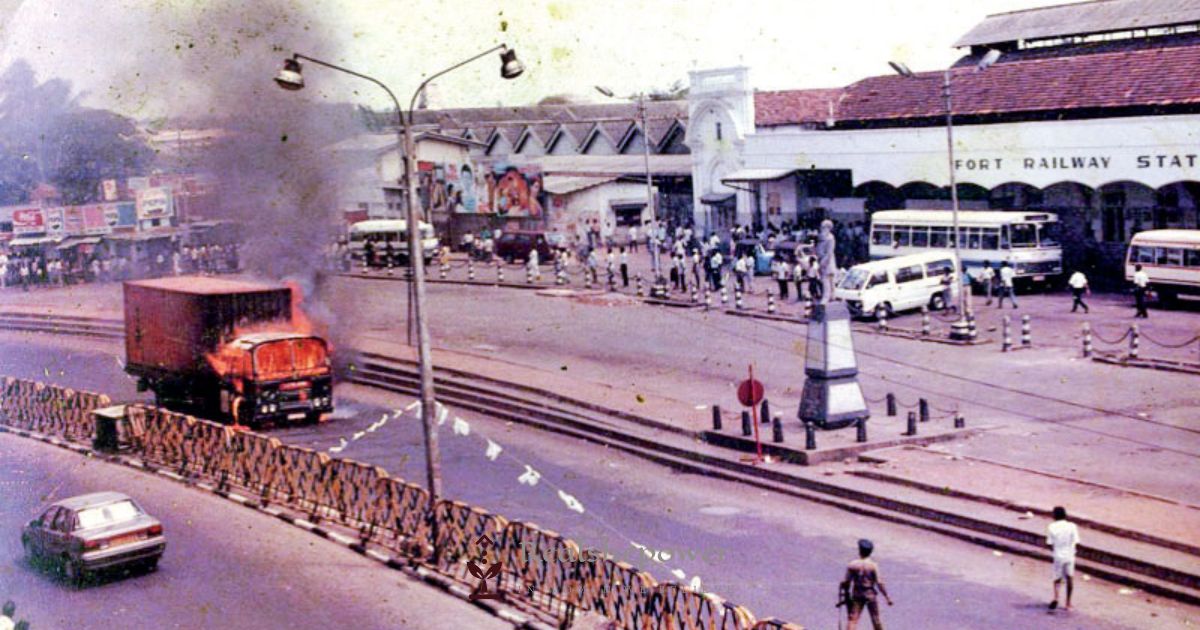
The violence began in Colombo on the night of July 24, 1983, following the funeral of the slain soldiers. What started as targeted attacks by Sinhalese mobs quickly spiraled into a nationwide pogrom. Armed with electoral rolls to identify Tamil homes and businesses, mobs looted, burned, and killed with chilling precision. Over seven days, the violence spread from Colombo to other cities, including Kandy, Galle, and Matara, leaving a trail of devastation.
Estimates of the death toll vary widely, ranging from 400 to over 3,000 Tamils killed. Tens of thousands of homes and businesses were destroyed, and over 100,000 Tamils were displaced, many fleeing to the north and east or seeking refuge abroad. The violence was marked by extreme brutality: Tamils were burned alive in vehicles, hacked with machetes, or beaten to death. Eyewitness accounts describe mobs dousing victims with petrol, setting them alight, and celebrating amid the carnage. In Colombo’s Welikada prison, 53 Tamil political prisoners were massacred by Sinhalese inmates, allegedly with the complicity of prison authorities.
The government’s response was widely criticized. President J.R. Jayawardene delayed imposing a curfew until July 25, and security forces often stood by or aided the mobs. Jayawardene’s infamous statement to the Daily Telegraph— “I am not worried about the opinion of the Jaffna people… the more you put pressure in the north, the happier the Sinhala people will be here”—reflected a callous disregard for Tamil suffering and emboldened the rioters. The International Commission of Jurists later concluded that the pogrom was orchestrated by elements within the ruling United National Party (UNP), with the soldier killings serving as a pretext for a pre-planned attack on Tamils.
Black July 1983: Key Points and Takeaways
Key Points of Black July 1983
- Trigger: LTTE ambush on July 23, 1983, killed 13 Sinhalese soldiers in Jaffna, sparking anti-Tamil violence.
- Scale of Violence: Nationwide pogrom from July 24–30, 1983, killed 400–3,000 Tamils, displaced over 100,000, and destroyed thousands of homes and businesses.
- Methods: Mobs used electoral rolls to target Tamils, employing arson, machetes, and petrol bombings; 53 Tamil prisoners massacred in Welikada prison.
- State Complicity: Government delayed curfew; security forces often aided mobs; President Jayawardene’s remarks emboldened rioters.
- Monastic Involvement: Some Buddhist monks incited or joined mobs, though specific 1984 school rape allegations remain unverified in primary sources.
- Context: Decades of Sinhala-Tamil tensions, fueled by discriminatory policies like the 1956 Sinhala Only Act and Buddhist nationalism.
Key Takeaways
- Ethnic Divide: Black July deepened Tamil distrust, radicalized youth, and escalated the civil war until 2009.
- Nationalism’s Role: Sinhala-Buddhist nationalism, sometimes involving monks, amplified ethnic hatred, highlighting religion’s complex role.
- Impunity: Lack of accountability for perpetrators, including state actors, hinders reconciliation; no senior officials prosecuted.
- Diaspora Impact: Mass Tamil exodus created a global diaspora advocating for justice and accountability.
- Reconciliation Need: Healing requires truth, justice, and dismantling nationalist ideologies that fueled the pogrom.
Allegations of Monastic Involvement
Among the most disturbing claims surrounding Black July are allegations that Sinhala Buddhist monks participated in the violence, including extreme acts such as the gang rape of Tamil girls at a Buddhist-run school in July 1984. These claims have appeared in posts on X and certain online narratives, often tied to broader accusations of monastic complicity in anti-Tamil violence. However, these specific allegations require careful scrutiny, as they are not widely corroborated in primary sources or mainstream historical accounts of Black July, which focus on the events of July 1983, not 1984.
Eyewitness testimonies and reports from the time do confirm that some Buddhist monks were among the rioters. A survivor cited in the Tamil Guardian described a line of monks “arms flailing, their voices raised in a delirium of exhortation, summoning the Sinhalese to put all Tamils to death.” Norwegian tourist Eli Skarstein recounted seeing monks inciting mobs in Colombo, where “women, children, and old people were slaughtered.” These accounts align with the broader role of certain monks in promoting Sinhala-Buddhist nationalism, a movement that portrays Sri Lanka as a sacred Buddhist land destined for Sinhalese dominance.
However, the specific claim of monks gang-raping Tamil girls in a Buddhist-run school in July 1984 appears to be a distinct narrative, potentially conflating the 1983 pogrom with later incidents or unverified reports. While hundreds of Tamil women were raped during Black July 1983, as documented in survivor testimonies and international press coverage, no primary sources explicitly tie these acts to monks or a Buddhist-run school in 1984. For example, the Tamil Guardian and BBC reported widespread sexual violence, including the rape of “hundreds of women” and specific cases of girls being abducted and assaulted, but these accounts do not mention monastic perpetrators or a school setting in 1984.
The lack of corroboration does not dismiss the possibility of such atrocities, given the chaotic nature of the violence and the suppression of information by state-controlled media. The mainstream media’s blackout of Tamil suffering, as noted by scholars, may have obscured specific incidents. Additionally, the involvement of monks in earlier anti-Tamil riots (e.g., the 1956 Gal Oya massacre) and their role in nationalist politics lend plausibility to claims of monastic complicity, even if the 1984 school incident remains unverified.
The Role of Sinhala-Buddhist Nationalism
The alleged involvement of monks in Black July reflects the broader influence of Sinhala-Buddhist nationalism, which has shaped Sri Lanka’s ethnic dynamics for decades. Rooted in texts like the Mahavamsa, a chronicle that glorifies Sinhalese Buddhist kings as protectors of the Dharma, this ideology portrays Tamils and other minorities as threats to the island’s Buddhist destiny. Monks, revered as moral authorities, have historically played a dual role: some advocated peace, while others fueled chauvinism.
In the 20th century, figures like Anagarika Dharmapala championed a militant Buddhist nationalism, framing Tamils and Muslims as “outsiders.” By the 1980s, monks were deeply enmeshed in politics, with groups like the Jathika Hela Urumaya (JHU) advocating an all-out war against the LTTE. During Black July, some monks reportedly led mobs or incited violence from temples, transforming sacred spaces into “anti-Tamil war schools.” This paradox—monks, bound by vows of non-violence, endorsing or participating in violence—highlights the complex interplay of religion and ethnicity in Sri Lanka.
Not all monks embraced this path. Figures like Galkande Dhammananda, a contemporary monk, have worked to heal ethnic divisions, condemning the nationalism that fueled Black July. However, such voices were rare in 1983, overshadowed by hardline clerics who amplified Sinhalese grievances.
Aftermath and Legacy
Black July was a turning point in Sri Lanka’s history. The pogrom radicalized Tamil youth, swelling the LTTE’s ranks and intensifying the civil war, which lasted until 2009. The violence also triggered a Tamil diaspora, with hundreds of thousands fleeing to countries like Canada, the UK, and Australia, forming a global network that continues to advocate for justice.
The pogrom exposed the fragility of Sri Lanka’s multi-ethnic fabric. While some Sinhalese and Muslims sheltered Tamils during the riots, the state’s complicity and the public’s indifference in many areas deepened Tamil distrust. President Chandrika Kumaratunga’s 2004 apology, likening Black July to Nazism, acknowledged the state’s failure, but justice remains elusive. No senior officials or perpetrators have faced prosecution, and successive governments have resisted international calls for accountability.
The allegations of monastic violence, including the unverified 1984 school incident, underscore the polarized narratives surrounding Black July. For Tamils, these claims reflect the betrayal of a community targeted by those meant to embody compassion. For Sinhalese nationalists, such accusations are often dismissed as propaganda, further entrenching denialism. The truth, obscured by censorship and competing narratives, may never be fully uncovered.
Conclusion
Black July 1983 was a tragedy born of deep-seated ethnic hatred, state complicity, and nationalist fervor. The pogrom’s horrors—murder, arson, rape, and displacement—left scars that endure four decades later. While allegations of Sinhala Buddhist monks gang-raping Tamil girls in a Buddhist-run school in 1984 remain unverified in primary sources, they echo the documented involvement of some monks in inciting and perpetrating violence during Black July 1983. These claims, whether factual or symbolic, reflect the profound trauma inflicted on Tamils and the role of religious nationalism in exacerbating ethnic strife.
Sri Lanka’s path to reconciliation requires confronting these painful truths. Acknowledging the role of all actors, including religious figures, in past atrocities is essential to dismantling the ideologies that fueled Black July. As the nation grapples with its fractured history, the voices of survivors and advocates like Galkande Dhammananda offer hope for a future where compassion transcends division. Only through truth, justice, and mutual understanding can Sri Lanka heal the wounds of its darkest chapter.