The Unyielding Sacrifice of Hadi Rani: A Rajput Queen’s Legendary Valor
In the heart of Rajasthan, where honor burns brighter than the desert sun, a tale of unparalleled sacrifice echoes through the ages—a story of Hadi Rani, a queen whose name is etched in the annals of valor. Born into the proud Hada Chauhan Rajput clan, she was wed to Ratan Singh Choudaawat, the chieftain of Salumbhar in Mewar. Their love, still fresh as the dew of dawn, was barely a week old when destiny summoned them to a crucible of duty and sacrifice. What unfolded was a saga of courage so profound, it would stir the soul of even the hardest warrior.
The year was somewhere between 1653 and 1680, during the reign of Raj Singh I of Mewar, a ruler who dared to defy the iron grip of the Mughal governor of Ajmer Subah. When the call to arms came, Ratan Singh, newly married and still basking in the glow of his union with Hadi Rani, felt the weight of hesitation. The mehendi on his bride’s hands had not yet faded, the alta on her feet still vivid, yet the Rajput code of honor pulsed in his veins. Raj Singh’s mission was clear: to revolt against the Mughal tyranny and ensure the marriage of Raj Singh to Charumati remained untainted by Aurangzeb’s schemes. Ratan Singh, torn between love and loyalty, chose the battlefield, unaware that his young bride would make a choice that would immortalize her name.
It was a crisp morning, the air heavy with the scent of jasmine and the promise of a fleeting honeymoon. Hadi Rani, adorned in her bridal finery, entered their chamber to rouse her husband, the Hada Sardar, from a deep slumber. His eyes, heavy with sleep, sparkled with affection as she teased him awake. But their tender moment was shattered by the gatekeeper’s urgent announcement: a messenger from Maharana Raj Singh stood waiting, bearing a letter of grave importance. Ratan Singh’s heart sank. The timing was cruel—his marriage was but a week old, the joy of his new life with Hadi Rani barely tasted. Yet, the summons of the Maharana could not be ignored. “Something urgent must have happened,” he murmured, sending Hadi Rani to her chambers as he prepared to meet the messenger.
In the drawing room, the messenger, Shardul Singh, awaited—a familiar face, a friend who had danced at Ratan Singh’s wedding as a baraati. But today, there was no trace of his usual joviality. His face was a mask of solemnity, his eyes betraying the weight of his mission. Ratan Singh, ever the playful friend, tried to lighten the mood. “What’s this, Shardul? Has your sister-in-law thrown you out so early? Or have you come to ruin my newlywed bliss like a bone stuck in a kebab?” He laughed, but the sound faltered as Shardul’s silence grew heavier. “Friend, stop jesting,” Shardul finally said, his voice low. “A time of great crisis has come. I must return at once.” He hesitated, clutching the letter from Raj Singh, his heart torn at the thought of his friend’s fresh marriage. The mehendi on Hadi Rani’s hands, the red mahavar on her feet—these were the marks of a love too young to be tested by war. Yet, duty demanded otherwise.
Braveheart, take your army and halt Aurangzeb’s forces. The Mughal army advances to aid him, and you must hold them at bay to give me time to crush their emperor. This task is perilous, and your life may be the price. I trust only you. – Raj Singh
With a trembling hand, Shardul handed over the letter. Raj Singh’s words were a clarion call: “Braveheart, take your army and halt Aurangzeb’s forces. The Mughal army advances to aid him, and you must hold them at bay to give me time to crush their emperor. This task is perilous, and your life may be the price. I trust only you.” The words struck Ratan Singh like a thunderbolt. His small contingent was no match for the vast Mughal army, yet the Maharana’s faith in him was unshakable. The stakes were monumental—not only was Mewar’s freedom at risk, but the very soul of the Hindu community was under siege. Aurangzeb, in his zeal, had imposed the hated Jizya tax, a penalty for remaining Hindu, an insult that had ignited rebellion across the land. From Shivaji in the south to Guru Gobind Singh in the north, warriors rose against the Mughal yoke, and Raj Singh stood at the forefront, his marriage to Charumati a spark that further enraged the emperor.
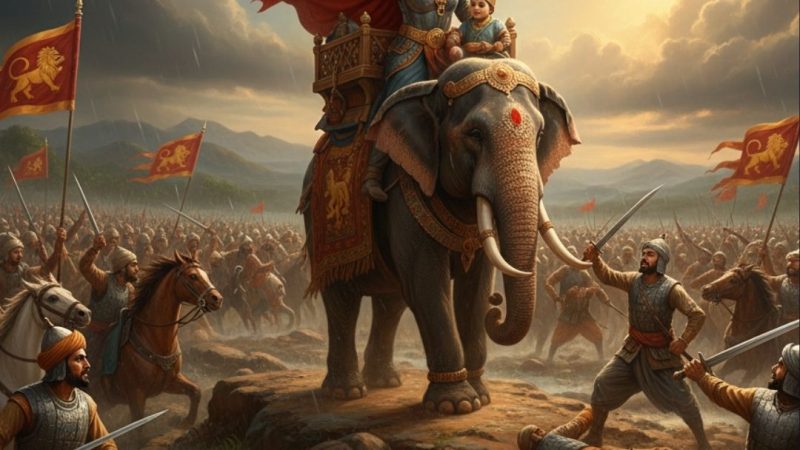
Ratan Singh knew the odds. The Mughals were a juggernaut, their numbers overwhelming. Yet, the fire of resistance burned bright. Raj Singh had already wrested Mewar’s lost territories from Mughal control, and now, with Aurangzeb’s forces closing in, he had divided his army into three: his son Jaisingh to guard the Aravali passes, Bhim Singh to block aid from Ajmer, and himself, alongside Akbar and Durgadas Rathore, to confront Aurangzeb head-on. The plan was audacious, and Ratan Singh’s role was critical—to delay the Mughal reinforcements from Delhi, buying time for Raj Singh’s victory.
With resolve hardening in his heart, Ratan Singh donned his saffron war robes and prepared to bid farewell to his bride. Hadi Rani, seeing him clad for battle, was struck with shock. “Swami, where are you going so soon?” she asked, her voice trembling. “Did you not say you had months of respite from war?” Ratan Singh smiled, though his heart was heavy. “Dear, a Kshatriya woman lives for the day her husband proves his valor. That moment has come. I must face the enemies of our land. Bid me farewell with a smile, for we may not meet again.” His words carried the weight of truth, yet his eyes betrayed a flicker of doubt—not for the battle, but for the wife he might leave behind.
Dear, a Kshatriya woman lives for the day her husband proves his valor. That moment has come. I must face the enemies of our land. Bid me farewell with a smile, for we may not meet again. – Ratan Singh
Hadi Rani, her heart a storm of love and duty, saw the conflict in her husband’s gaze. His voice, choked with emotion, revealed a man torn between his warrior’s oath and his love for her. She understood that a wavering heart could spell defeat on the battlefield. Steeling herself, she said, “Swami, wait a moment. I will return.” She hurried to her chamber, returning with an aarti thali, her hands steady as she applied a tilak on his forehead and performed the ritual. “I am blessed to be the wife of such a brave man,” she declared, her voice firm despite the tears she swallowed. “Go, Swami. I will await you with a victory garland.” Her words were a shield, protecting him from her own sorrow.
As Ratan Singh spurred his horse and rode toward war, Hadi Rani stood motionless, watching until he vanished into the horizon. Only then did the dam of her resolve break, and tears streamed down her face. Meanwhile, Ratan Singh, galloping with his army, could not shake the fear that his beloved might forget him. Halfway to the battlefield, he sent a trusted soldier with a message: “Do not forget me. I will return.” Hadi Rani reassured the messenger, but the next day, another came, bearing the same plea. On the third day, a letter arrived, written in her husband’s hand: “Dear, I fight the enemy here, holding them like Angad held Ravana’s court. Your strength shields me, but I miss you dearly. Send me a token of your love, something to ease my heart.”
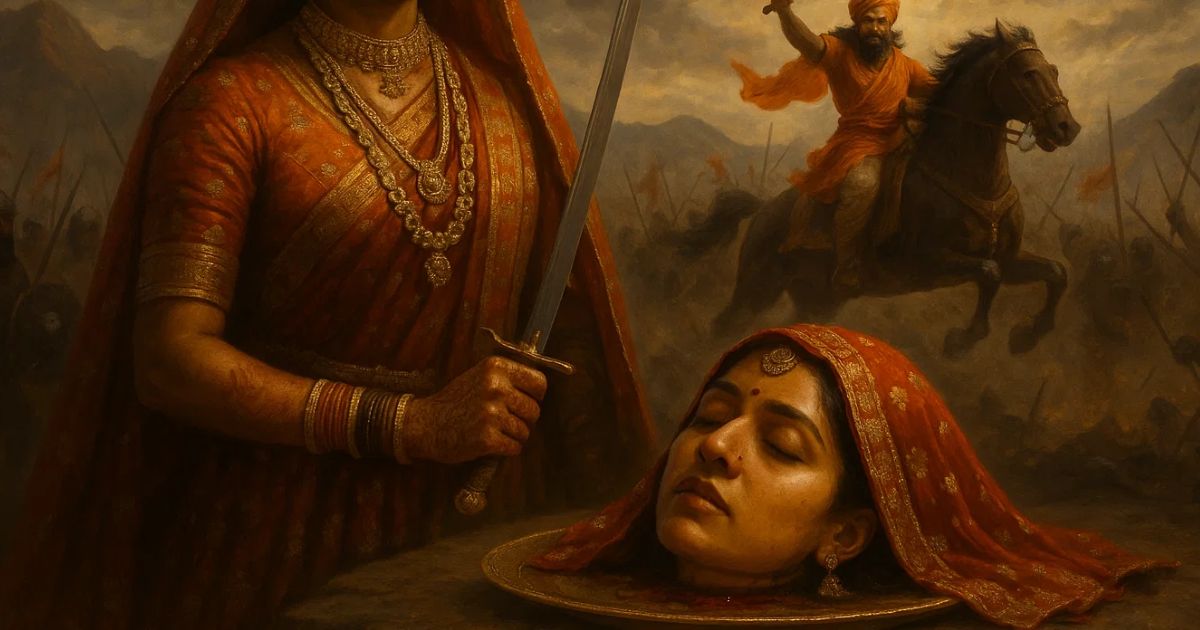
Hadi Rani read the letter, her heart sinking. Her husband’s mind, so vital to the battle, was tethered to her. If his thoughts lingered on her face, how could he wield his sword with the ferocity needed to triumph? A resolve, fierce and unbreakable, took root in her soul. She turned to the soldier. “Brave one, I give you my final token. Place it on a golden plate, cover it with my wedding dupatta, and deliver it to my husband. Let no one but him see it. And give him this letter.” In her note, she wrote: “Dear, I send you my last sign. I cut all bonds of attachment. Do your duty without worry. I will wait for you in heaven.” With a swift, unflinching motion, she drew the sword at her waist and severed her own head. It fell to the ground, a testament to her unyielding sacrifice.
Dear, I send you my last sign. I cut all bonds of attachment. Do your duty without worry. I will wait for you in heaven. – Hadi Rani
The soldier, tears streaming down his face, obeyed her command. He adorned her head on a golden plate, draped it with her dupatta, and raced to the battlefield. When Ratan Singh saw the soldier’s grief-stricken face, his heart froze. “Yadu Singh, have you brought the queen’s token?” he asked, his voice trembling. The soldier extended the plate, his hands shaking. Ratan Singh lifted the cloth, and his world shattered. “Oh, my queen,” he whispered, staring at her serene face. “What have you done? You punished my doubt with such a sacrifice. I am coming to you.” The sight of her head severed the last threads of his attachment to life. With a roar of anguish and fury, he charged into battle, his sword a whirlwind of vengeance. His bravery was unmatched, his small contingent holding Aurangzeb’s army at bay until the Mughal emperor fled, defeated.
The victory belonged to Mewar, to Raj Singh, to Ratan Singh’s valor. But at its heart was Hadi Rani, whose sacrifice ensured her husband’s mind was free to fight. Her head, a symbol of love and duty intertwined, became a legend—a beacon of what it means to place honor above all. Who truly won that day? Raj Singh, who led the charge? Ratan Singh, who fought to his last breath? Or Hadi Rani, whose ultimate act of love turned the tide of history? Her story, a flame that never fades, burns eternal in the heart of Rajasthan.