Vijayanagara Empire’s History Is the Epic You Were Never Taught

The Vijayanagara Empire (1336–1646 CE) stands as one of the most remarkable kingdoms in Indian history, a beacon of South Indian culture, resilience, and grandeur. Centered in the magnificent city of Vijayanagara (modern-day Hampi, Karnataka), this empire thrived for over three centuries, leaving an indelible mark on India’s political, cultural, and architectural landscape. Known for its resistance against northern invasions, its patronage of arts and literature, and its awe-inspiring monuments, the Vijayanagara Empire is a testament to South India’s enduring legacy. This exploration delves into the empire’s origins, rise to power, golden age, decline, and lasting influence, offering an authentic and detailed account for history enthusiasts, travelers, and scholars.
Table of Contents
Origins of the Vijayanagara Empire
The Vijayanagara Empire emerged in a period of turmoil in South India. By the early 14th century, the Delhi Sultanate, under rulers like Alauddin Khalji and Muhammad bin Tughluq, had launched repeated invasions into the Deccan and South India, disrupting established kingdoms like the Hoysalas, Kakatiyas, and Pandyas. The devastation wrought by these campaigns created a power vacuum, prompting the need for a unified Hindu resistance.
In 1336 CE, two brothers, Harihara I and Bukka Raya I, founded the Vijayanagara Empire under the spiritual guidance of the sage Vidyaranya, a prominent Advaita Vedanta scholar. Historical accounts suggest that Harihara and Bukka, possibly former officers of the Hoysala or Kakatiya kingdoms, were captured by the Delhi Sultanate and converted to Islam before being sent back to the south to serve as vassals. Inspired by Vidyaranya, they reconverted to Hinduism and established a new kingdom to restore Hindu sovereignty.
The empire’s capital, Vijayanagara, was strategically located on the banks of the Tungabhadra River, surrounded by natural fortifications of rocky hills and fertile plains. The choice of this site was influenced by its defensibility and proximity to trade routes connecting the Deccan with coastal ports. According to legend, Vidyaranya blessed the city’s foundation after witnessing a hare chasing a dog, interpreting it as a sign of invincibility. From these humble beginnings, Vijayanagara grew into one of the world’s most splendid cities, rivaling contemporary capitals like Beijing and Constantinople.

Early Expansion and Consolidation
The early rulers of Vijayanagara, belonging to the Sangama dynasty (1336–1485 CE), focused on consolidating power and expanding their territory. Harihara I (r. 1336–1356 CE) laid the foundation by annexing Hoysala territories and establishing control over parts of modern-day Karnataka. His brother, Bukka Raya I (r. 1356–1377 CE), extended the empire’s influence southward, clashing with the Madurai Sultanate and securing Tamil Nadu’s northern regions.
Bukka I also strengthened diplomatic ties with neighboring powers, including the Bahmani Sultanate, founded in 1347 CE as a rival in the Deccan. However, tensions between Vijayanagara and the Bahmani Sultanate soon escalated, leading to a series of wars over control of the Raichur Doab, a fertile region between the Tungabhadra and Krishna rivers. These conflicts defined much of the empire’s early military history, with both sides vying for dominance in the Deccan.
Under subsequent rulers like Harihara II (r. 1377–1404 CE) and Deva Raya I (r. 1406–1422 CE), Vijayanagara expanded its maritime influence, controlling key ports along the Malabar and Coromandel coasts. The empire’s navy facilitated trade with Southeast Asia, Persia, and East Africa, bringing immense wealth to the capital. Foreign travelers, such as the Italian Niccolò de’ Conti, who visited Vijayanagara in the 1420s, described a prosperous kingdom with a well-organized administration and a vibrant economy.

Administrative Structure and Society
The Vijayanagara Empire was governed by a centralized monarchy, with the king as the supreme authority, often revered as a divine figure. The empire was divided into provinces called rajyas or nadus, each administered by governors (nayakas) who enjoyed considerable autonomy but owed allegiance to the king. This decentralized system allowed efficient governance over a vast territory but later contributed to the empire’s fragmentation.
The Vijayanagara rulers maintained a sophisticated bureaucracy, with officials overseeing taxation, justice, and public works. Land revenue, based on a detailed assessment of agricultural productivity, was the primary source of income. The empire’s irrigation systems, including tanks, canals, and wells, supported intensive farming, ensuring food security and surplus for trade.
Society under Vijayanagara was hierarchical yet diverse. The Brahmins held high status as priests and scholars, while Kshatriyas dominated the military and administrative roles. Vaishyas engaged in trade and commerce, and Shudras formed the backbone of agriculture and artisanal work. Women enjoyed relative autonomy, with some, like Queen Alamelamma, wielding significant influence. The empire was a melting pot of religions, with Hinduism as the dominant faith, alongside Jainism, Islam, and Christianity, reflecting its cosmopolitan nature.
Vijayanagara’s capital was a vibrant cultural center, home to people from diverse regions and backgrounds. The city’s markets bustled with merchants trading spices, textiles, horses, and precious stones, including diamonds from the Golconda mines. Portuguese traveler Domingo Paes, visiting in the 1520s, marveled at Hampi’s grandeur, describing its wide streets, ornate palaces, and towering temples.
The Golden Age: Krishna Deva Raya’s Reign
The Vijayanagara Empire reached its zenith under Krishna Deva Raya (r. 1509–1529 CE), a ruler whose military genius, administrative reforms, and cultural patronage earned him the title Andhra Bhoja (King of Andhra). His reign marked the empire’s greatest territorial expansion and cultural flourishing, cementing Vijayanagara’s status as a global power.
Krishna Deva Raya launched successful campaigns against the Deccan Sultanates, capturing the Raichur Doab in 1512 CE after a decisive victory over the Adil Shahi dynasty of Bijapur. He also subdued the Gajapati rulers of Odisha, extending Vijayanagara’s influence to the eastern coast. These conquests brought immense wealth, enabling grand construction projects and patronage of the arts.
As a scholar-king, Krishna Deva Raya composed Amuktamalyada, a Telugu epic poem blending devotion and statecraft, which remains a literary masterpiece. His court, known as the Ashtadiggajas (eight literary giants), included luminaries like Allasani Peddana and Tenali Ramakrishna, whose works enriched Telugu and Kannada literature. The king’s patronage extended to Sanskrit, Tamil, and Persian, reflecting the empire’s linguistic diversity.
Krishna Deva Raya’s architectural contributions transformed Hampi into a city of unparalleled splendor. He commissioned the construction of the Hazara Rama Temple, dedicated to Lord Rama, and expanded the Vittala Temple, famous for its musical pillars and iconic stone chariot. The empire’s aqueducts, granaries, and fortifications showcased advanced engineering, supporting a population estimated at 500,000.
Foreign relations flourished under Krishna Deva Raya, with Portuguese traders establishing a presence in coastal ports like Goa and Bhatkal. The king’s alliance with the Portuguese secured a steady supply of warhorses, strengthening Vijayanagara’s cavalry. Persian envoy Abdur Razzak, visiting in the 1440s, described the empire as a land of “unimaginable wealth and power,” a sentiment echoed by later travelers.
Cultural and Architectural Achievements
The Vijayanagara Empire’s cultural and architectural legacy is among its most enduring contributions. Hampi, the capital, was a showcase of Dravidian architecture, blending functionality with aesthetic brilliance. Temples like the Virupaksha, Vittala, and Achyutaraya temples featured towering gopurams (gateway towers), intricate carvings, and expansive courtyards. The Lotus Mahal, a fusion of Hindu and Islamic architectural styles, reflected the empire’s syncretic culture.
Vijayanagara’s architects mastered urban planning, designing Hampi with distinct zones for royal residences, temples, markets, and military quarters. The city’s water management system, with canals and tanks fed by the Tungabhadra, supported agriculture and civic needs. The empire’s stone inscriptions, found across South India, provide valuable insights into its administration, economy, and religious practices.
Art flourished under Vijayanagara’s patronage, with painting, sculpture, and music reaching new heights. Temple walls were adorned with murals depicting mythological scenes, while bronze sculptures of deities showcased exquisite craftsmanship. The empire’s festivals, such as Mahanavami (celebrated during Dasara), featured grand processions, music, and dance, drawing participants from across the region.
Literature thrived in multiple languages, with Vijayanagara rulers supporting works in Telugu, Kannada, Tamil, and Sanskrit. The Rayavachakamu, a historical text, and Manucharitramu, a poetic narrative, highlight the empire’s literary richness. The empire also preserved ancient texts, with its scholars compiling commentaries on the Vedas and Puranas.
Decline and the Battle of Talikota
The Vijayanagara Empire’s decline began after Krishna Deva Raya’s death in 1529 CE. His successors, including Achyuta Deva Raya and Sadasiva Raya, faced internal strife and external threats. The nayakas, who governed provinces, grew increasingly autonomous, weakening central authority. Meanwhile, the Deccan Sultanates—Bijapur, Golconda, Ahmadnagar, and Bidar—formed a coalition to counter Vijayanagara’s dominance.
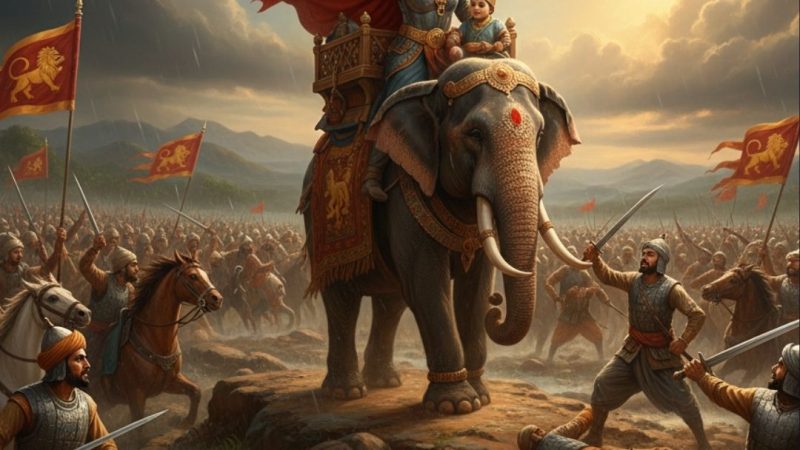
The turning point came in 1565 CE with the Battle of Talikota (also known as the Battle of Rakkasa-Tangadi). Under the regent Rama Raya, Vijayanagara’s forces faced the combined armies of the Deccan Sultanates. Despite initial successes, betrayal by two of Rama Raya’s Muslim generals led to a catastrophic defeat. Rama Raya was captured and beheaded, and Hampi was sacked for six months, its temples, palaces, and markets reduced to ruins.
The sacking of Hampi marked the end of Vijayanagara’s golden era. The capital was abandoned, and the empire fragmented into smaller principalities under local nayakas. Later rulers, such as those of the Aravidu dynasty, attempted to revive the empire from Penukonda and Chandragiri, but it never regained its former glory. By the mid-17th century, Vijayanagara had faded into obscurity, with its territories absorbed by the Mughals, Marathas, and regional powers.
The Role of Queen Alamelamma
A notable postscript to Vijayanagara’s history involves Queen Alamelamma, whose story is tied to the empire’s twilight years. Alamelamma was the wife of Tirumala Raya, a viceroy of Srirangapatna under the Aravidu dynasty. In 1610 CE, Raja Wodeyar I of Mysore seized Srirangapatna, forcing Alamelamma to flee to Talakadu with her husband’s treasures, including sacred jewelry dedicated to Goddess Ranganayaki.
When Wodeyar’s soldiers pursued her, Alamelamma, standing on the banks of the Cauvery River at Malangi in 1612 CE, uttered a legendary curse: “May Talakadu turn into sand, Malangi become a whirlpool, and the Wodeyars never have heirs.” She then leapt into the river, sacrificing her life. The curse’s effects are striking: Talakadu is buried under sand dunes, Malangi is known for its whirlpools, and the Wodeyar dynasty has faced a pattern of heirlessness, with many rulers adopting successors. Alamelamma’s idol is worshipped in the Mysore Palace during Dasara, a testament to her enduring legacy.

Vijayanagara’s Lasting Legacy
The Vijayanagara Empire’s influence extends far beyond its historical lifespan. It preserved Hindu culture and traditions during a period of external aggression, serving as a cultural bridge between ancient and modern South India. Its architectural innovations, such as the Dravidian temple style, influenced later kingdoms like the Nayakas of Madurai and the Wodeyars of Mysore.
Hampi, now a UNESCO World Heritage Site, attracts millions of visitors annually, offering a glimpse into Vijayanagara’s grandeur. The site’s ruins, including the Vittala Temple’s stone chariot, the Virupaksha Temple’s soaring gopuram, and the royal enclosures, evoke the empire’s opulence. Archaeological excavations continue to uncover artifacts, shedding light on its urban sophistication.
The empire’s contributions to literature, music, and dance remain integral to Karnataka’s cultural identity. Telugu and Kannada literature flourished under its patronage, while its temple dance traditions evolved into modern forms like Bharatanatyam. The Mahanavami festival, celebrated as Dasara in Mysore, traces its origins to Vijayanagara’s royal rituals.
Economically, Vijayanagara’s trade networks laid the foundation for South India’s integration into global commerce. Its irrigation systems and agricultural practices influenced regional development, with many tanks and canals still in use today.
Exploring Vijayanagara’s Legacy Today
For travelers and history enthusiasts, Hampi is a treasure trove of heritage. Located 350 km from Bengaluru, the site is easily accessible by road or rail. Key attractions include:
- Virupaksha Temple: A functioning temple dedicated to Lord Shiva, known for its 50-meter gopuram.
- Vittala Temple: Famous for its musical pillars and stone chariot, a marvel of Vijayanagara engineering.
- Hazara Rama Temple: Adorned with carvings depicting the Ramayana, reflecting the empire’s devotion to Lord Rama.
- Lotus Mahal: A blend of Hindu and Islamic architecture, showcasing Vijayanagara’s syncretic style.
- Hampi Bazaar: A restored market street offering insights into the city’s commercial vibrancy.
The Hampi Utsav, held annually in November, recreates Vijayanagara’s cultural splendor with music, dance, and processions. Visitors can also explore nearby sites like Talakadu and Srirangapatna, linked to the empire’s later history and Queen Alamelamma’s curse.
For scholars, Hampi’s inscriptions, manuscripts, and archaeological remains provide a wealth of research material. Institutions like the Archaeological Survey of India and Karnataka’s Department of Archaeology continue to study Vijayanagara’s contributions, ensuring its history is preserved for future generations.
Conclusion
The Vijayanagara Empire, with its blend of military might, cultural richness, and architectural brilliance, remains a cornerstone of South Indian history. From its founding by Harihara and Bukka to its golden age under Krishna Deva Raya, it shaped the region’s destiny, preserving Hindu traditions amidst turbulent times. The tragic Battle of Talikota and the poignant story of Queen Alamelamma add layers of drama to its narrative, while Hampi’s ruins stand as a silent witness to its glory.
Today, Vijayanagara’s legacy lives on in Karnataka’s temples, festivals, and literature, inviting travelers and scholars to explore its timeless heritage. Whether you’re wandering through Hampi’s boulder-strewn landscape or marveling at its intricately carved temples, the Vijayanagara Empire offers a journey into one of India’s most magnificent eras. Plan a visit to Hampi, delve into its history, and discover the enduring spirit of a kingdom that once shone as the “City of Victory.”