These Hidden Villages Feel Like Stepping Into Another Century
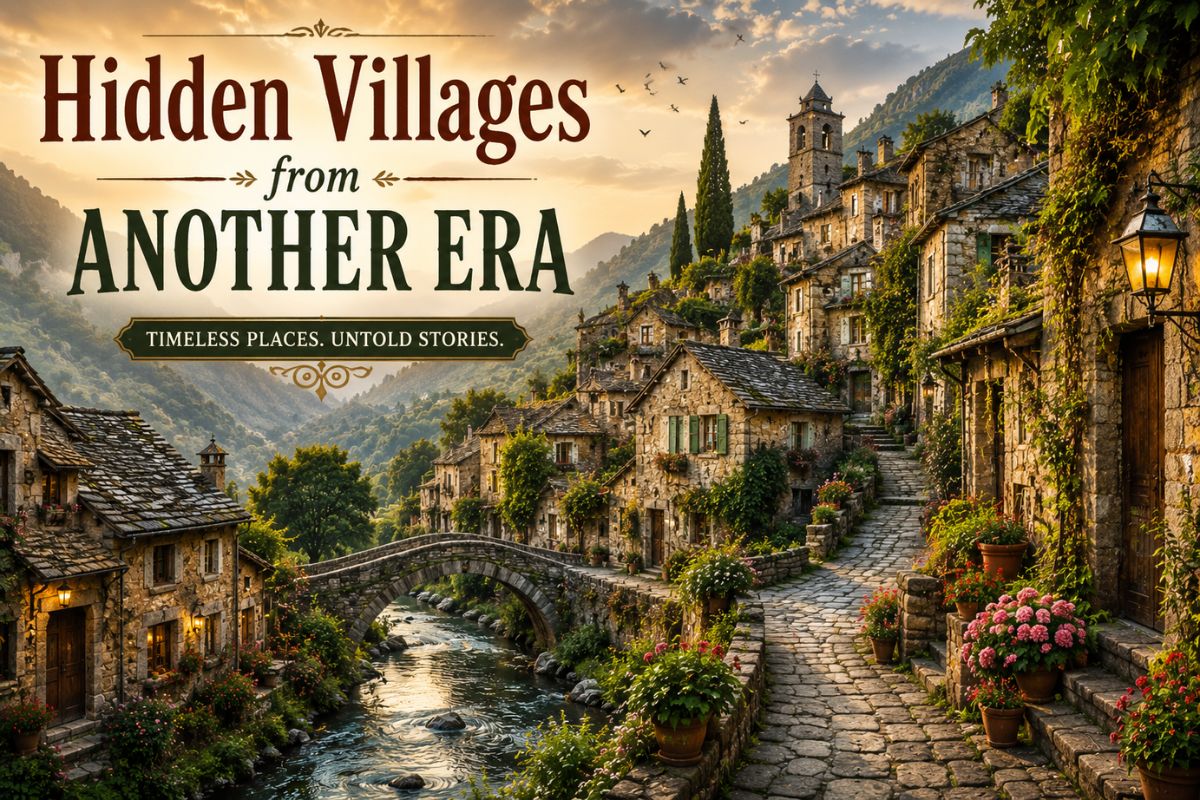
Places Time Forgot
Most travel content chases what’s new. This list does the opposite. Scattered across four continents are villages where the streets, the architecture, and even the daily rhythms of life have barely shifted in decades — sometimes centuries. Some are frozen in time by geography, cut off by mountains, water, or the simple absence of roads. Others survive because their traditions were too valuable, too sacred, or too structurally clever to abandon.
If you’ve ever wanted to feel what it’s like to physically walk into another century, these are the places that deliver — no filter required. For more on how travel can be as grounding as it is beautiful, see our related piece on the mystical Himalayan temples hidden above the clouds.
1. Shirakawa-go, Japan — The Village Built Like Praying Hands

🏡 Shirakawa-go
Tucked away in Japan’s Gifu Prefecture, Shirakawa-go is a UNESCO World Heritage village renowned for its traditional gassho-zukuri farmhouses. With their steep thatched roofs built to withstand heavy snowfall, these centuries-old homes showcase one of Japan’s most distinctive rural landscapes.
Image: Wikimedia Commons (licensed under the applicable Wikimedia Commons license).
Tucked into the mountains of Gifu Prefecture, Shirakawa-go is a living museum of gassho-zukuri farmhouses — steep, thatched-roof homes built without a single nail, engineered centuries ago to shed the region’s brutal snowfall. The style gets its name from the roof’s resemblance to hands folded in prayer, with a slope steep enough to shed snowfall of up to four meters, and the village’s cluster of 59 such houses is considered one of Japan’s finest surviving examples of traditional rural architecture. Long isolated by the surrounding mountains, the community developed its own self-sufficient culture, including a cooperative labor system called “yui” used for maintaining the massive roofs. Shirakawa-go, together with the neighboring Gokayama villages, was named a UNESCO World Heritage Site in 1995.
Feel factor: Snow-covered rooftops, wood smoke, rice paddies, and farmhouses that have sheltered the same families for generations.
2. Civita di Bagnoregio, Italy — “The City That Is Dying”

🏰 Civita di Bagnoregio
Perched atop a fragile volcanic plateau in central Italy, Civita di Bagnoregio is a beautifully preserved medieval hill town often called “The Dying City.” Accessible only by a pedestrian bridge, it enchants visitors with its stone alleys, flower-filled piazzas, and spectacular views over the surrounding valleys.
Image: Wikimedia Commons (licensed under the applicable Wikimedia Commons license).
Perched on a crumbling volcanic outcrop in Lazio and reachable only by a footbridge, Civita di Bagnoregio has earned the nickname La città che muore — “the dying town.” Founded by the Etruscans roughly 2,500 years ago, the town today has only around a dozen permanent residents, even as the surrounding cliffs continue to erode into the valley below. Perched above the Tiber River valley, the town feels as though it exists in another realm entirely — frozen in time, with history persisting in every corner. Walking its stone alleys, past ivy-draped courtyards and Renaissance doorways, feels less like sightseeing and more like time travel.
Feel factor: Medieval stonework, near-silence, and the eerie sense that the town could vanish within your lifetime.
3. Kandovan, Iran — The Only Inhabited Cliff Village on Earth

🏡 Kandovan Village
Nestled in northwestern Iran, Kandovan is one of the world’s few inhabited rock villages. Residents continue to live in centuries-old cone-shaped volcanic rock dwellings carved into the mountainside, making it a remarkable blend of natural geology and human ingenuity.
Image: Wikimedia Commons (licensed under the applicable Wikimedia Commons license).
In northwest Iran, roughly an hour from Tabriz, the village of Kandovan looks like a cluster of giant beehives carved into volcanic rock. Still occupied by around 117 families, it’s considered the only fully inhabited cliff village of its kind anywhere in the world, with homes hollowed directly out of cone-shaped volcanic formations. Kandovan is often grouped with Cappadocia in Turkey and the Manitou cave dwellings in the United States as one of only three rock-carved settlements on Earth — but it’s the only one still fully lived in. Residents have modernized the interiors with plumbing and electricity, but the thick stone walls still keep homes naturally cool in summer and warm in winter, just as they have for centuries.
Feel factor: Cone-shaped rock houses, narrow carved staircases, and a genuine sense of “how is anyone still living here?”
4. Mawlynnong, Meghalaya, India — Grown, Not Built

💙 Dawki River
Flowing along the India–Bangladesh border in Meghalaya, the Dawki (Umngot) River is famous for its astonishingly clear water, especially during winter when boats appear to float on air. Surrounded by lush hills, it has become one of Northeast India’s most photographed natural attractions.
Image: Madhumita Das / Wikimedia Commons (CC BY-SA 4.0).
In the East Khasi Hills of Meghalaya, the Khasi people have spent generations engineering something no other culture has quite replicated: bridges grown from living tree roots. Long before modern construction materials were available, the Khasi devised a way to cross turbulent waterways using living root bridges, locally known as jing kieng jri. For over five centuries, Khasi communities have guided the roots of rubber fig trees through hollow betel nut trunks, allowing them to grow, strengthen, and interweave over 15 to 20 years into structures sturdy enough to hold dozens of people at once. The nearby village of Mawlynnong itself has been recognized as one of the cleanest villages in Asia, run on a community-first ethic that predates any modern sustainability movement.
Feel factor: Living architecture, misty valleys, and a community that has quietly practiced ecological engineering for 500 years.
Related on Real Shee Power: Devbhoomi’s Hidden Heartbeat: The Offbeat Temple Villages of Uttarakhand
5. Giethoorn, Netherlands — The Village With No Roads

🚣 Giethoorn
Often called the “Dutch Venice”, Giethoorn is a picturesque village in the Netherlands where canals replace roads and boats are the primary mode of transport. Its charming thatched-roof cottages, wooden bridges, and peaceful waterways make it one of Europe’s most enchanting destinations.
Image: Wikimedia Commons (licensed under the applicable Wikimedia Commons license).
In the Dutch province of Overijssel, Giethoorn has no roads through its historic center — just canals, footbridges, and quiet electric “whisper boats.” Locals and visitors navigate entirely by bike, boat, or foot, and the village’s peat-cutting origins in the 13th century shaped the maze of waterways that still defines it today. The name traces back to large quantities of goat horns found buried in the marshland, believed to be remnants of wild goats drowned in a 12th-century flood — “Geytenhoren,” shortened over time to Giethoorn. The result is a village that looks unmistakably medieval, despite being just a couple of hours from Amsterdam.
Feel factor: Thatched farmhouses reflected in still canals, near-total silence, and not a single car in sight.
6. Ollantaytambo, Peru — The Last Living Inca Town

🏔️ Ollantaytambo
Nestled in Peru’s Sacred Valley, Ollantaytambo is one of the best-preserved living Inca towns. Known for its massive stone terraces, ancient fortress, and narrow cobbled streets that still follow their original Inca layout, it serves as both a historical treasure and the gateway to Machu Picchu.
Image: Wikimedia Commons (licensed under the applicable Wikimedia Commons license).
Most Inca sites in Peru are ruins. Ollantaytambo is not. Known as the “Living Inca Town,” it remains continuously inhabited since Inca times, with its streets, houses, and water canals still following the original Inca urban design. Locals still live in kanchas — traditional courtyard blocks — laid out under the 15th-century emperor Pachacuti, and the stone-lined canals that once served as the town’s water system still function as drainage today. Unlike Machu Picchu, which was abandoned and later rediscovered, Ollantaytambo simply never stopped being lived in.
Feel factor: Original Inca stonework, working irrigation channels older than the Spanish conquest, and daily life unfolding on 500-year-old streets.
7. Saksun, Faroe Islands — A Village at the Edge of the World

🌿 Saksun
Tucked away on the island of Streymoy, Saksun is one of the Faroe Islands’ most picturesque villages. Surrounded by dramatic mountains, cascading waterfalls, and a tranquil tidal lagoon, its traditional grass-roofed houses and untouched landscapes create a scene that feels almost frozen in time.
Image: Wikimedia Commons (licensed under the applicable Wikimedia Commons license).
On the island of Streymoy, Saksun sits inside what was once a natural harbor — until a storm in the 1600s sealed it with sand and turned it into a tidal lagoon. Saksun’s history dates back to at least 1400, and in 1602 a severe storm blocked the harbor with sand, transforming it into the lagoon that defines the village today, accessible only by small boats at high tide. Today the village has only around 14 residents, alongside grazing sheep, turf-roofed houses, and a picturesque church built in 1858. The turf-roof building tradition itself dates back to the Vikings and remains very much alive across the Faroe archipelago today.
Feel factor: Grass-covered rooftops, sheer cliffs, and a lagoon that only reveals its beach at low tide.
Related on Real Shee Power: The Faroe Islands Are Not On Most Bucket Lists Yet, and That Is Exactly the Point
8. Hallstatt, Austria — Europe’s Oldest Still-Inhabited Village

🏔️ Hallstatt
Nestled between the Hallstätter See and the Austrian Alps, Hallstatt is one of Europe’s most picturesque villages. Known for its colorful lakeside houses, centuries-old salt mining heritage, and breathtaking mountain scenery, it has become an iconic destination celebrated for both its natural beauty and rich history.
Image: Wikimedia Commons (licensed under the applicable Wikimedia Commons license).
Wedged between the Dachstein Alps and a glassy alpine lake, Hallstatt has been continuously inhabited for thousands of years. A village of fewer than 800 residents, it carries outsized cultural significance — archaeological finds here were so important they gave their name to an entire era of European civilization, the Hallstatt culture of 800–400 BC. Its salt mines have been worked for over 7,000 years, among the oldest documented mining operations anywhere on Earth. Pastel houses still cascade down the same hillside they always have, and the salt trade that built the town’s wealth in the Bronze Age is still, remarkably, in operation.
Feel factor: Postcard alpine houses, working salt mines older than the pyramids, and a lake that mirrors the entire village.
Why These Villages Still Exist Today
A few patterns show up again and again across these places:
Geographic isolation preserved them. Mountains, cliffs, water, and remoteness kept modernization at arm’s length for centuries.
Necessity shaped the architecture. Steep thatched roofs, cave homes, and turf insulation weren’t aesthetic choices — they solved real climate and survival problems, and that’s exactly why they’ve endured.
Communities chose continuity. In places like Ollantaytambo and Kandovan, residents never left. The “living history” label isn’t a marketing gimmick; people simply kept living the way their ancestors did.
Recognition came later, not first. Most of these villages earned UNESCO status or “cleanest village” titles decades or centuries after the traditions that made them special were already in place.
Frequently Asked Questions
What makes a village feel “frozen in time”? Usually a combination of geographic isolation, architecture built for necessity rather than trend, and a resident population that has kept traditional building methods and daily routines intact rather than replacing them with modern equivalents.
Are these hidden villages safe and easy to visit? Most are well-established, safe tourist destinations with basic infrastructure — Shirakawa-go, Hallstatt, Giethoorn, and Ollantaytambo in particular are set up for regular visitors. Kandovan and Saksun are more remote and are best visited with some travel planning or a local guide.
Which of these villages is least crowded? Saksun and Kandovan see far fewer visitors than Hallstatt or Shirakawa-go, both of which have become increasingly popular stops on well-trodden tourist routes in recent years.
Can I still see locals actually living in these places, or are they just tourist attractions? Yes, all eight are genuinely inhabited communities, not open-air museums. Ollantaytambo and Kandovan in particular are known specifically for residents still living in centuries-old original structures as their permanent homes.
You Might Also Like on RealShePower
- Mystical Himalayan Temples Hidden Above the Clouds: The Sacred Geography Every Empowered Woman Must Know
- The Faroe Islands Are Not On Most Bucket Lists Yet, and That Is Exactly the Point
- Is Spiti Valley India’s Last Real Escape From Everything?
- Devbhoomi’s Hidden Heartbeat: The Offbeat Temple Villages of Uttarakhand
- The 10 Safest Places on Earth for a Woman to Travel Completely Alone in 2026
- Browse more under Cultural Travel and Travel Guide