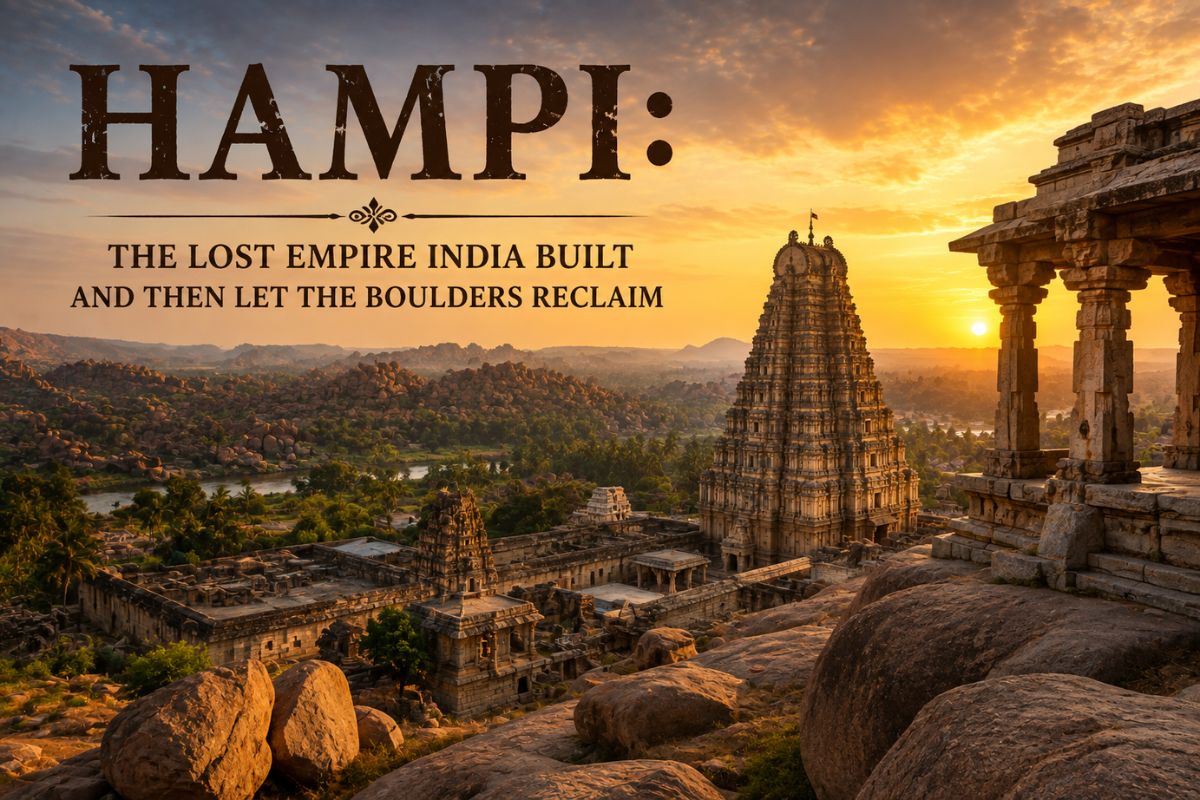
Hampi: The Lost Empire India Built and Then Let the Boulders Reclaim
Quick Summary
Hampi was once one of the richest cities on earth, larger than medieval Rome. Today its ruins sit scattered across a surreal boulder landscape, UNESCO-listed but still remarkably uncrowded. Here is everything you need to plan the trip.
- Best time to go: October through February
- Where to stay: Hampi Bazaar for immersion, Hospet for comfort
- What to do: temple ruins, boulder sunsets, and a river coracle ride
- What to eat: Karnataka thali and Hampi Bazaar’s traveler cafes
- A realistic 4-day itinerary and a note on Hampi’s unusual alcohol rules
In the early 16th century, a Portuguese traveler named Domingo Paes walked through a city on the banks of the Tungabhadra River and wrote that it was as large as Rome, and as beautiful to behold. That city was Vijayanagara, capital of one of the largest and wealthiest empires in Indian history, a trading hub so prosperous that diamonds were reportedly sold in the open street markets by the handful. Today, that same site, now called Hampi, sits scattered across roughly 26 square kilometers of surreal granite boulder landscape in northern Karnataka, its temples and palaces in various states of ruin, its UNESCO World Heritage status secured, and its tourist numbers still, remarkably, a fraction of what a site this significant would draw almost anywhere else in the world.
This guide covers how that empire rose and fell, exactly what’s worth seeing across a landscape large enough to genuinely overwhelm an unplanned visit, and how to structure a trip that does the place justice.
The Empire Behind the Ruins
Vijayanagara was founded in the 14th century and grew, over roughly two centuries, into the capital of an empire that at its peak controlled most of South India, built on a combination of military strength, sophisticated irrigation engineering, and control over lucrative trade routes moving spices, textiles, and precious stones between the Indian interior and international ports. The empire’s rulers poured enormous wealth into building projects, hundreds of temples, palaces, market streets, and elaborate stepped water tanks, much of it carved directly into or around the massive granite boulders that define the region’s landscape, a natural feature the empire’s architects worked with rather than against.
The empire’s fall was as dramatic as its rise. In 1565, a coalition of neighboring Deccan sultanates decisively defeated Vijayanagara’s forces at the Battle of Talikota, and in the aftermath, the victorious armies sacked the capital over several months, destroying temples, palaces, and markets in a campaign of destruction severe enough that the city was essentially abandoned within a generation. What remains today is what survived that sacking, plus roughly 450 years of subsequent weathering, a landscape of genuinely staggering scale, more than 1,600 surviving structures spread across the site, most of which see only a trickle of the visitors a comparable UNESCO site elsewhere in the world would receive.
Why Hampi Stays Underrated

Part of the reason is sheer scale, which paradoxically works against Hampi in tourist awareness. Unlike a single palace or fort that can be photographed and marketed as one iconic image, Hampi’s ruins are spread across a landscape so large that no single photograph captures it, making it a harder site to package into the kind of instantly recognizable image that drives mainstream tourist interest.
Part of the reason is location. Hampi sits in a less-traveled corner of northern Karnataka, requiring a specific, deliberate trip rather than sitting along an established tourist circuit the way Rajasthan’s forts or Kerala’s backwaters do. And part of the reason is simply that India has an enormous number of genuinely significant heritage sites competing for the same limited tourist attention, and Hampi, despite its scale and significance, has never quite broken through to the same recognition as the Taj Mahal or Rajasthan’s palace circuit.
That combination, genuine UNESCO-level significance and comparatively low visitor numbers, is Hampi’s core appeal for travelers willing to make the trip. You can, on most days outside major Indian holidays, walk through structures as significant as anything in Rajasthan and have long stretches of the ruins largely to yourself.
When to Go
October through February is the clear best window, with daytime temperatures sitting in a comfortable range for the extensive walking and boulder-climbing that a proper Hampi visit involves, since the region gets genuinely brutal, well past 40 degrees Celsius, during peak summer months from March through May.
December and January specifically offer the most comfortable evening temperatures for the sunset boulder-climbing that’s become one of Hampi’s signature experiences, cool enough to sit out watching the light change over the ruins without the discomfort that creeps into even October and November evenings.
The Hampi Utsav, a multi-day cultural festival typically held in the winter months featuring classical dance, music, and light shows staged directly among the ruins, is worth timing a visit around if the dates align, though it does bring a noticeable, if still modest by Indian tourism standards, increase in visitor numbers.
Getting There and Getting Around
The nearest airport with meaningful connectivity is Hubli, roughly three hours away, with a smaller, more limited airport at Ballari (Bellary) closer still for travelers whose flight options align. Most visitors, however, arrive by train into Hospet Junction, roughly 13 kilometers from Hampi itself, with reasonably well-connected overnight trains from Bangalore, Goa, and Hyderabad that let travelers arrive rested rather than after a long day of flight connections and road transfers.

Once in the region, Hampi itself is best explored on foot or by rented bicycle for the compact core sites around Hampi Bazaar, with an auto-rickshaw or hired car necessary for reaching the more spread-out sites like the Royal Enclosure and Vittala Temple complex, both several kilometers from the central bazaar. Crossing the Tungabhadra River, which splits Hampi’s ruins into two distinct zones, the temple-dense southern bank and the quieter, more laid-back Hampi Island on the northern bank, is done via a small motorized coracle ferry, a genuinely charming, low-cost crossing that’s worth experiencing even without a specific reason to cross.
Where to Stay: Two Very Different Experiences
Hampi Bazaar, the village directly adjacent to the main temple complex, offers the most immersive experience, a cluster of small guesthouses and traveler cafes built up over decades around the ruins themselves, walking distance from the Virupaksha Temple and several other major sites. This is the right choice for travelers prioritizing atmosphere and proximity over polish, since accommodation here tends toward simple, clean guesthouses rather than genuine luxury.
Hampi Island, across the river via coracle, offers a quieter, more laid-back version of the same immersive experience, popular with longer-staying travelers and known for a handful of well-regarded guesthouses with rice paddy and boulder views, along with a noticeably more relaxed pace than the bazaar side.
Hospet, the nearest town roughly 13 kilometers away, offers Hampi’s most comfortable accommodation options, including a small number of proper resort-style properties, at the cost of a daily commute into the ruins themselves. This is the right choice for travelers prioritizing comfort, particularly those visiting during the hotter shoulder months when air conditioning matters more.
For most first-time visitors, splitting a stay, a night or two in Hampi Bazaar for immersion and proximity to the main sites, followed by a night in Hospet or on Hampi Island for a change of pace, offers the fullest picture of what the region has to offer.
What to Actually Do
Explore the Vittala Temple Complex. Home to Hampi’s single most photographed structure, the ornate stone chariot carved from a single block of granite, and the famous musical pillars that produce different musical notes when struck, though authorities now restrict physical tapping to preserve the structure. The complex’s scale and detail, ornately carved pillared halls stretching across a wide courtyard, represent Vijayanagara architecture at its most ambitious.
Visit the Virupaksha Temple. Unlike most of Hampi’s ruins, this temple remains an active place of worship, continuously functioning since well before the empire’s fall, and offers a striking contrast, a living religious site standing directly amid the surrounding ruins of a civilization that otherwise ended centuries ago.
Climb Matanga Hill for sunset. This has become Hampi’s signature evening ritual, a moderate climb up granite boulders rewarded with a panoramic view over the entire ruined city as the light turns the boulder landscape gold and then deep orange. Arriving with enough daylight to descend safely afterward matters, since the trail has no lighting and the boulders become genuinely difficult to navigate after dark.
Explore the Royal Enclosure and Lotus Mahal. This section of the ruins, several kilometers from the main bazaar and requiring a rickshaw or bicycle to reach comfortably, holds the remains of the empire’s royal palace complex, including the elegant, symmetrical Lotus Mahal and the striking, elephant-scaled Elephant Stables, both offering a different architectural character from the temple-focused sites closer to the bazaar.
Take a coracle ride on the Tungabhadra River. Beyond the practical river crossing, a dedicated coracle ride, ideally near sunset, offers a genuinely peaceful, low-cost way to see the boulder landscape and riverside ruins from the water, a pace and perspective the walking-focused main sites don’t offer.
Cycle through Hampi Island’s rice paddies. The quieter northern bank of the river, away from the dense concentration of major ruins, offers gentle cycling routes through rice paddies framed by the same dramatic boulder formations, a good half-day activity for travelers wanting a slower, less monument-focused stretch of the trip.
The lesser-known secrets of Hampi, India
What to Eat
Hampi’s food scene reflects its dual identity, a small pilgrimage and heritage town with genuine Karnataka home cooking, layered with decades of backpacker cafe culture built up around Hampi Bazaar specifically.
A traditional Karnataka thali, found at local eateries around Hospet and the outskirts of Hampi Bazaar, offers the region’s genuine home cooking, typically featuring ragi mudde, a millet-based staple, alongside a rotating selection of vegetable curries, sambar, and rice, worth seeking out specifically for travelers wanting food beyond the traveler-cafe circuit.
Hampi Bazaar’s traveler cafes, a distinct fixture of the area for decades, serve a mix of international backpacker staples, banana pancakes, hummus plates, fresh juices, alongside Indian dishes, and remain worth a meal or two, both for the food itself and for the genuinely international, long-stay traveler community that congregates in them, a distinct social atmosphere found in relatively few other Indian destinations.
Fresh local bananas, grown throughout the surrounding region and sold at stalls around Hampi Bazaar, are a genuinely notable local specialty, sweeter and more distinctly flavored than the standard variety found across most of India.
A specific practical note worth flagging here: Hampi, as a site of significant religious importance, has historically restricted alcohol sales within the core heritage zone, and while this has loosened somewhat in recent years at certain establishments, travelers expecting readily available alcohol throughout their stay should check current specifics with their accommodation rather than assuming it matches typical Indian tourist-town norms.
A Suggested Four-Day Itinerary
Day one starts with arrival via Hospet and a settle-in afternoon in Hampi Bazaar, exploring the Virupaksha Temple and the surrounding bazaar street before an evening sunset climb up Matanga Hill.
Day two is dedicated to the Vittala Temple complex in the morning, when the light and temperature are both more forgiving, followed by an afternoon exploring the Royal Enclosure and Lotus Mahal, both requiring a rickshaw or bicycle for the distances involved.
Day three moves across the river via coracle to Hampi Island, spending the day cycling through the quieter rice paddy landscape, visiting the smaller boulder-set temples on that side, and returning for a sunset coracle ride back across the river.
Day four closes with a slower morning, any remaining sites or return visits to favorite spots from earlier in the trip, and departure via Hospet.
This pacing spreads the walking-intensive main sites across the first two days, when energy levels are highest, while saving the more relaxed island exploration for the third day, a natural rhythm most travelers find easier to sustain across the visit.
Budgeting the Trip
Budget-conscious travelers can expect to spend roughly ₹1,500 to ₹3,000 per night for a comfortable guesthouse in Hampi Bazaar or on Hampi Island, with train fares from major cities like Bangalore or Hyderabad typically running ₹500 to ₹1,500 each way depending on class.
Comfort-focused travelers opting for Hospet’s better resort properties should budget closer to ₹5,000 to ₹9,000 per night, still notably affordable relative to the site’s UNESCO-level significance, a gap that reflects Hampi’s continued lack of mainstream tourist recognition rather than any shortfall in what it offers.
Either way, Hampi remains one of the more genuinely affordable heritage destinations in India relative to its historical and architectural significance.
Practical Tips
Sun protection matters more in Hampi than most Indian heritage sites, given how much of the exploration happens across open, shadeless boulder terrain with minimal tree cover, so a hat, sunscreen, and more water than feels necessary are worth carrying on every full day of sightseeing. Proper closed-toe walking shoes with real grip matter specifically for the boulder-climbing involved in reaching Matanga Hill and several of the more scattered ruin sites, since the granite surfaces, while generally stable, can be genuinely slippery in areas with loose gravel or morning dew. A local guide, easily arranged through most guesthouses, is worth the modest cost for at least one day, since Hampi’s scattered layout and limited on-site signage mean a huge amount of historical and architectural context is easy to miss without one. And because Hampi sits within a protected UNESCO site, respecting posted restrictions around climbing on certain structures and not removing or disturbing any stone fragments, tempting as some scattered carved pieces might look, matters both legally and for the preservation of a site that’s already survived one deliberate destruction.
How Hampi Compares to India’s Other Great Ruins
The comparison worth making is against Rajasthan’s forts and palaces, since both represent grand Indian architectural history at genuine scale. Rajasthan’s forts were built to be lived in and defended, with a continuity of use, many remain at least partially inhabited or actively maintained today, that gives them a polished, well-preserved character. Hampi, by contrast, was violently abandoned in a single devastating campaign and left to the elements for nearly five centuries, which gives its ruins a rawer, more genuinely archaeological character, stone structures emerging from and half-swallowed by natural boulder formations in a way no maintained fort can replicate.
The scale difference matters too. A single Rajasthan fort, however grand, can typically be explored thoroughly in a few hours. Hampi’s ruins span roughly 26 square kilometers, more comparable in scope to Cambodia’s Angkor complex than to any single Indian fort, which is precisely why a rushed day trip does the site such a disservice. For travelers who’ve done Rajasthan’s palace circuit and want to see what Indian imperial architecture looks like left to genuinely weather across centuries rather than carefully preserved, Hampi offers a fundamentally different, and arguably more moving, encounter with the country’s history.
Extending the Trip: Badami and the Deccan Ruins Circuit
Since reaching Hampi already involves a deliberate trip into northern Karnataka, it’s worth considering an extension to the nearby Badami, Aihole, and Pattadakal cluster, roughly three hours from Hampi, which together hold some of India’s earliest surviving stone temple architecture, predating Vijayanagara by nearly a thousand years. Badami’s cave temples, carved directly into red sandstone cliffs overlooking a artificial lake, offer a striking contrast to Hampi’s granite boulder setting, while Pattadakal’s UNESCO-listed temple cluster showcases the transitional architectural styles that would later influence temple building across South India.
Travelers with an additional two to three days can loop through this circuit either before or after Hampi, creating a broader arc through the Deccan plateau’s architectural history that few travelers, even within India, take the time to properly explore. Goa, roughly six hours from Hampi by road, offers a further, very different extension for travelers wanting to close the trip with a few days of coastline after several days of ruins and temples.
Photography Notes
Hampi rewards a specific kind of patience with light more than almost any other Indian heritage site, given how central the interplay between weathered stone and open sky is to its visual character. The golden hour just after sunrise and just before sunset produces the region’s most striking light, warm tones against the granite boulders that flatten into a duller grey under harsh midday sun, making an early start and a late finish worth prioritizing over a compressed midday visit. Matanga Hill at sunset remains Hampi’s single most photographed vantage point, and arriving thirty to forty minutes before the actual sunset secures a good position before the modest but real crowd that gathers there each evening. The Vittala Temple’s stone chariot and musical pillars photograph best in the softer, more even light of early morning, both for the quality of light and for having the complex largely free of other visitors before the day’s tour groups arrive. And the coracle crossing of the Tungabhadra River offers a genuinely different, water-level perspective on the boulder landscape worth deliberately building into the itinerary rather than treating purely as transport.
Quick Answers to Common Questions
Is two days enough to see Hampi properly? Two full days covers the core sites, Vittala Temple, Virupaksha Temple, the Royal Enclosure, and a Matanga Hill sunset, but given the site’s scale, three to four days, as outlined above, allows for the slower island exploration and a proper Royal Enclosure visit without feeling rushed.
Is Hampi accessible for travelers with limited mobility? Parts of it, yes, the Virupaksha Temple and much of Hampi Bazaar sit on relatively flat ground, but a significant portion of the site’s most striking experiences, Matanga Hill’s sunset climb especially, involve genuine boulder-scrambling that isn’t accessible for travelers with significant mobility limitations.
Is alcohol actually unavailable in Hampi? Restrictions have historically been tighter here than in most Indian tourist towns given the site’s religious significance, though this has loosened somewhat at certain licensed establishments in recent years. Checking current specifics with your accommodation on arrival is more reliable than assuming based on typical Indian tourist-town norms.
How does the heat compare to Rajasthan? Similarly intense during peak summer, but Hampi’s exposed boulder terrain, with minimal shade across most of the major sites, can feel even more punishing than a shaded Rajasthan fort during the hottest months, reinforcing why the October through February window matters more here than at many other Indian heritage destinations.
The Case for Going Now, Not Later
Hampi occupies an unusual position among the world’s great heritage sites: UNESCO-recognized significance on a scale genuinely comparable to Angkor Wat or Machu Picchu, and visitor numbers that remain, for now, a fraction of either. That gap exists mostly because of geography and marketing rather than any shortfall in what the site actually offers, and gaps like that, once discovered by mainstream international travel media, tend to close permanently rather than gradually. For travelers willing to make the specific, deliberate trip to northern Karnataka, Hampi right now offers one of the most genuinely significant and least crowded heritage experiences left anywhere in the world.
Suggested Reading
- Meghalaya: The Living Root Bridge Country India Keeps Forgetting to Mention Another site proving India’s most remarkable travel experiences aren’t always the well-known ones.
- Chettinad: The Heritage Mansion Trail India Forgot to Talk About A different kind of forgotten grandeur, merchant mansions instead of a ruined empire.
- Udaipur Like Royalty: The Ultimate Luxury Travel Guide India’s better-known royal history, worth comparing against Vijayanagara’s much older empire.
- How to Live Like Royalty in India Without a Royal Budget Booking and timing strategies that stretch even further given Hampi’s already low pricing.