
India’s Deep-Tech Mandate: How the National Quantum Mission is Reshaping Industry in 2026
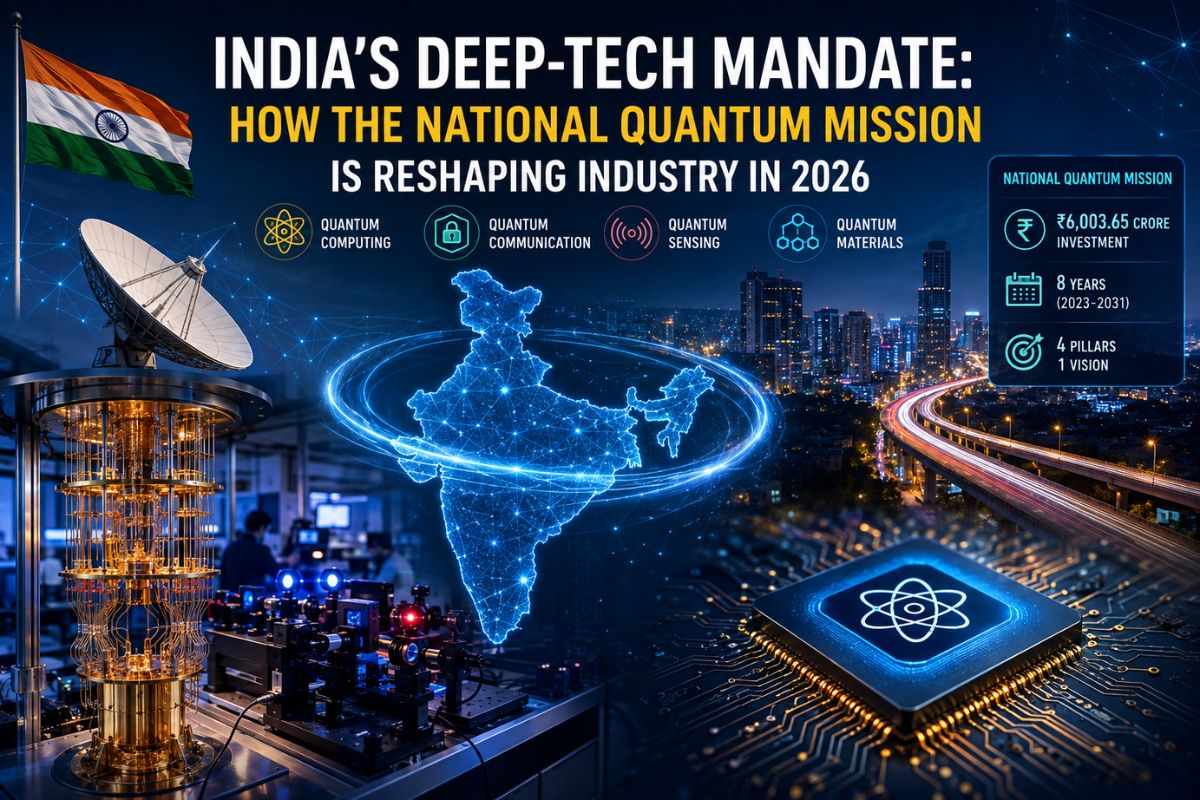
In 2026, India’s technology ecosystem is undergoing a fundamental pivot. While the country built its global reputation on IT services and software development, the rapid rollout of the National Quantum Mission (NQM)—backed by a total budget outlay of ₹6,003.65 crore ($730 million)—is shifting the national focus toward hardware-level deep tech, quantum computing, and secure communications.
With critical project milestones hitting operational phases this year, India is carving out a distinct position in the global quantum race alongside the United States, China, and the European Union.
Key Pillars of the National Quantum Mission
The NQM, executed under the Department of Science and Technology (DST), focuses on four primary thematic hubs (T-Hubs) established across premier academic and research institutions:
- Quantum Computing: Developing intermediate-scale quantum computers with 20 to 100 physical qubits utilizing superconducting and photonic platforms.
- Quantum Communication: Building secure satellite-based and terrestrial fiber-optic Quantum Key Distribution (QKD) networks over distances exceeding 2,000 kilometers.
- Quantum Sensing & Metrology: Engineering high-precision atomic clocks, magnetometers, and sensors for defense, navigation, and biomedical applications.
- Quantum Materials & Devices: Fabricating novel topological materials, single-photon sources, and superconductors to power next-generation hardware locally.
Commercial Impact & Startup Ecosystem
The mission’s structured capital deployment is accelerating private sector participation. Indian deep-tech startups—traditionally constrained by long capital cycles and high R&D entry barriers—are entering public-private partnerships across three critical sectors:
- Pharmaceuticals & Materials Science: Leveraging quantum simulation algorithms to model molecular structures, dramatically reducing drug discovery timelines.
- Financial Services: Top Indian banking institutions are testing post-quantum cryptography (PQC) standards to safeguard transaction networks against future decryption threats.
- Telecommunications: Defense agencies and telecom providers are actively running trials on QKD-backed secure lines to protect critical national infrastructure.
Strategic & Geopolitical Significance
Quantum technology has emerged as a core pillar of strategic autonomy. Beyond domestic development, India’s quantum efforts align with international technology frameworks, such as the US-India Initiative on Critical and Emerging Technology (iCET).
By investing directly in sovereign quantum infrastructure, the nation aims to prevent dependence on foreign hardware, train a specialized workforce of researchers and quantum engineers, and maintain supply chain security in sensitive dual-use technologies.
The Road Ahead
While challenges remain—particularly in sub-kelvin cryogenic infrastructure, specialized semiconductor fabrication, and talent retention—2026 marks the inflection point where laboratory research translates into field-deployable assets. As the NQM enters its mid-term execution phase, India’s deep-tech landscape is shifting from theoretical exploration to enterprise-grade reality.