The Liquor Of The Rich: What India’s Wealthiest Actually Pour
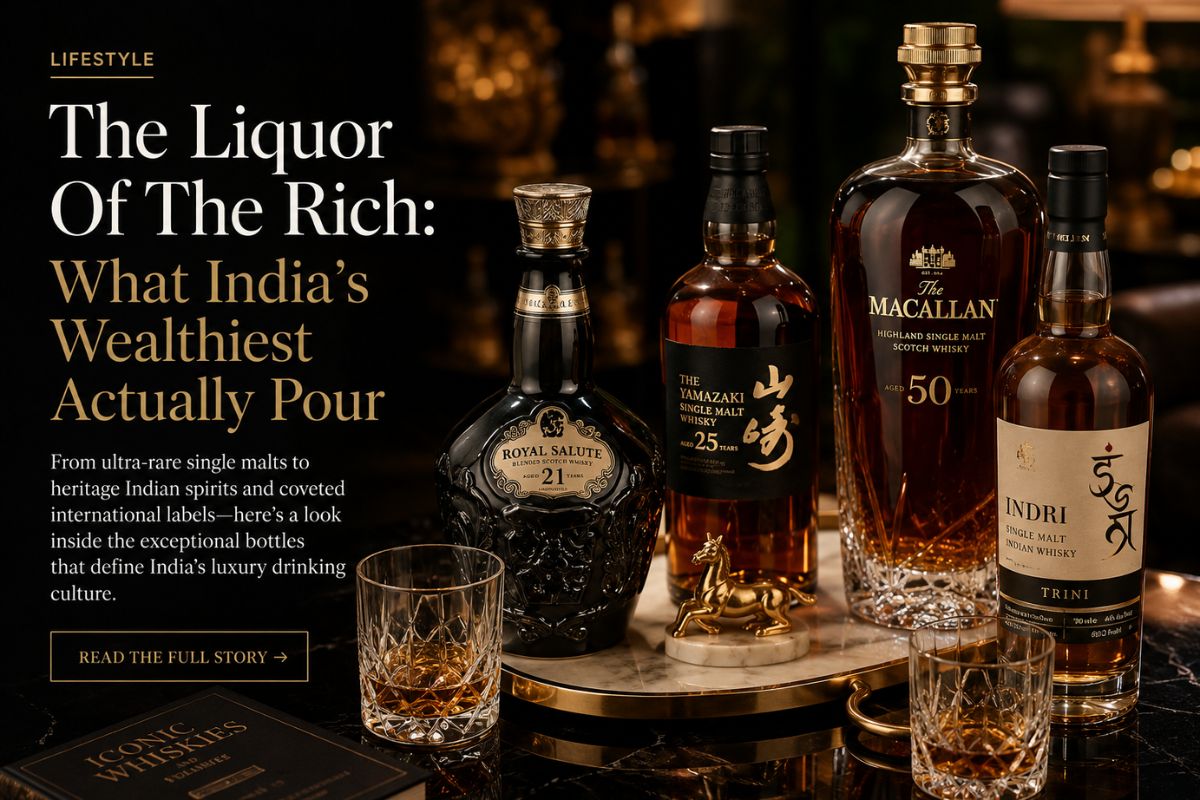
There is a particular category of alcohol that has almost nothing to do with getting a drink and almost everything to do with what the bottle signals the moment it lands on the table. A round of Macallan 30 at a private club, a decanter of Louis XIII passed around a boardroom celebration, a bottle of Indian single malt that costs more than a mid range car, none of it is really about the taste, though the taste is usually genuinely excellent. It is about provenance, scarcity, and the specific kind of quiet flex that only registers with people who already know exactly what they are looking at. Here is what actually fills the glasses at the top of India’s wealth pyramid, and increasingly, what India itself is now bottling for that same audience.
Scotch Whisky Still Sits At The Top Of The Table
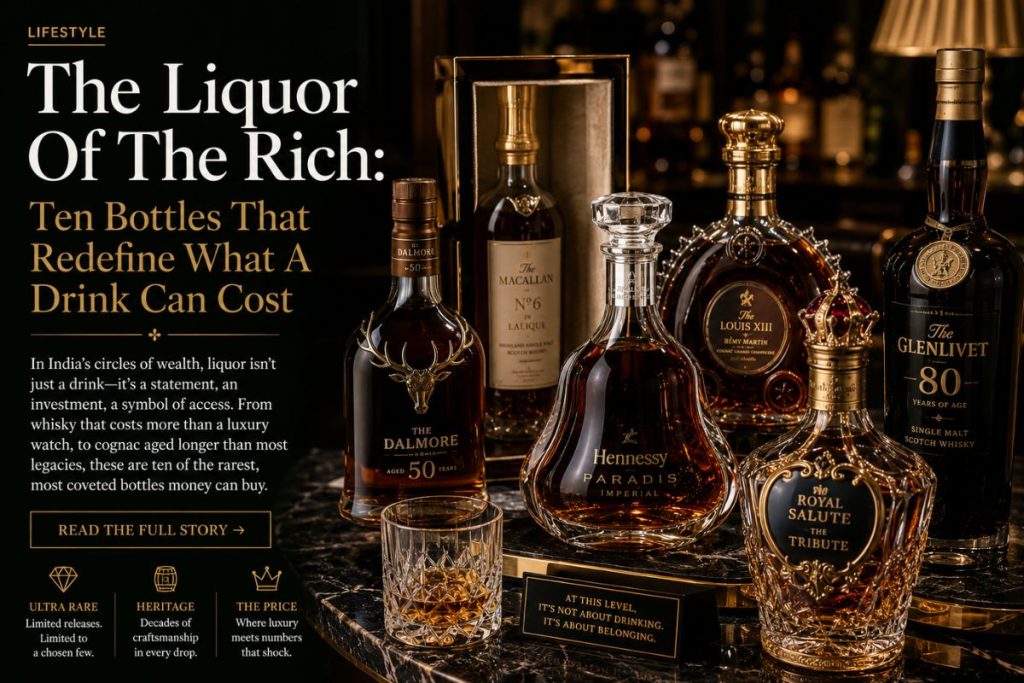
For decades, old money in India signalled taste through imported Scotch, and that has not changed so much as it has narrowed toward a smaller set of genuinely elite labels. The Macallan remains the default flex, a 30 year old bottle typically running between four and a half and six lakh rupees in India depending on state taxes, and the brand’s rarer editions have set world records at auction, a Macallan 1926 Fine & Rare, labelled by Italian artist Valerio Adami, fetched roughly two hundred thirty nine crore rupees at a single sale. Japanese whisky has muscled into the same conversation over the past decade, allocation only releases from Yamazaki and Hibiki rarely reach standard retail shelves in India at all, moving instead through a small circle of licensed premium retailers who reserve their best bottles for existing collectors rather than walk in customers.
Cognac For The Boardroom, Not The Bar Cart

Where Scotch signals patience and heritage, cognac signals something closer to raw excess, and nothing occupies that lane in India quite like Louis XIII de Rémy Martin, a blend of up to twelve hundred separate eaux de vie that currently retails in India for somewhere between three and a half and four and a quarter lakh rupees for a seven hundred millilitre decanter. It shows up disproportionately at business celebrations rather than casual dinners, deal closings, milestone birthdays, the kind of occasion where the cost of the bottle is meant to be noticed as part of the gesture rather than quietly absorbed into the evening.
Champagne As A Status Signal, Not Just A Celebration Drink
Champagne has carried an association with wealth and celebration for centuries, largely thanks to more than a hundred years of deliberate marketing by the major Champagne houses themselves, and that marketing has aged into genuine cultural shorthand. In India’s five star hotel bars and private clubs, brands like Armand de Brignac and Dom Pérignon function less as a drink choice and more as a visible marker the moment the bottle, often gold or black rather than the traditional green glass, arrives at a table. It is champagne bought as much to be seen as to be tasted, and the industry has built its most expensive releases around exactly that instinct.
The Diamond Encrusted Bottles That Are Barely About Drinking At All
At the furthest edge of this market sits a category that has almost stopped pretending to be about alcohol at all. Isabella’s Islay, currently the world’s most expensive whisky bottle at an estimated value north of six million dollars, comes from a well regarded smoky Islay distillery, but its price tag rests almost entirely on a bottle made from English crystal, covered in eighty five hundred diamonds and three hundred rubies, with lettering rendered in pure gold. Certain editions of Tequila Ley .925, wrapped in platinum and thousands of diamonds, occupy a similar space, valued for the vessel rather than the spirit itself. These bottles rarely appear in India even among the country’s wealthiest collectors, ownership tends to concentrate among European and Gulf buyers, but they define the outer boundary of what “liquor of the rich” can mean once the bottle itself becomes the actual asset.
India’s Own Luxury Whisky Boom
The most genuinely interesting shift in this entire category over the past several years has happened inside India rather than in the import aisle. Indian single malts have gone from a punchline to a serious collector’s category in barely a decade. Amrut Distilleries currently holds the record for India’s most expensive domestically produced whisky with Expedition, a fifteen year old release launched in 2025 and priced at roughly ten lakh rupees a bottle, ranked among the world’s finest whiskies in the 2026 edition of the Whisky Bible. Amrut’s earlier Greedy Angels 12 Year Chairman’s Reserve, released in 2016 at just under one and a half lakh rupees, remains a benchmark bottle for serious Indian collectors, alongside Rampur’s Signature Reserve, the only Indian whisky brand to crack the Top 100 Premium Wine and Spirits Brands of the World list, and Paul John’s Mithuna, a roughly twenty two thousand rupee single malt that has built genuine international critical respect for a distillery working in tropical Goan conditions Scotland’s producers never have to contend with. Indri’s Diwali Collector’s Edition and Kamet’s regional releases round out a domestic luxury tier that simply did not exist a generation ago, Indian whisky bought today not as a substitute for imported Scotch, but as a genuine status object in its own right.
Where India’s Wealthy Actually Drink It
Very little of this happens at a standard retail counter. Premium bottles at this level typically move through a small set of licensed specialty retailers in Mumbai, Delhi, and Bangalore, several of which now offer valet service, climate controlled storage, and quiet, appointment only access for serious collectors rather than open shelf browsing. Delhi’s own high end nightlife scene has built entire venues around exactly this clientele, Real Shee Power’s guide to the city’s most luxurious rooftop bars and lounges documents spaces built around serious whiskey programs and genuinely deep wine cellars, the kind of setting where a bottle like this is as much the evening’s centrepiece as the view itself. Much of the rest happens even more privately still, inside the city’s most exclusive private members’ clubs, where a well stocked cigar lounge and a serious spirits collection function as a genuine membership perk rather than a bar menu anyone outside the club will ever see.
A Liquid Investment, Not Just A Drink
What separates this category from ordinary luxury spending is how openly it has started functioning as an actual asset class rather than simple consumption. Rare whisky and cognac increasingly move through the same auction houses that handle fine art and watches, with age, provenance, and scarcity driving value in ways that mirror a genuine investment market rather than a bar tab. Industry observers now describe premium Indian and imported bottles explicitly as liquid investments, purchased with the expectation that a sealed, well provenanced bottle will appreciate meaningfully over a decade or two, the same logic that drives fine wine collecting in Europe, now firmly established in India’s own luxury spirits market.
The Honest Bottom Line
None of this changes what alcohol actually is, however elaborate the bottle or the story behind it, and worth remembering that even the most expensive glass in the room carries the same basic health considerations as any other. What has genuinely changed is the range of choice available to India’s wealthiest drinkers, a market that once meant importing everything worth having now runs equally through Bangalore and Goan distilleries producing whisky good enough to sit on the same shelf as Scotland’s oldest names. Whether that bottle ends up opened at a private club, displayed unopened as a long term collectible, or handed over as the kind of gift that says more than words could, the liquor of the rich in India today looks less like an imported status symbol and increasingly like a genuinely homegrown one.