Aiming Beyond Limits: The Unstoppable Rise of Sheetal Devi

Sheetal Devi: The Armless Archer Who Redefined Possibility
There are stories that lift us. Then there are stories that rearrange what we believe is possible. Sheetal Devi’s journey from a mountain village in Jammu & Kashmir to becoming a world-class archer is the latter: a quiet, relentless redefinition of skill, courage and who deserves a place on the podium.
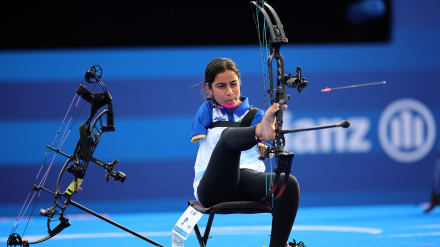
Photo: Sheetal Devi aiming an arrow.
Born without arms, Sheetal didn’t find a narrative written for her. She wrote one of her own: inventive, patient, and incandescent. This feature explores how she sculpted technique from limitation, how communities and mentors catalyzed her rise, and why her story matters far beyond medals.
“The world told her she couldn’t — so she taught the world how to aim without arms.”
A Childhood of Improvisation and Will
Sheetal Devi was born on January 10, 2007 in Lander (Lãndhar), a small village in the Kishtwar district of Jammu & Kashmir. She has phocomelia, a congenital condition that left her without arms. In many places, such a circumstance would narrow a child’s options. In Sheetal’s village, it became the canvas for improvisation: feeding herself, writing, dressing, climbing — she learned to use her legs with a fluency that both startled and humbled those around her.
How the Army and a Coach Saw Something Different
In 2019, during an Army-organized youth event, personnel noticed the dexterity and balance in Sheetal’s movements. The Rashtriya Rifles and the sports wing connected her with mentors and adaptive-sport programs. There, the idea to try archery surfaced. If Matt Stutzman — the armless American archer who uses his feet and shoulders to shoot — could compete at high levels, perhaps India had a talent waiting to be shaped.
What followed was not an overnight miracle. It was iterative engineering: coaches, physiotherapists and Sheetal herself experimented endlessly — adjusting posture, bow angle, how to nock an arrow using toes, and how to release without hands. The result: a unique technique that marries core strength, balance and an uncanny spatial sense.
The Technique — Precision Built on Adaptation
Understanding Sheetal’s technique is to understand adaptation as art. She stabilizes the bow between her legs, uses toes to nock and draw the string, and employs chin and shoulder stability to aim. Her releases are timed through breath control and millimetre-perfect foot positioning. Each arrow is the product of kinesthetic intelligence — a body learning and re-learning itself.
Her regimen includes intense core workouts, flexibility drills and balance training that would be impressive for any elite athlete. The difference is the orchestration: muscles and movement patterns usually auxiliary in able-bodied archery become her primary instruments.
“She doesn’t fight her body; she listens to it — and it listens back.”
A Meteoric Rise and Historic Moments
From local tournaments to the world stage, Sheetal’s ascent was rapid and deliberate. She represented India at the 2023 Asian Para Games and collected multiple medals, and in 2024 she made history as the first para-athlete selected for India’s able-bodied national team for the Asia Cup — a watershed moment in the country’s sporting history.
In 2025, competing at the Para Archery World Championships in Gwangju, South Korea, she clinched gold, defeating top-ranked opponents and announcing to the world what those who had watched her train already knew: she belonged.
The Cost of Greatness: Pain, Negotiation and Persistence
There is a human cost behind every medal. For Sheetal, those costs were physical and psychological. Her unconventional posture places strain on neck, shoulders and lower back; early training left her with bruises and soreness. Equally difficult was the burden of expectation — from media, sponsors and a nation eager for symbols.
Yet her response to pain has been instructive: she treats discomfort as data. What hurts indicates what needs recalibration. This empirical approach — trial, measure, correct — turned her body into a feedback loop for performance improvement.
Why Sheetal’s Story Matters
Sheetal’s significance is threefold. First, she is a high-performance athlete whose results stand on merit. Second, she is a social symbol: a visible proof that adaptive methods can equalize opportunity. Third, her journey is a policy nudge — urging sports federations, schools and funders to reimagine infrastructure and coaching for differently-abled athletes.
In practical terms, her visibility has catalysed conversations about inclusive training centres, access to adaptive equipment and targeted funding for para-sports. But the cultural shift is just as important: popular imagination now includes the image of a girl from a hill village winning on the world stage.
Voices That Helped Her Rise
The Indian Army’s sports outreach, coach Kuldeep Wadhwan, mentors, physiotherapists and local supporters all played roles in translating raw talent into repeatable performance. Sheetal herself—humble, disciplined and fiercely focused—was always the axis around which this support turned.
One recurring theme from interviews and reports is her emotional steadiness: she approaches competition with a quiet confidence rather than performative bravado. That steadiness, combined with rigorous practice, allowed her to convert pressure into focused execution.
Lessons for Women, Athletes and Society
- Redefine limits: Limits are largely social and cognitive; technique and adaptation can redraw them.
- Design over pity: Practical support, not sentimental charity, creates outcomes.
- Persistence beats talent alone: Daily work compounded — that is the essence of elite development.
- Representation matters: Seeing a woman like Sheetal makes it more likely that other girls will consider competitive sport as an option.
What Lies Ahead
Sheetal has publicly expressed a desire to make adaptive sports accessible in her region. Her long-term vision includes an academy for specially-abled athletes in Jammu & Kashmir — a space to teach technique, build confidence and connect young athletes with coaches and equipment. She’s also reportedly training with an eye on the next Paralympics.
- Born: January 10, 2007 — Lander, Kishtwar, Jammu & Kashmir
- Condition: Phocomelia (congenital absence of arms)
- Notable achievements: Multiple para-Asian medals; first para-athlete in India to join able-bodied national archery team (Asia Cup selection); 2025 Para Archery World Champion.
A Note on Coverage and Context
Coverage of Sheetal’s rise has come from national and international outlets. While media attention has helped build recognition and sponsorship interest, it also demands responsible storytelling: portraying her as an elite athlete first, and a symbol second. Her life is not a single inspirational anecdote; it is an ongoing project of training, learning and teaching.
RealShePower’s Reflection
Some stories are meant to comfort; others are meant to change us. Writing about Sheetal Devi did both. She reminded us that courage doesn’t always arrive as a roar — sometimes it is patient, exacting, and barefoot. At RealShePower, we write to amplify such quiet revolutions: women who refuse to be reduced by the world’s expectations and instead rewrite them.