Bangkok: The Real Shee Power Guide to the World’s Greatest Street Food City
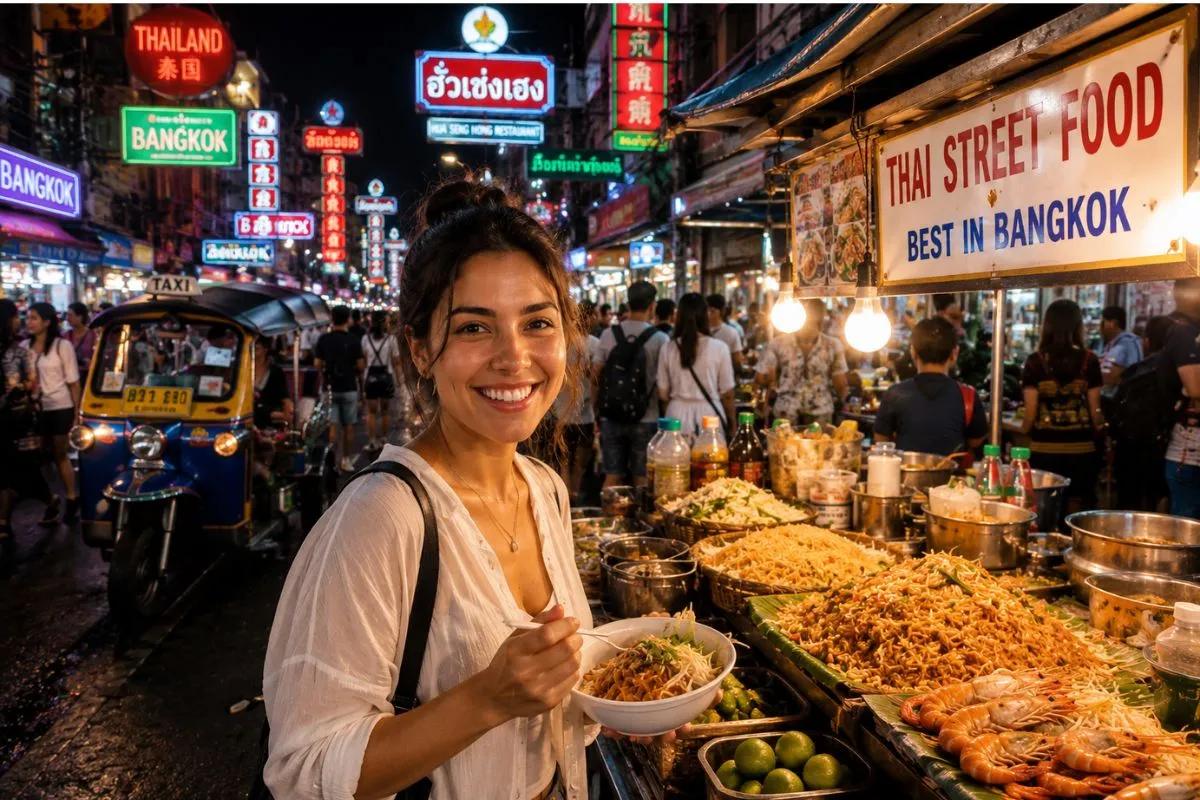
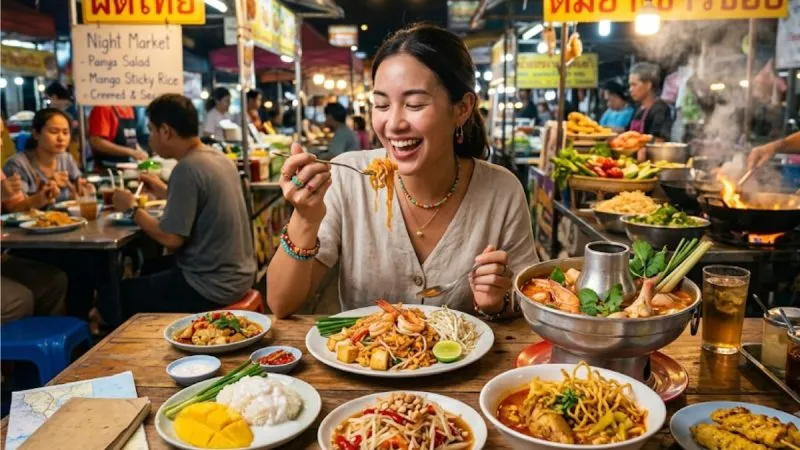
There’s a moment that happens to almost everyone on their first night in Bangkok, usually somewhere around a plastic stool on a side soi, plate balanced on a knee, motorbikes weaving past close enough to feel the breeze — you take one bite of something cooked over charcoal by someone who has made this exact dish for twenty years, and every restaurant meal you’ve ever had suddenly feels slightly beside the point.
This is the part of Real Shee Power series: Travel the World on a Plate — a culinary travel line built around the idea that the fastest, truest way into any culture is through what’s cooking on the street corner. And there is no better place to start than Bangkok, a city that CNN, Bloomberg, and nearly every major travel publication has crowned the best street food destination on Earth, and that the Michelin Guide itself validated when it awarded a star to a street-side cook working a single charcoal wok.
🧞♀️ Genie’s Take: New series, same rule I’ve followed in every city so far: I don’t send you somewhere just because it photographs well. Bangkok earns its reputation one plate at a time — let’s eat.
Why Bangkok Is the World’s Street Food Capital
The scale alone is hard to overstate — estimates put the number of street food vendors operating across Bangkok on any given day somewhere between 30,000 and 300,000, depending on how loosely you count. That density means specialization: a cart that sells only boat noodles, a stall that’s done nothing but grilled pork skewers for two decades, a woman in ski goggles who has cooked Michelin-starred crab omelets from a single wok since 2018. When a vendor does one thing and one thing only, that focus is almost always a very good sign.
Unlike a lot of food cities where street food is a budget fallback, in Bangkok it’s often simply the best food available — tuk-tuk drivers and wealthy families eat from the same carts, and the Michelin Guide’s Bib Gourmand list now reads less like a hidden-gems roundup and more like a directory of the city’s most essential stalls.
Where to Eat: The Neighborhoods That Matter
Yaowarat (Chinatown)

Photo: Wikimedia Commons, licensed under CC BY-SA 3.0
Established in 1782 as a resettlement area for Teochew Chinese immigrants when Bangkok became the Rattanakosin capital, Yaowarat Road has anchored Bangkok’s Chinese-Thai community for well over two centuries, and it remains one of the largest and oldest Chinatowns in the world. By day it’s a gold trade and dried-goods market; after dark, the 1.5-kilometer road that winds through the district in a dragon-like curve transforms into a wall-to-wall food corridor — seafood grills, noodle stalls, and dessert vendors under a canopy of neon signage. Come hungry and come after sunset; this is peak Yaowarat, and nothing here really gets going before dark.
Banthat Thong Road
The city’s trendiest street food strip as of 2026, popular with students from nearby Chulalongkorn University — a good, less touristy alternative to Yaowarat if you want the same energy with fewer crowds.
Or Tor Kor Market
Widely regarded as one of the best fresh markets in Asia, with exceptionally high food safety standards and premium Thai produce sourced from across the country’s regions — a strong pick for a daytime visit, especially if you want to see the ingredients before you commit to the dishes.
Talad Rot Fai (Train Market)
A weekend-only market set on an old railway siding in the Ratchada district, mixing vintage stalls with a serious food scene — go on a Friday evening or over the weekend, since it’s largely closed on weekdays.
What to Actually Eat
Pad Thai, Som Tam, and Mango Sticky Rice — The Holy Trinity
The three dishes most visitors already know, and for good reason: stir-fried rice noodles with tamarind and egg, a spicy-sour green papaya salad pounded to order, and ripe mango over coconut-infused sticky rice. All genuinely excellent — but locals eat khao mun gai (Hainanese chicken rice) and guay teow (noodle soup) far more often day-to-day, so don’t stop at the trinity.
Jay Fai’s Crab Omelet
The most famous Michelin star in Thai street food belongs to Jay Fai, a street-side cook in Phra Nakhon who has run the same charcoal wok since long before the accolade arrived. Expect a wait, and expect it to be worth it.
Khao Moo Daeng
A comforting rice dish topped with roasted red pork, boiled egg, and a sweet-savory sauce — one of the easiest, most satisfying orders for a first-timer still adjusting to the heat of Thai spice.
Moo Ping (Grilled Pork Skewers)
Sweet, smoky, grilled over charcoal and served with sticky rice — the perfect walking snack between stops.
Boat Noodles
Rich, dark broth noodles historically sold from boats along Bangkok’s canals, now served from land-based stalls in small, intensely flavorful bowls — order several rounds, since portions are traditionally tiny by design.
Real Shee Power Genie’s Insider Notes
🧞♀️ On safety: Follow the local rule — if there’s a queue, the food is fresh. Choose high-turnover stalls, vendors who cook fresh over high heat in front of you, and avoid pre-cut fruit or unsealed water. Thailand has a strong street food safety culture, but basic vigilance still matters.
🧞♀️ On spice: Thai street food is spicy by default. Learn two phrases before you land: “mai phet” (not spicy) and “phet nit noi” (a little spicy) — though honestly, leaning into the heat is half the experience.
🧞♀️ On getting around: Use the BTS Skytrain and MRT subway to move between food zones efficiently; for Yaowarat and the Old Town specifically, a Grab taxi or tuk-tuk gets you closer to the action.
🧞♀️ On budget: Street food here is astonishingly cheap — roughly 150–400 THB ($4–12 USD) covers three to four meals in a day, and even Michelin-recognized stalls rarely exceed 200 THB a dish.
🧞♀️ On timing: November through February brings cooler, less humid weather — the most comfortable stretch for a full day of walking between food stops. Mango season begins around March, which is worth planning around if mango sticky rice is a priority.
Sample 3-Day Food Itinerary
- Day 1: Or Tor Kor Market in the morning, Banthat Thong Road for dinner and a first taste of the city’s street food energy.
- Day 2: Boat noodles and khao mun gai for lunch, Jay Fai (reserve or queue early) or another Michelin-recognized stall for dinner.
- Day 3: Yaowarat after dark — the essential Bangkok food night, worked slowly, one stall at a time.
FAQs
Is Bangkok street food safe to eat? Generally yes, for a destination with this scale of street food culture — follow high-turnover stalls, watch food being cooked fresh in front of you, and avoid pre-cut fruit or unsealed water.
How much does street food cost in Bangkok? Very little by Western standards — most dishes land under 100 THB (roughly $3), with a full day of eating typically costing $4–12 USD total.
What’s the single must-try Bangkok street food dish? There’s no single answer, but khao mun gai, pad thai, and a bowl of boat noodles together give a strong, representative first taste of the city’s range.
When is the best time to visit for food? November through February for the most comfortable walking weather; if mango sticky rice is a priority, plan around mango season starting in March.
Is Yaowarat only good at night? Mostly — it functions as a market by day, but the full street food experience begins after sunset when the stalls, grills, and neon signage come alive.
This is Part of the Real Shee Power “Travel the World on a Plate” series. Next up: Oaxaca, Mexico’s culinary capital. Explore more Real Shee Power travel guides →
Sources: Tictivity — Bangkok Street Food Guide · BKKScene — Best Street Food in Bangkok 2026 · ComfortMyTrip — Bangkok Street Food Guide 2026 · Go2Thailand — Best Street Food Markets · IndochinaVoyages — Chinatown Bangkok Guide