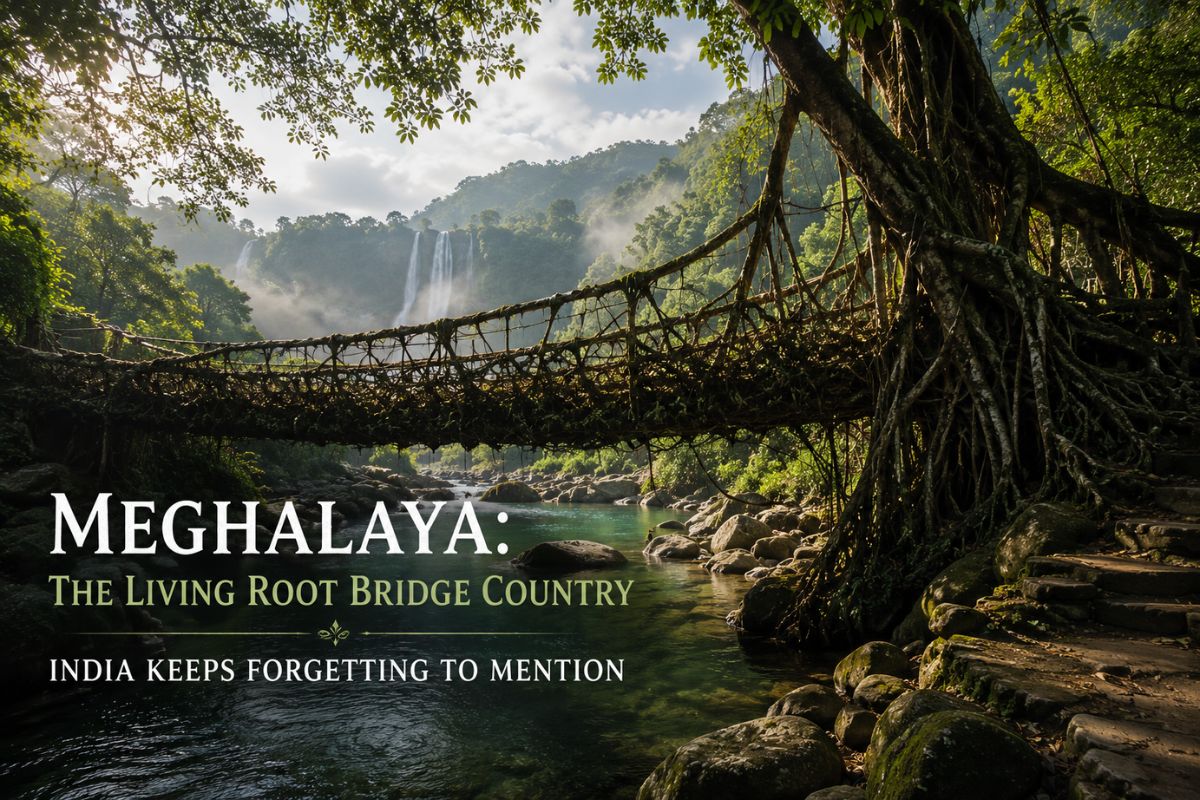
Meghalaya: The Living Root Bridge Country India Keeps Forgetting to Mention
Quick Summary
Meghalaya has bridges grown, not built, from living tree roots, waterfalls that rank among the tallest in India, and a matrilineal culture found nowhere else in the country. Here is everything you need to plan the trip.
- Best time to go: October through April, avoiding the monsoon
- Where to stay: Shillong for comfort, Cherrapunji and Mawlynnong for immersion
- What to do: living root bridges, caves, and Asia’s cleanest village
- What to eat: Khasi pork, jadoh, and tungrymbai
- A realistic 5-day itinerary and honest trekking guidance
There is a bridge in a village called Nongriat, deep in Meghalaya’s East Khasi Hills, that has been growing for well over a hundred years. It isn’t built. It’s alive, its structure formed from the aerial roots of rubber fig trees, guided across a river by hand over decades until the roots fused into a walkway strong enough to hold dozens of people at once. It is, by most accounts, one of the more remarkable pieces of human and natural collaboration anywhere on earth, and most Indian travelers have never heard of it, let alone visited.
That bridge is just one entry point into Meghalaya, a small northeastern state that holds some of India’s most dramatic landscape, one of its most distinct indigenous cultures, and almost none of the tourist infrastructure or recognition its counterparts in Rajasthan, Kerala, or Himachal have built up over decades. This guide covers what makes the state worth the extra effort to reach, and exactly how to plan a trip that does it justice.
Why Meghalaya Stays Off Most Itineraries
Part of the answer is simple geography. Meghalaya sits in India’s northeast, connected to the rest of the country by a narrow corridor of land, and reaching it has historically meant more effort than a direct flight to a more established hill station. Part of the answer is unfamiliarity, since the region’s culture, landscape, and even cuisine differ so sharply from mainland Indian tourism staples that it rarely gets mentally filed alongside more conventional hill destinations.
But the gap is closing. Better flight connectivity into Shillong and Guwahati, growing recognition of the living root bridges as a genuinely unique global attraction, and a slow but steady rise in homestay and small-hotel infrastructure have made the state significantly more accessible over the past several years than it was a decade ago. What hasn’t caught up yet is awareness, which means Meghalaya currently offers a rare combination for Indian travel: genuinely world-class natural attractions, reasonable infrastructure, and still-modest crowds.
When to Go
October through April is the strongest window overall, falling after Meghalaya’s intense monsoon season, during which the state, among the wettest places on earth, becomes difficult and occasionally dangerous to trek through, and before the pre-monsoon humidity builds back up in late spring.
October and November offer the clearest skies and the most dramatic waterfall volume, since the rivers and falls are still running high from the tail end of the monsoon while the trails have dried out enough to trek safely.
December through February brings cooler, crisper weather, ideal for the state’s caving and trekking activities specifically, though waterfall volume drops noticeably as the dry season progresses.
March and April see wildflowers and a milder, warming climate, a solid secondary window for travelers who can’t make the October to February stretch.
The monsoon months, roughly May through September, are worth avoiding for a first visit specifically, since several of the state’s signature treks and root bridge routes become genuinely hazardous, not just uncomfortable, during peak rainfall.
Getting There and Getting Around
Shillong, Meghalaya’s capital, doesn’t have its own major airport, so most travelers fly into Guwahati in neighboring Assam, roughly a three-hour drive from Shillong, with regular flights from Delhi, Mumbai, Bangalore, and Kolkata. A smaller airport in Shillong itself handles limited flights, primarily from Kolkata, which can save the road transfer time for travelers whose dates align.
Once in the state, a private driver for the duration of the trip is close to essential, both because public transport infrastructure remains limited outside Shillong and because several of the state’s best attractions, the root bridges especially, require navigating winding mountain roads to trailheads that aren’t well served by any other option. Most homestays and hotels can arrange a driver directly, and booking this in advance, rather than trying to arrange it on arrival in Shillong, is worth the effort given how quickly good drivers get booked up during the peak October to February window.
Where to Stay: A Three-Base Strategy
Meghalaya rewards a trip structured around three distinct bases rather than a single hotel, since the state’s best attractions are spread across meaningfully different areas.
Shillong, the state capital, offers the widest range of comfortable hotels, from heritage colonial-era buildings to newer boutique properties, along with the state’s best restaurant and cafe scene. It’s the natural first and last base for the trip, both for comfort and for easing into the region’s culture before heading into more remote areas.
Cherrapunji, also known as Sohra, roughly 90 minutes from Shillong, sits close to several of the state’s most dramatic waterfalls and serves as the base for reaching the more accessible living root bridges. Accommodation here ranges from basic guesthouses to a growing number of well-reviewed homestays run by local Khasi families, several of which offer a far more genuine cultural experience than a conventional hotel would.
Mawlynnong, celebrated as one of the cleanest villages in Asia, and its neighboring village Nongriat, home to the most famous double-decker living root bridge, require a further, more remote stay for travelers wanting to properly experience the deeper root bridge treks rather than a rushed day trip. Basic but comfortable homestays in this area put you within walking distance of trailheads that would otherwise mean a punishing early morning drive from Shillong or even Cherrapunji.
Splitting a trip across all three bases, roughly two nights each, gives a far fuller picture of the state than concentrating time in Shillong alone with day trips stretched thin across long drives.
What to Actually Do
Trek to the Double-Decker Living Root Bridge in Nongriat. This is Meghalaya’s single most iconic attraction, a genuinely two-tiered bridge formed from generations of guided root growth, reachable via a steep trek down and back up roughly 3,500 steps. The trek is demanding, not technical, but does require a reasonable baseline fitness level and proper footwear, and is best attempted early in the day to avoid both the midday heat and the risk of afternoon rain making the steps slippery.
Visit Nohkalikai Falls near Cherrapunji. Among the tallest plunge waterfalls in India, Nohkalikai is at its most dramatic during and just after monsoon season, when water volume peaks, though it remains a striking sight well into the dry season. A well-maintained viewpoint makes this one of the more accessible major attractions in the region, requiring no trek at all.
Explore Mawsmai Cave. Meghalaya’s limestone cave systems are among the least visited but most striking natural attractions in the state, and Mawsmai, near Cherrapunji, offers a well-lit, relatively accessible route through dramatic limestone formations, a good entry point for travelers curious about the region’s caves without committing to the state’s more serious, headlamp-and-harness caving expeditions.
Walk through Mawlynnong. Asia’s cleanest village lives up to its reputation, immaculately maintained pathways, bamboo dustbins at regular intervals, and a genuine, longstanding community commitment to cleanliness that predates the accolade by decades. A living root bridge sits just outside the village itself, smaller and more accessible than Nongriat’s double-decker version, making it a good option for travelers with less time or lower fitness levels.
Spend an evening in Shillong’s cafe and live music scene. Shillong holds a distinct, decades-old relationship with Western rock and blues music, a legacy of the region’s history and cultural exchange, and the city’s live music venues and cafes offer a genuinely different evening experience from anywhere else in India, worth building into at least one night of the itinerary.
What to Eat
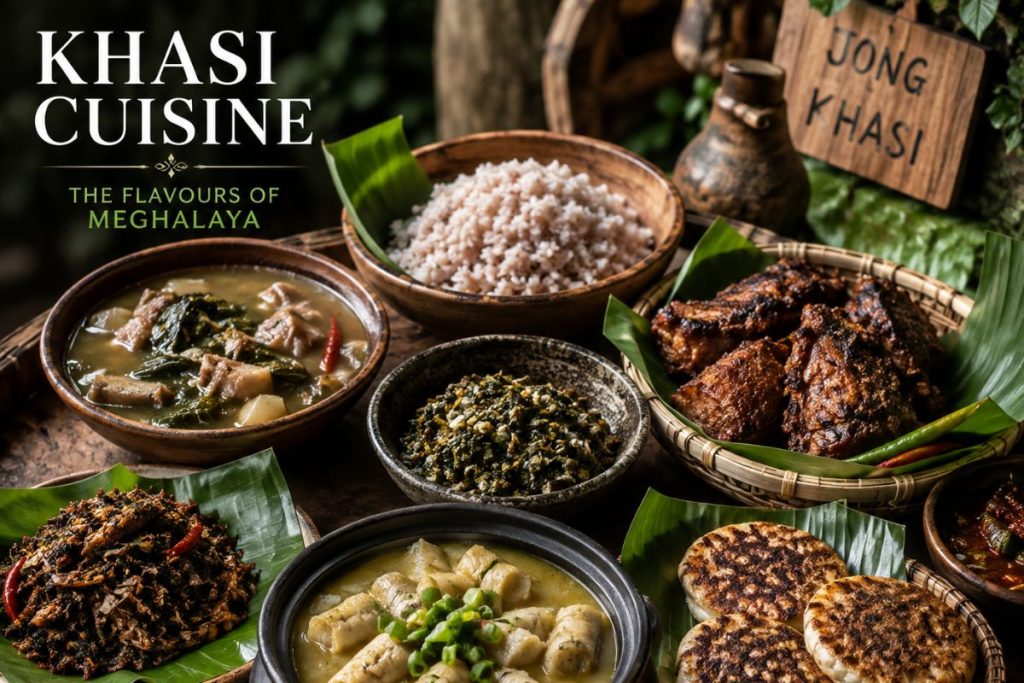
Khasi cuisine, the food tradition of Meghalaya’s largest indigenous community, is distinct from anything found in mainland Indian cooking, built around minimal spicing, generous use of pork, and fermentation techniques that produce genuinely unique flavors.
Jadoh, a rice dish cooked with pork blood and meat, is one of the most iconic Khasi dishes, deeply savory rather than spicy, and worth trying at a local eatery rather than a tourist-facing restaurant for the most authentic version.
Tungrymbai, a fermented soybean preparation often cooked with pork, carries a distinctive pungent flavor that takes some adjustment for travelers unfamiliar with fermented foods, but represents one of the more genuinely unique tastes available anywhere in Indian regional cuisine.
Dohneiiong, a pork curry cooked with black sesame, and pumaloi, a light, fluffy rice preparation, round out a typical Khasi meal, both worth trying at homestays specifically, where cooking tends to follow traditional household methods more closely than restaurant versions.
Local tea and Khasi rice beer, where available, offer a further window into the region’s everyday food culture, and asking a homestay host directly about what’s traditionally served with a specific meal tends to produce far more interesting answers than a printed menu would.
A Suggested Five-Day Itinerary
Day one starts with arrival in Guwahati and a transfer to Shillong, with the afternoon spent easing into the city, exploring its cafes and colonial-era architecture before an evening built around its live music scene.
Day two moves to Cherrapunji, visiting Nohkalikai Falls and Mawsmai Cave in the same day, with an overnight stay at a Khasi-run homestay in the area.
Day three is dedicated to a full day trek to the Double-Decker Living Root Bridge in Nongriat, an early start essential given the trek’s length, with an overnight stay either in Nongriat itself or a return to a Cherrapunji base depending on homestay availability.
Day four continues to Mawlynnong, exploring the village and its own smaller root bridge at a slower pace than the previous day’s trek, with an overnight stay nearby.
Day five closes with a return drive to Shillong, time for any last shopping or cafe visits, and departure via Guwahati.
This pacing intentionally builds in a genuinely demanding trekking day, day three, bracketed by lighter days on either side, since the Nongriat trek specifically benefits from travelers who aren’t already exhausted from back-to-back activity.
Budgeting the Trip
Mid-range travelers can expect to spend roughly ₹4,000 to ₹7,000 per night combined across homestays and mid-tier Shillong hotels, with flights from major Indian cities to Guwahati typically running ₹6,000 to ₹14,000 round trip depending on the city and how far ahead they’re booked.
More comfort-focused travelers opting for Shillong’s better boutique hotels and private guided treks throughout should budget closer to ₹8,000 to ₹15,000 per night, still notably below equivalent comfort levels in more established Indian hill destinations, since Meghalaya’s tourism pricing hasn’t yet caught up to its scenery.
Either way, this remains one of the more affordable regions in India relative to what it actually delivers, a gap that reflects limited awareness rather than limited quality.
Honest Trekking Guidance
The Nongriat double-decker bridge trek deserves a specific, honest note, since it gets described online with wildly inconsistent difficulty ratings. The roughly 3,500 steps down and back up are not technically difficult, no climbing or scrambling required, but they are long, and the return climb specifically catches unprepared travelers off guard. A reasonable baseline fitness level, comfortable trekking shoes with real grip, and starting early enough to avoid both midday heat and any afternoon rain risk are the three things that actually determine whether the day goes well. Carrying enough water, since options thin out significantly once past the initial village, and packing a change of clothes for the inevitable stream crossings along the route, round out the practical preparation that makes the difference between a demanding but enjoyable day and a genuinely miserable one.
Practical Tips
Mobile network coverage is reliable in Shillong and reasonably so in Cherrapunji, but drops significantly around Mawlynnong and Nongriat specifically, so downloading offline maps and confirming homestay directions in advance matters more here than in most Indian travel destinations. Cash is strongly preferred outside Shillong, since card and UPI infrastructure remains limited in smaller villages, and carrying enough for several days at a time is a sensible default. Meghalaya’s matrilineal Khasi culture, where property and lineage pass through the mother’s line rather than the father’s, a genuine rarity globally, is worth a brief read before arriving, since it shapes social dynamics in ways visibly different from most of mainland India and tends to make for far more interesting conversation with local hosts once understood even at a basic level. And because several of the state’s best attractions sit within community-managed land rather than a formal national park system, hiring local guides, easily arranged through any homestay, both supports the community directly and generally results in a far richer experience than navigating independently.
How Meghalaya Compares to Other Hill Destinations
The comparison worth making is against Himachal and Uttarakhand, India’s default answer to “hill station,” since Meghalaya offers something structurally different from both. Shimla, Manali, and their neighbors built their tourism identity around colonial-era hill stations and, more recently, adventure sports, with infrastructure and crowd levels that have grown substantially over decades of mainstream popularity. Meghalaya, by contrast, offers a landscape shaped less by colonial hill-station culture and more by the indigenous Khasi and Jaintia communities who’ve lived there for centuries, and a set of natural attractions, living root bridges especially, that simply don’t exist anywhere else in the Himalayan belt.
The crowd difference is significant and, for now, works entirely in Meghalaya’s favor. A popular Himachal trekking route during peak season can mean queues at scenic viewpoints and a steady stream of fellow trekkers on the trail. The Nongriat root bridge trek, despite being Meghalaya’s single most famous attraction, still offers stretches where you’ll walk for twenty or thirty minutes without passing another traveler, a genuinely rare experience for an attraction this well documented. For travelers who’ve done the standard Himachal or Uttarakhand circuit and are looking for a hill destination with a fundamentally different culture and landscape rather than a variation on the same theme, Meghalaya is the more distinct choice by a wide margin.
Extending the Trip: Assam and the Wider Northeast
Since Guwahati serves as the primary gateway into Meghalaya for most travelers, it’s worth considering at least a day built around Assam itself rather than treating Guwahati purely as a transit point. Kaziranga National Park, roughly four to five hours from Guwahati, holds the largest population of one-horned rhinoceroses in the world and offers a genuinely different kind of wildlife experience from India’s more commonly visited tiger reserves, worth the detour for travelers with an extra two or three days to spare.
Guwahati itself, often dismissed as a transit city, holds the Kamakhya Temple, one of the most significant Shakti Peeth pilgrimage sites in India, perched on a hill overlooking the Brahmaputra River, along with a growing riverside cafe scene worth an afternoon of exploration. Travelers with significantly more time might also consider extending further into the northeast toward Nagaland or Arunachal Pradesh, though both require more advance planning and, in Arunachal’s case, specific inner-line permits that Meghalaya itself does not require.
Photography Notes
Meghalaya rewards patience over a shot list, given how much of its appeal lies in landscape and light rather than staged attractions. The living root bridges photograph best in dappled midday light filtering through the forest canopy, since the roots’ texture and the surrounding greenery both benefit from soft, diffused light rather than harsh direct sun, which is one of the few places in this guide where midday isn’t the worst time to shoot. Nohkalikai Falls and the state’s other major waterfalls are at their most dramatic shortly after rainfall, when water volume and the resulting mist create a more atmospheric frame, worth timing a visit for the morning after a rain shower where the itinerary allows some flexibility. Mawlynnong’s neat, ordered village pathways offer a striking contrast subject against Meghalaya’s otherwise wild, overgrown forest landscape, worth a deliberate wide shot capturing both in the same frame. And because much of the state’s charm lies in its indigenous Khasi culture, portraits and community photography are best approached the same way as anywhere else in India with a distinct local culture, a friendly ask first, ideally through a homestay host who can help make the introduction feel natural rather than transactional.
Quick Answers to Common Questions
Is Meghalaya safe for solo travelers? Yes, and increasingly popular specifically among solo women travelers, thanks in part to the region’s matrilineal Khasi culture, which tends to translate into a social environment where women moving independently draws considerably less unwanted attention than in many other parts of India. Booking through an established homestay network and arranging guides for the more remote treks remains the sensible default regardless.
Do you need any special permits to visit? No inner-line permit is required for Meghalaya itself, unlike some neighboring northeastern states such as Arunachal Pradesh, which makes it one of the more straightforward northeastern destinations to visit without advance paperwork.
Is the Nongriat trek suitable for children or older travelers? The roughly 3,500 steps make it a genuinely demanding day for both groups, and while not technically dangerous, it’s worth being honest about fitness requirements rather than assuming the “no climbing involved” framing means it’s an easy walk. Mawlynnong’s smaller, more accessible root bridge is a better alternative for travelers wanting the experience without the extended trek.
How does Meghalaya compare to Kerala for a nature-focused trip? Kerala’s backwaters and hill stations offer a gentler, more leisurely nature experience with well-established tourism infrastructure. Meghalaya trades some of that polish for landscape and cultural experiences genuinely unavailable anywhere else in India, a worthwhile trade for travelers specifically seeking something less conventional.
The Case for Going Now, Not Later
Meghalaya currently occupies a genuinely rare position in Indian travel: natural attractions substantial enough to draw serious international attention once discovered, a culture found nowhere else in the country, and a level of quiet, uncrowded access that most of India’s more established hill destinations lost decades ago. Improving flight connectivity and slowly growing recognition mean that position won’t hold indefinitely. For travelers willing to build in the extra transit time and a genuinely demanding trekking day, Meghalaya right now offers one of the most singular travel experiences left anywhere in the country.
Suggested Reading
- Chettinad: The Heritage Mansion Trail India Forgot to Talk About Another underrated region proving India’s best travel isn’t always where the crowds already are.
- Udaipur Like Royalty: The Ultimate Luxury Travel Guide A very different pace and landscape, worth pairing as a contrast trip within the same year.
- How to Live Like Royalty in India Without a Royal Budget Booking strategies worth applying even in a destination where prices are already this reasonable.
- Palace Stays in Rajasthan That Feel Unreal: The Complete Women’s Booking Guide For travelers curious how Meghalaya’s homestay culture compares to Rajasthan’s grander palace stays.