Kiran Mazumdar-Shaw: The Woman Who Built India’s Biotech Industry From A Rented Garage
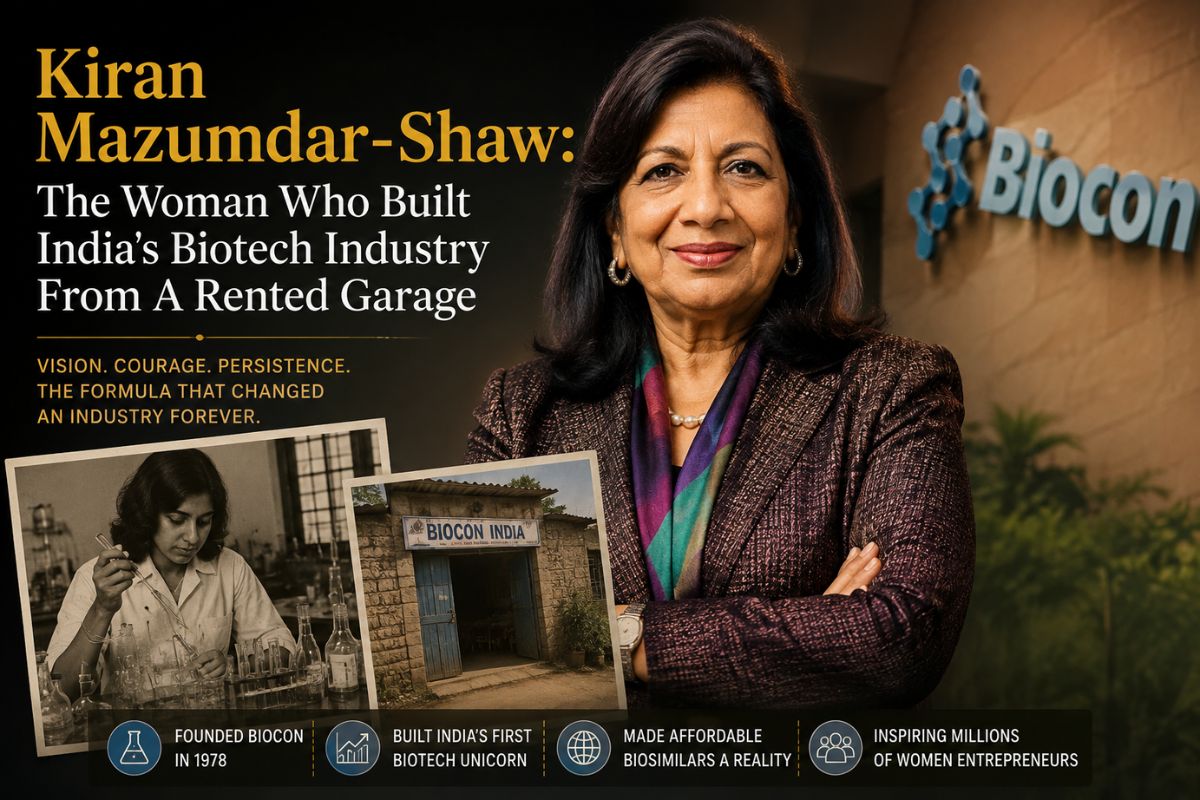
In 1975, a newly qualified master brewer returned to India from Australia and applied for a job in the one industry she had trained for. Every brewery in the country turned her down for the same reason. Brewing was considered a man’s job, and no one was prepared to hire a woman to run a fermentation tank, regardless of her degree. Kiran Mazumdar-Shaw did not stay in brewing. Three years later, with ten thousand rupees and a rented garage in Bangalore, she started a company to extract an enzyme from papaya. That company became Biocon, and the woman who could not get hired as a brewer became the founder of India’s largest biopharmaceutical firm and, for a time, the country’s richest self made woman.
A Career Built On A Rejection
Mazumdar-Shaw studied zoology at Bangalore University before training as a master brewer in Australia, following in her father’s footsteps as head brewer at United Breweries. It was a genuinely unusual path for a woman from Karnataka in the early 1970s, and it turned into a dead end the moment she came home looking for work. Rather than force her way into an industry unwilling to have her, she pivoted the skills she already had, fermentation science, enzyme chemistry, industrial biology, toward a field with almost no existing footprint in India at all. In 1978, she partnered with a small Irish company, Biocon Biochemicals, to found Biocon India, working initially out of a garage with a handful of employees and a mandate to extract enzymes for industrial use. Banks turned her down for loans on three separate grounds, the field was unfamiliar, the company had no assets, and women entrepreneurs were treated as a novelty rather than a credible bet. She built the company anyway.
From Industrial Enzymes To India’s Insulin Supply
Biocon‘s early decades were unglamorous by design, papain and other enzymes sold into industrial processes, a slow accumulation of scientific credibility rather than a dramatic launch. The real turn came when the company shifted its focus toward fermentation based drug manufacturing, culminating in Biocon becoming one of the first companies in the world to develop and commercialise recombinant human insulin using a novel yeast expression system, a technical achievement that made a life sustaining medication meaningfully more affordable for millions of diabetics. Biocon has since sold billions of doses of insulin worldwide and operates Asia’s largest insulin manufacturing facility in Malaysia. In 2004, Biocon’s initial public offering was oversubscribed thirty three times over, the first Indian biotechnology company to go public, and it instantly made Mazumdar-Shaw India’s richest self made woman.
The Friend She Couldn’t Save
The part of Biocon’s story that gets told least often is also the part that explains its current direction most clearly. Mazumdar-Shaw has spoken publicly about her decades long friendship with Nilima Rovshen, a fellow single professional woman in Bangalore at a time when that was itself a rarity, and about watching Rovshen fight breast cancer for six years through a relentless, financially crushing cycle of chemotherapy, radiation, and increasingly expensive biologic therapies before her death. Mazumdar-Shaw has described the experience plainly, that she watched her friend struggle not only with the disease but with the sheer cost of trying to survive it, and that the memory of that struggle became the reason she pushed Biocon’s scientists to build something specific, an affordable version of the exact class of cancer drugs her friend had needed and could barely access. That decision led directly to one of the company’s most significant achievements. In 2017, Biocon became the first company in the world to win United States FDA approval for a biosimilar version of trastuzumab, the breast cancer treatment that had been financially out of reach for patients like Rovshen a decade earlier. The insulin breakthrough proved the model could work at scale. Her friend’s death is the reason she pointed that same model directly at cancer.
Building An Affordable Cancer Care Model, Not Just A Drug
Mazumdar-Shaw’s response to her friend’s death did not stop at the laboratory. In partnership with cardiac surgeon Dr Devi Shetty, she co-founded the Mazumdar-Shaw Cancer Centre, a fourteen hundred bed facility in Bangalore built specifically around the idea that cancer care could be delivered at scale without the crushing cost structure that had defined Rovshen’s final years. The centre specialises in head and neck, breast, and blood related cancers, and has since expanded to include an advanced therapeutics wing with a bone marrow transplant unit and a dedicated translational research centre. Since 2005, her philanthropic giving toward cancer diagnosis, research, and patient care has run into tens of millions of dollars, funded substantially by the same biotechnology business her friend’s illness had shaped in the first place.
What Biocon Looks Like Today
Under Mazumdar-Shaw’s leadership, Biocon expanded well beyond its original enzyme business into a full biopharmaceutical enterprise spanning diabetes, oncology, and autoimmune disease, with two major subsidiaries, Syngene, focused on research services, and Biocon Biologics, which consolidated the company’s biosimilar capabilities into a dedicated global division. In 2022, Biocon Biologics acquired the biosimilars business of American pharmaceutical company Viatris in a deal worth 3.3 billion dollars, a scale of transaction that would have been unthinkable for the papaya enzyme company operating out of a Bangalore garage forty four years earlier. The company’s products are now approved and sold in more than 120 countries, and Biocon ranks among the most significant biotechnology employers anywhere in Asia.
Recognition, And What She Still Wants To Be Remembered For
Mazumdar-Shaw’s honours span the Padma Shri in 1989, the Padma Bhushan in 2005, and repeated recognition from Forbes, Time, and the Financial Times as one of the world’s most influential businesswomen. She has served as chairperson of the Indian Institute of Management, Bangalore, and has publicly signed the Giving Pledge, committing the majority of her wealth to philanthropy over her lifetime. Asked what she hopes her legacy will actually be, her own answer skips past the awards entirely. She has said she wants to be remembered as someone who made a genuine difference to global healthcare through affordable innovation, a description that reads less like a mission statement and more like a promise kept to a friend she could not save in time.
Why Her Story Still Matters
Nearly fifty years after a brewing industry decided her degree did not matter because of her gender, Kiran Mazumdar-Shaw’s career remains one of the clearest available answers to what happens when that kind of rejection gets redirected rather than absorbed. India’s female STEM graduation numbers have climbed dramatically since she started Biocon, but the gap between graduating and actually leading a lab or a company has proven far more stubborn to close, a pattern documented in detail in a recent look at India’s STEM leadership paradox. Mazumdar-Shaw’s own path, rejected by an entire industry, undercapitalised by every bank she approached, and still standing four and a half decades later at the head of the country’s largest biopharmaceutical company, sits alongside a broader generation of Indian women reshaping science and healthcare from the inside, a lineage that includes vaccine scientist Dr Gagandeep Kang’s own decades of public health work and the twenty five Indian women in STEM whose breakthroughs defined 2025. None of these were straight paths, and none of these women waited for an industry’s permission before building something an entire field eventually had to reckon with.