Why Does Everyone Think Their Mother Had Better Hair?
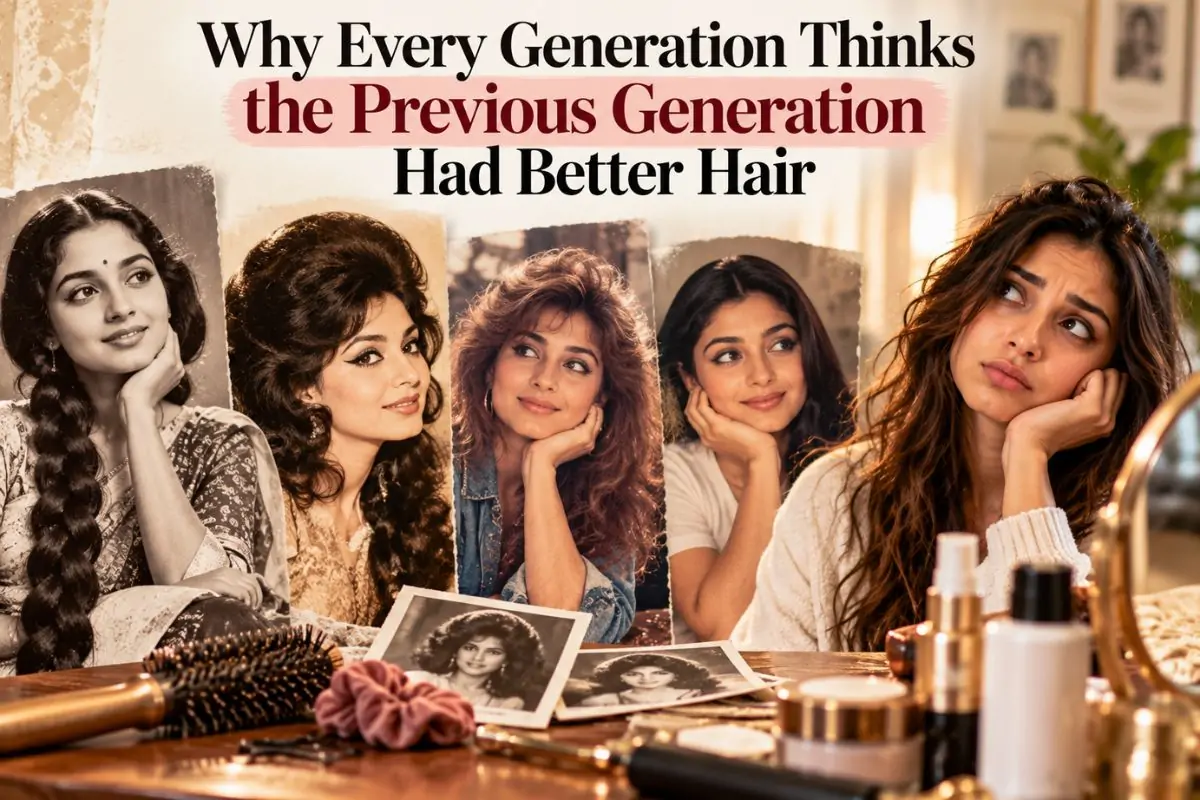
Look at old photographs and the complaint is almost universal. Our mothers had thicker hair. Our grandmothers had longer hair. Women in the 1970s had extraordinary volume. Men in the 1980s somehow had enough hair to survive an entire monsoon. And every generation seems convinced that the one before it possessed the secret to hair that has now been lost.
Maybe they did.
But probably not in the way we think.
The Hair We Remember Was Never Quite Real
Old photographs are powerful because they compress an entire era into its most memorable images. We remember the woman with the enormous blowout, not the thousands of women whose hair was ordinary. We remember the thick braid, the dramatic curls and the glossy film-star hairstyle because those are the images that survived.
There is also a selection effect. Photographs were once less frequent, so people tended to be photographed on special occasions, dressed and groomed particularly well. Today’s phones document everything, including bad hair days, thinning hair, humidity, breakage and the moment you wake up looking like you’ve fought a ceiling fan.
We are comparing the highlight reel of the past with the entire archive of the present.
But Hair Really Has Changed
That doesn’t mean the nostalgia is completely imaginary. Hair health can be influenced by nutrition, stress, illness, hormones, pollution, smoking, medications, genetics and the way hair is treated.
Modern life has also introduced an extraordinary amount of chemical and mechanical stress. Frequent colouring, bleaching, straightening, heat styling, extensions and tight hairstyles can damage the hair shaft and contribute to breakage.
Then there is the environmental load. Urban air pollution can deposit particles and chemicals on the scalp and hair, while hard water can affect how hair feels and behaves. None of this means our ancestors lived in some mythical hair paradise, but the modern beauty routine can be remarkably aggressive.
The “Grandmother Had Better Hair” Theory Has Another Problem
Your grandmother may have had spectacular hair.
But she may also have had a completely different relationship with it.
She probably wasn’t washing, blow-drying, straightening, curling, bleaching, colouring and restyling it several times a week. Many women also wore their hair in protective styles that reduced daily manipulation.
Hair wasn’t necessarily treated as a constantly changing fashion accessory.
It was simply hair.
That difference matters because the visible length and thickness of hair depend not only on how much grows from the scalp but also on how much survives without breaking.
If hair grows normally but repeatedly breaks at the ends, you never get to see its full potential length.
We Also Live in a Much More Stressed World
This is where the nostalgia becomes less romantic.
Hair is biologically responsive to the body. Significant stress, illness, nutritional deficiencies and hormonal changes can affect the hair-growth cycle. Telogen effluvium, for example, can cause increased shedding after physical or emotional stress, illness, major weight loss or other physiological disruptions.
And modern life has plenty of potential triggers.
Poor sleep. Chronic stress. Restrictive diets. Long working hours. Pollution. Constant stimulation. The pressure to look good while simultaneously performing at work and maintaining a social life.
Your hair doesn’t know that you have a deadline.
Your body does.
The Diet Has Changed Too
Generational comparisons become particularly interesting when food enters the picture.
Previous generations certainly did not eat perfectly. They also had nutritional deficiencies, food insecurity and many other health problems that are easy to romanticize away.
But the modern diet can be extremely convenient and nutritionally uneven. Highly processed foods are everywhere, while restrictive dieting has become a cultural obsession.
Hair is not a survival priority for the body. When nutrition is inadequate, the body has more important things to deal with than producing luxurious hair.
Protein, iron, zinc and other nutrients are relevant to healthy hair growth, although supplements aren’t a universal solution and excessive supplementation can itself be harmful.
The answer isn’t necessarily going back to your grandmother’s kitchen.
It may simply be eating enough of the right things.
And Then There Is Genetics, The Part Nobody Wants to Hear
Sometimes your grandmother genuinely had incredible hair because she had genes for incredible hair.
You may not have inherited exactly the same combination.
Hair density, texture, growth patterns and susceptibility to certain types of hair loss are strongly influenced by genetics. Two sisters can have completely different hair even while growing up in the same house and eating the same food.
So before blaming shampoo, hard water, your birth decade or modern society, remember that biology has been quietly making its own decisions all along.
Perhaps We Don’t Actually Want Their Hair
This may be the most interesting part.
When people say previous generations had better hair, they are often remembering more than hair.
They remember a particular visual culture.
The thick braid represents an era before constant comparison. The enormous blowout represents glamour. The natural grey hair represents a different attitude toward ageing. The old photographs seem slower, more polished and somehow more substantial.
We attach those feelings to the hair.
Then we look at our own split ends and wonder what happened.
But perhaps the real difference is that we have never had more ways to see, compare and criticize ourselves.
Previous generations couldn’t scroll through thousands of strangers with perfect hair before breakfast.
They couldn’t compare their hair texture with someone in Seoul, their colour with someone in Los Angeles and their density with a celebrity in Mumbai.
Their hair simply existed.
Ours is constantly being evaluated.
So, Did Previous Generations Really Have Better Hair?
Some did.
Some absolutely didn’t.
And some of what we remember is lighting, photography, genetics, styling, selective memory and nostalgia doing a remarkably convincing job together.
The bigger truth is that every generation inherits different advantages and different problems.
Our grandmothers may have had fewer chemical treatments but fewer effective treatments for hair loss. They may have eaten more traditional foods but had less access to dermatologists and modern diagnostics. They may have used fewer products but also had fewer options when something went wrong.
So perhaps the secret isn’t hidden in an old hair oil bottle waiting to be rediscovered.
Maybe the lesson is simpler.
Hair was never meant to survive an entire lifestyle built around constantly changing it.
And perhaps the next generation will look at our photographs one day, stare at our impossibly glossy hair and say the same thing:
“They had such good hair back then.”