
The Mystery of Malana: A Guide to the Hidden Republic and its ‘No-Touch’ Code

The “no-touch” policy in Malana isn’t just a quirk; it is a rigid religious law dictated by their chief deity, Jamlu Rishi. To the villagers, their territory is sacred ground, and outsiders (and even their goods) are considered spiritually impure or “unclean.”
What is the ‘no-touch’ rule in Malana village? The ‘no-touch’ rule is a religious mandate in Malana where outsiders are forbidden from touching residents, their homes, or their temples. Visitors must not hand money directly to shopkeepers (it must be placed on a surface) and must stay on designated paths. Breaking this rule results in a fine, typically used to fund a purification ritual involving a sacrificial animal to appease the local deity, Jamlu Rishi.
The Core Rules for Visitors
The social code is built on the principle of physical distance. If you visit, you are effectively a guest in a space that considers you a potential source of contamination.
- Do Not Touch People: Never initiate a handshake or brush against a resident.
- Do Not Touch Property: This includes temple walls, the stones of houses, and even the products in shops.
- The Shopkeeper’s Protocol: When buying anything, do not hand money to the shopkeeper. You must place the cash on the counter or the floor, and they will place your change down for you to pick up.
- Stay on the Path: Straying into private courtyards or sacred groves is a major violation.
- No Photography of Sacred Sites: While you can take general photos, taking pictures of the temples or the village council (Chaupal) is strictly forbidden.
What Happens if You Break the Rules?
The Malanese legal system is swift and focuses on “purification” rather than traditional criminal punishment.
1. The Immediate Fine
If you touch a temple or a house, you will be asked to pay a fine on the spot. Historically, this was around ₹2,500 to ₹3,500, though it can vary. This money isn’t a “penalty” in the Western sense—it is specifically used to pay for a purification ritual.
2. The Sacrificial Ritual
The village believes that your touch has defiled the sanctity of the space, which angers Jamlu Rishi. To appease him, the fine is used to buy a lamb or a goat, which is then sacrificed by the village priest to cleanse the area and restore spiritual balance.
3. Social Ostracization
If a visitor is seen as repeatedly disrespectful or refuses to pay a fine, they may be forcibly asked to leave the village immediately. In extreme cases, the village council can ban an individual from ever returning.
The Religious Logic: Malana operates as a “Theocracy.” The villagers believe that if they allow outsiders to touch their sacred structures without purification, Jamlu Rishi will bring bad luck, crop failure, or illness to the entire community.
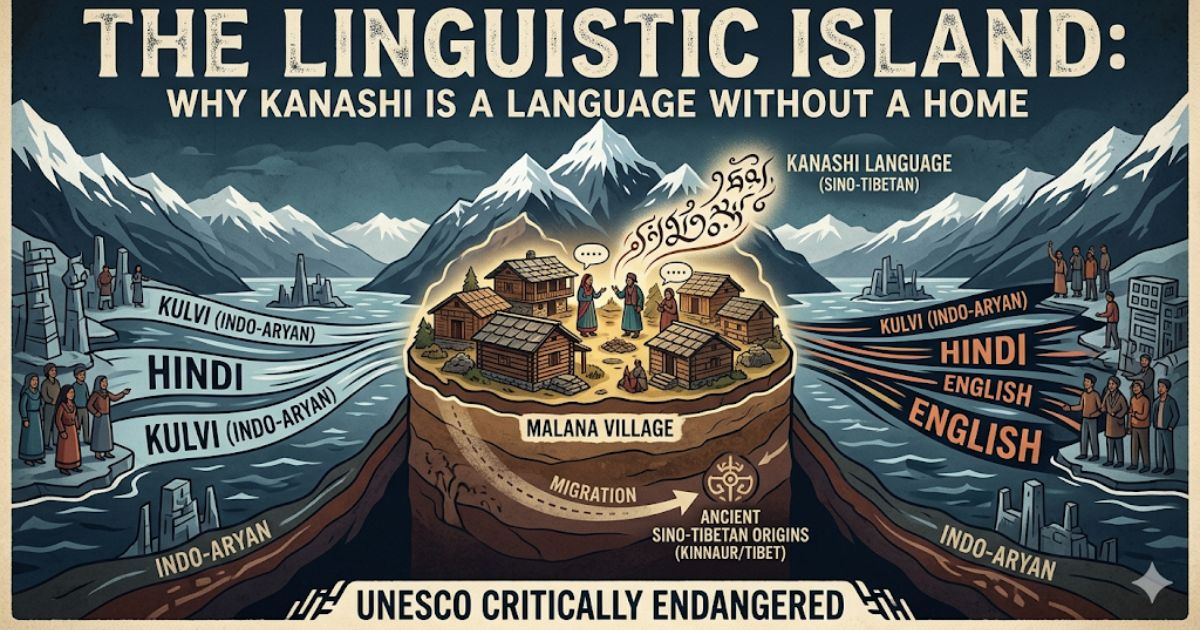
Explore the story of Kanashi, a rare and endangered language, and understand why it struggles to survive in a rapidly changing world.


