The Linguistic Island: Why Kanashi is a Language Without a Home
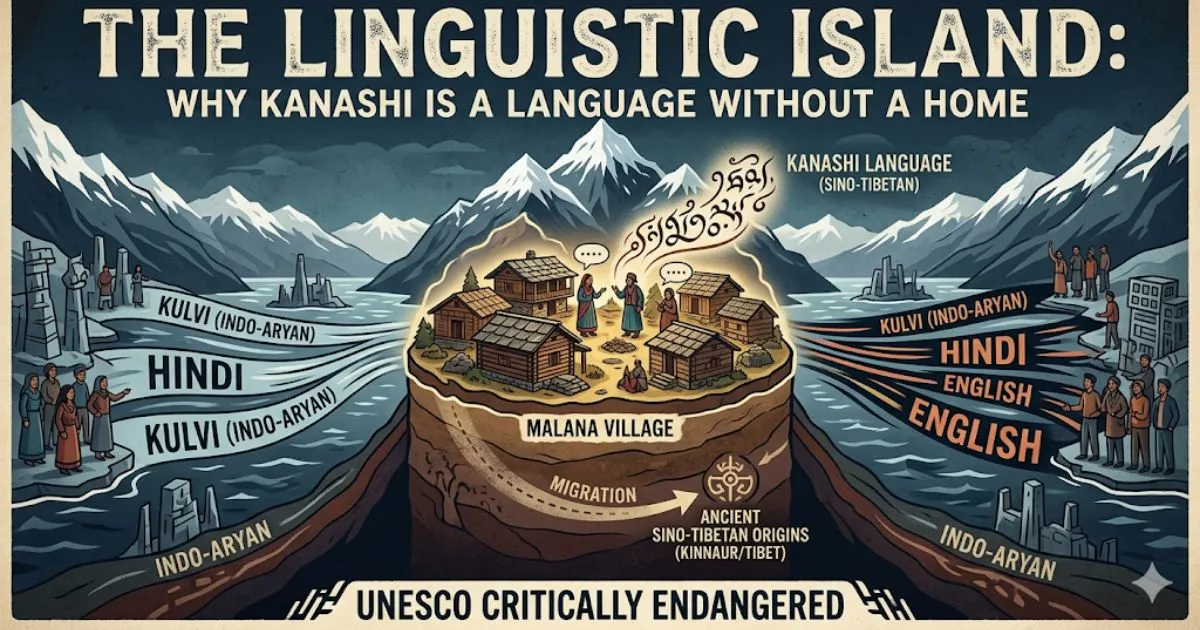
Kanashi is more than just a local dialect; it is a “linguistic island.” Spoken only by the ~2,500 residents of Malana, it has remained largely unchanged for centuries due to the village’s extreme geographic and social isolation.
Linguists are fascinated by it because it shouldn’t exist where it does—it is a language that seems to have wandered far from home.
1. The Linguistic Mystery: A Sino-Tibetan Outlier
The most jarring thing about Kanashi is its ancestry. While almost every neighboring village in the Parvati Valley speaks an Indo-Aryan language (like Kulvi), Kanashi belongs to the Sino-Tibetan family.
- The Disconnect: It is structurally and lexically related to languages found in Kinnaur and Tibet, rather than the surrounding Kullu district.
- The “Relic” Status: Because it is surrounded by Indo-Aryan languages, it has become a “relic language”—a snapshot of an ancient migration or pocket of people that survived while everything around them changed.
2. Why Linguists Are Obsessed
The “Language of the Gods”
The Malanese believe Kanashi was gifted to them by their deity, Jamlu Rishi. This religious significance has acted as a natural barrier to language change. For a long time, it was strictly forbidden to teach the language to outsiders, and even today, there is a strong cultural taboo against using non-Kanashi words within the village boundaries.
Distinct Grammatical Features
Kanashi retains complex features that many related languages have lost:
- Verb Conjugation: It uses a highly intricate system of suffixes to indicate not just when an action happened, but the status of the person doing it.
- The Lack of a Script: Kanashi is entirely oral. It has no written form, meaning its history is carried solely through collective memory, folk songs, and the “divine” decrees of the village council.
3. The Threat of Extinction
UNESCO has classified Kanashi as a “critically endangered” language. As Malana becomes more connected to the world via tourism and the internet, the language is facing two major pressures:
- The Rise of Hindi/English: Younger generations are increasingly using Hindi for trade and English for interacting with tourists.
- Lexical Borrowing: Modern concepts (like “internet,” “mobile,” or “electricity”) don’t exist in ancient Kanashi, forcing the adoption of outside loanwords that slowly dilute the original tongue.
4. How it Compares to Neighbors
| Feature | Kanashi (Malana) | Kulvi (Neighboring Villages) |
| Family | Sino-Tibetan (Tibeto-Burman) | Indo-Aryan |
| Ancestor | Closely linked to Zhang-Zhung | Linked to Sanskrit |
| Speakers | ~2,500 | ~1.5 Million |
| Sacredness | High — “The Language of Jamlu” | Low — Daily vernacular |
The “Alexander” Connection: While the villagers claim descent from Alexander the Great’s Indo-Greek soldiers, Kanashi shows zero Greek influence. This is one of the biggest points of contention for researchers: the DNA may tell one story, but the language tells a completely different one of Tibetan-Kinnauri origins.