The Impact of Technology on Society: Progress, Power, and the Price We Pay
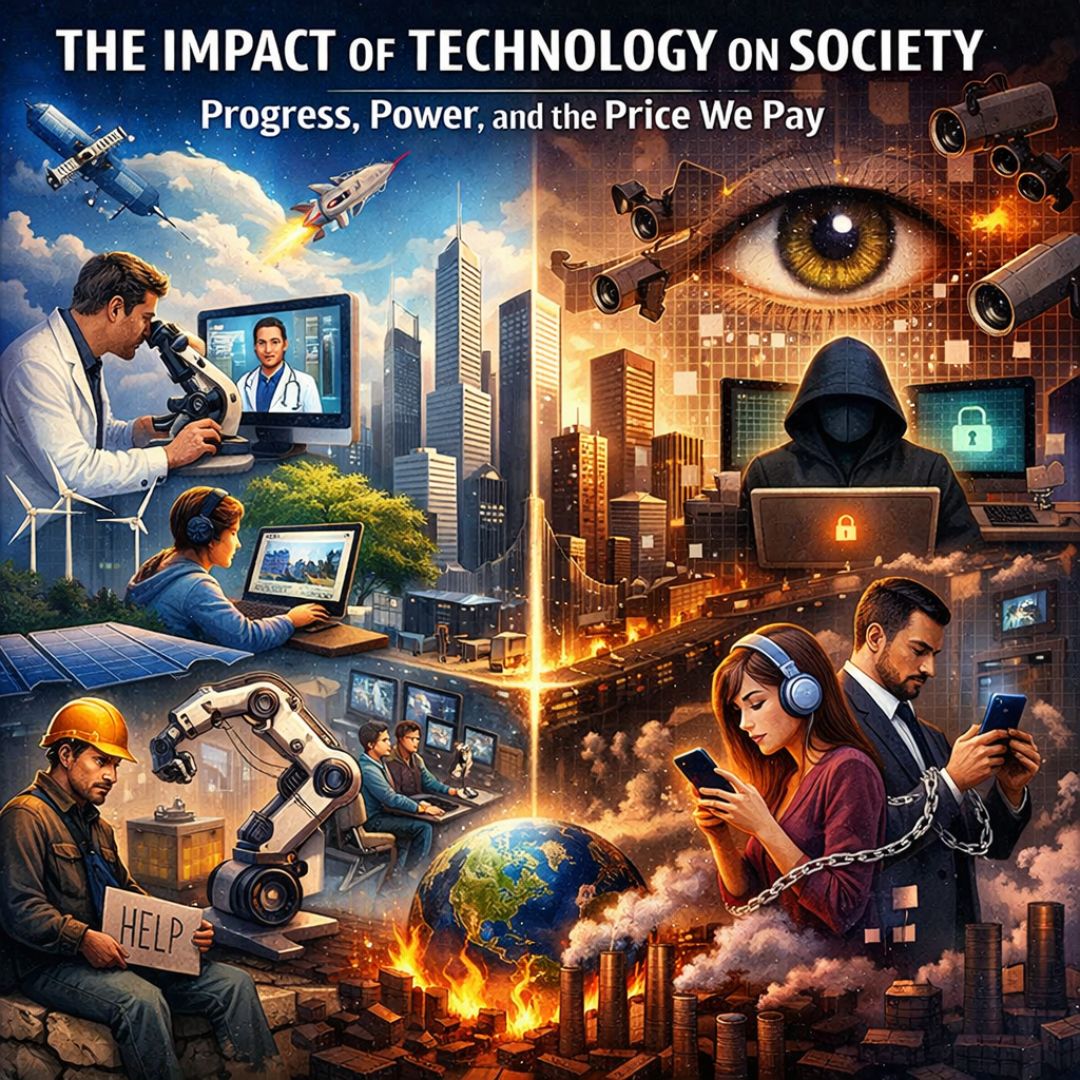

Technology is not just something we use. It is something that reshapes how we think, work, love, argue, and survive.
From the first mechanical calculators to artificial intelligence, technology has quietly become the backbone of modern civilization. It determines how fast economies move, how relationships form, how knowledge spreads, and increasingly, how power is distributed.
But every revolution comes with consequences.
The impact of technology on society is not a simple success story. It is a complex narrative of opportunity and loss, connection and isolation, empowerment and control.
Let’s unpack it.
1. Technology as the Engine of Human Progress
At its best, technology has been humanity’s greatest equalizer.
It has:
- Expanded access to education through online learning
- Revolutionized healthcare with telemedicine and advanced diagnostics
- Connected remote villages to global markets
- Enabled instant communication across continents
- Accelerated scientific discovery at unprecedented speed
A student in a small town can now attend lectures from Harvard. A rural entrepreneur can sell products globally. Doctors can consult specialists thousands of miles away.
The internet and platforms like Google and OpenAI have democratized information that once lived only inside elite institutions.
Knowledge is no longer scarce. Bandwidth is.
Entire industries have been born in a decade. Remote work has redefined geography. Digital payments have reshaped commerce. Governments operate faster. Disaster responses are more coordinated. Voices once silenced now find audiences.
Technology gave humanity reach.
2. Communication: More Connected, Yet Strangely Alone

Never in history have humans been this connected.
And never this lonely.
Social platforms promise community, but often deliver comparison. They amplify voices, but also distort reality. Apps allow instant messaging, video calls, and global networking, yet meaningful face-to-face interaction is quietly disappearing.
Platforms like Facebook (now Meta) changed how relationships form. Validation became measurable. Attention became currency. Identity became performance.
We curate lives for algorithms.
Psychologists now link excessive screen time to anxiety, depression, and reduced attention spans. Conversations compete with notifications. Presence competes with feeds.
Technology didn’t kill human connection.
But it redefined it, often in ways we are still struggling to understand.
3. Work, Automation, and the New Economic Divide
Technology has always replaced jobs. But this time is different.
Artificial intelligence and automation are not just replacing manual labor. They are disrupting:
- Accounting
- Journalism
- Customer support
- Design
- Programming
- Legal research
Entire professions are being reshaped in real time.
Yes, new roles emerge. But they demand advanced skills, adaptability, and digital literacy. Those who can keep up thrive. Those who cannot are left behind.
This creates a widening divide:
- Between digital natives and older workers
- Between urban tech hubs and rural communities
- Between high-skilled professionals and everyone else
The future of work is flexible, remote, algorithm-driven, and often unstable.
We are moving from lifetime careers to project-based survival.
Technology increased productivity.
But it also introduced precarity.
4. Surveillance, Data, and the Erosion of Privacy
Every click leaves a trace.
Every search is logged.
Every location pinged.
Modern technology runs on data, and we are the product.
Governments track citizens. Corporations profile behavior. Algorithms predict desires before we consciously form them. Facial recognition scans public spaces. Smart devices listen inside homes.
Convenience has slowly traded places with consent.
Most people do not know:
- Who owns their data
- How long it is stored
- Who it is sold to
- How it shapes the content they see
Digital freedom exists on paper. In practice, we live inside invisible systems of monitoring and manipulation.
Privacy is no longer default.
It is something you have to fight for.
5. Culture, Identity, and Algorithmic Influence

Technology doesn’t just reflect culture.
It creates it.
Algorithms decide which stories go viral. Recommendation engines shape political opinions. Filters redefine beauty standards. Trends are manufactured, accelerated, discarded.
Young people grow up inside digital ecosystems that reward outrage, spectacle, and constant visibility.
Even creativity is changing. AI generates art, music, essays, and videos. Authorship becomes blurred. Originality becomes harder to define.
We are entering an era where machines don’t just assist human expression.
They participate in it.
The question is no longer whether technology influences culture.
It is whether culture can still exist independently of it.
6. Education and the Battle for Attention
Technology made learning accessible.
It also made distraction infinite.
Students now compete with TikTok, games, notifications, and endless content streams. Deep reading is replaced by scanning. Long-form thinking is interrupted by alerts.
Education systems struggle to adapt.
While online platforms offer courses and certifications, critical thinking risks being replaced by copy-paste knowledge. Memorization gives way to search dependency.
The challenge is no longer access to information.
It is discipline in consuming it.
7. The Ethical Crossroads Ahead
We stand at a defining moment.
Technology is advancing faster than laws, ethics, and social frameworks.
Questions we must confront:
- Who controls AI?
- Who benefits from automation?
- How do we protect human dignity in digital spaces?
- What happens when machines outperform humans cognitively?
These are not technical problems.
They are moral ones.
Without regulation, accountability, and public awareness, technological power concentrates in the hands of a few.
History shows us what happens when power centralizes.
Conclusion: Technology Is a Tool. Society Chooses the Outcome.
Technology itself is neutral.
It becomes dangerous or transformative based on human intention.
It can amplify empathy or exploitation. It can democratize opportunity or deepen inequality. It can enlighten minds or numb them.
We cannot afford passive consumption anymore.
Society must actively shape how technology evolves through education, regulation, ethical design, and cultural awareness.
Otherwise, we risk building a future that moves fast but forgets what it means to be human.