People-Pleasing in Relationships: Why Women Struggle to Set Boundaries with Partners

Part of our series on the psychology of people-pleasing. Start with the pillar guide: Why Women People-Please
People-pleasing can be managed with a boss or smoothed over with a friend , but with a romantic partner, the stakes feel entirely different. This is the relationship where the fear of conflict, rejection, or abandonment often runs deepest, which is exactly why boundaries can feel hardest to hold here.
Why Romantic Relationships Amplify the Pattern
Romantic attachment activates some of our oldest, most primal wiring around safety and belonging. For a woman with a people-pleasing pattern rooted in childhood conditioning, a partner’s mild irritation can trigger a response wildly out of proportion to the situation — not because she’s overreacting, but because her nervous system is responding to an old, familiar threat: disapproval means danger.
This is why so many women find themselves agreeing to things in relationships they wouldn’t tolerate anywhere else — dismissing their own needs, avoiding necessary conflict, or apologizing for things that don’t require an apology, just to restore a sense of harmony.
The “Peacekeeper” Trap
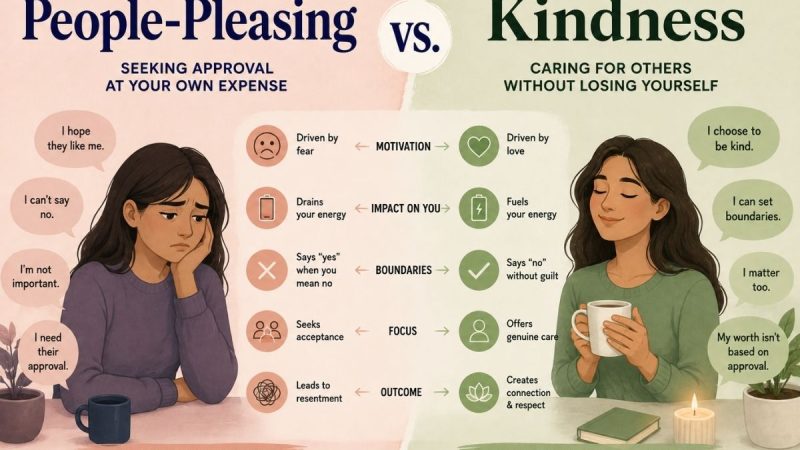
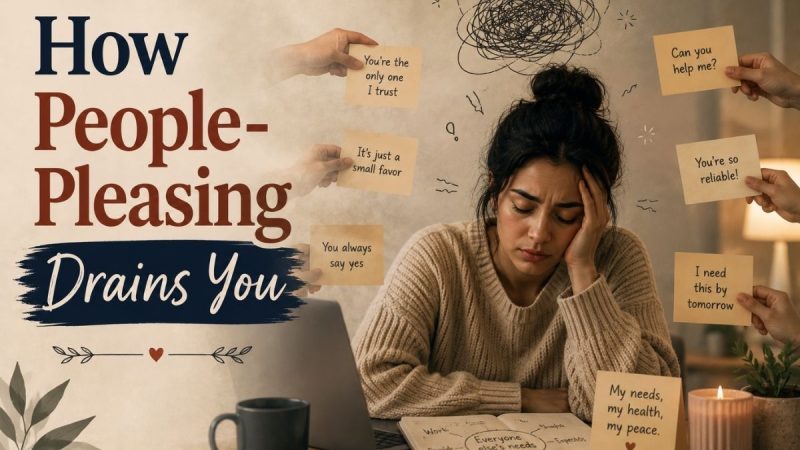
Many people-pleasers in relationships take on the role of designated peacekeeper — smoothing over every disagreement, absorbing blame to end conflict faster, or preemptively adjusting their own behavior to avoid a partner’s bad mood. It can look like emotional maturity from the outside. From the inside, it often feels like a low hum of anxiety and a slow erosion of authentic connection.
The uncomfortable truth: a relationship built on one person’s constant accommodation isn’t actually more stable — it’s just quieter about its instability.
Signs It’s Showing Up in Your Relationship
- Agreeing with your partner’s opinion even when you privately disagree
- Feeling responsible for your partner’s mood
- Avoiding topics that might lead to disagreement, even important ones
- Saying “I’m fine” when you’re not, to avoid seeming difficult
- Feeling disproportionate relief when your partner isn’t upset with you
What Healthier Boundaries Actually Look Like
Setting a boundary with a partner doesn’t require an ultimatum or a dramatic conversation. It can be as simple as: “I don’t want to talk about this right now, but I do want to come back to it later,” or “I’m not comfortable with that, so let’s find another option.” Boundaries expressed calmly, without over-apologizing, tend to be received far better than the anxious mind predicts.
A Partner Who Can Hold Your No
One useful gauge of relationship health: how does your partner respond when you say no? A partner capable of real intimacy can tolerate your boundaries without punishing you for them. If every no is met with withdrawal, guilt-tripping, or anger, that’s worth examining separately — because in that dynamic, the fear driving your people-pleasing isn’t just old conditioning. It’s also a reasonable read of your present-day environment.
For the broader toolkit on building this skill day to day: Breaking the Cycle: Practical Steps to Reclaim Your “No”
And to understand the deeper roots of why this feels so high-stakes in the first place: The Root Causes: How Childhood Conditioning Shapes People-Pleasing in Women