The Architecture of the ₹1000-Crore Club: Deconstructing the Mechanics of Modern Indian Event Cinema
There was a time when a box office hit in India meant a slow, rhythmic crawl toward a “100-day run” at single-screen theaters. Word of mouth was built over weeks, and success was measured in longevity.
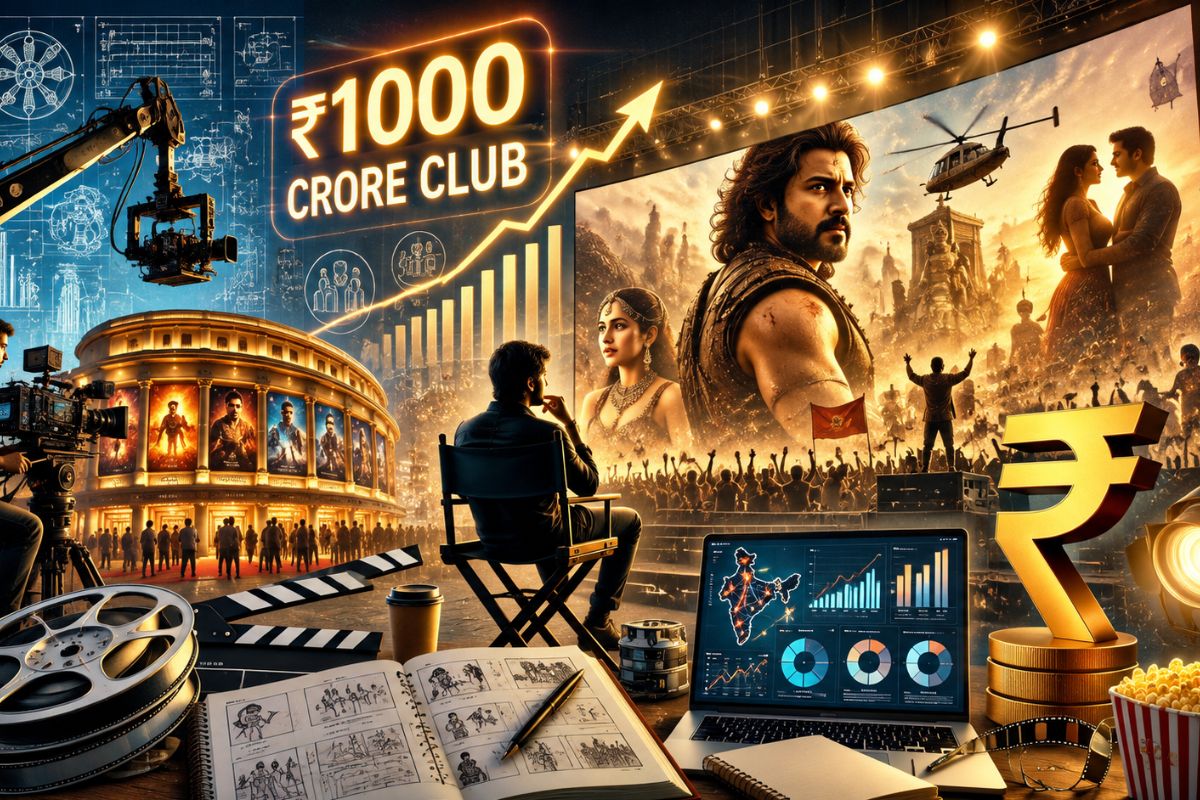
Today, the landscape is entirely unrecognizable. We live in the era of the “Event Film“—pan-Indian colossal productions mounted on budgets exceeding ₹300–500 crores, designed to detonatively breach the ₹1000-crore mark globally. But crossing this threshold is no longer a simple matter of star power or heavy action sequences. It is a highly engineered, data-driven mathematical feat combining hyper-compressed release windows, viral marketing hooks, and meticulous theatrical pricing models.
Let’s pull back the curtain on the core economic and psychological frameworks that drive modern Indian blockbuster analytics.
1. The Anatomy of the Front-Loaded Box Office
The biggest shift in modern box office mechanics is the extreme front-loading of revenue. Modern blockbusters aim to recover 60–70% of their theatrical budget within the first three days (Opening Weekend).
To achieve this, distributors employ a “scorched-earth” release strategy:
- Saturation Booking: Instead of rolling a film out gradually, mega-releases take over 10,000 to 12,000 screens across the country simultaneously. In premium hubs like Bengaluru, Hyderabad, and Mumbai, it is common to see a single multiplex dedicate 80% of its screens to one film, running shows as early as 4:00 AM or even round-the-clock.
- The FOMO Premium: By inflating ticket prices during the first weekend (often by 50–100% in Tier-1 cities), studios capitalize on the audience’s intense Fear Of Missing Out. Audiences willingly pay a premium to avoid spoilers online, turning the opening weekend into a massive, collective cultural event.
2. The Pan-Indian Cultural Arbitrage
The term “Pan-Indian” has evolved from a buzzy marketing phrase into a strict economic blueprint. To hit astronomical box office heights, a film can no longer rely on its home state or a single linguistic demographic. It must bridge the north-south cultural divide.
This involves a deliberate strategy executed during the screenwriting and casting phases:
- The Ensemble Matrix: Studios systematically pair a massive South Indian superstar with a prominent Bollywood antagonist or leading lady (or vice-versa). This instantly guarantees double-market penetration.
- Agnostic Visual Storytelling: High-concept action pieces, universal mythic archetypes, and sweeping emotion serve as the primary narrative drivers. Why? Because complex, dialogue-heavy exposition is notoriously difficult to translate across dubbed languages. High-fidelity visual spectacles pass through linguistic barriers effortlessly.
3. Viral Asset Drops: The Hype Cycle
In the hyper-distracted digital attention economy, a traditional two-minute trailer dropped a month before release is completely insufficient. Modern marketing campaigns are run like high-octane software product launches, complete with staggered “asset drops” engineered for maximum algorithmic velocity.
- The Short-Form Hook: Music tracks are no longer composed just for the film; they are tuned for vertical video algorithms. Creators ensure a song has a distinct, easily replicable 15-second signature dance step or audio transition designed to explode across Instagram Reels and YouTube Shorts weeks before the theatrical debut.
- The Easter Egg Economy: Teasers and trailers are deliberately packed with split-second frames, background symbols, and hidden character details. This feeds an army of independent digital content creators who generate millions of organic views through breakdown videos, fan theories, and frame-by-frame analysis—essentially outsourcing the film’s promotional momentum to the internet.
The Economic Blueprint: Event vs. Mid-Budget
| Metric | The Event Film Blockbuster | The Mid-Budget Narrative |
| Primary Driver | Cultural FOMO & IMAX/Premium Large Format (PLF) Spectacle | Genre-specific word-of-mouth (Comedy, Thriller, Drama) |
| Screen Count | 9,000 – 13,000 screens globally | 1,200 – 2,500 screens domestically |
| Revenue Curve | High peak opening weekend, rapid second-week stabilization | Slow “sleeper-hit” incline, steady performance over 3 weeks |
| OTT Window Delay | Strict 4–8 week exclusive theatrical hold | 3–4 week flexible streaming activation |
The Analytical Takeaway: The ₹1000-crore club is not an anomaly—it is a repeatable blueprint when visual scale, strategic casting arbitrage, and aggressive algorithmic marketing align perfectly. As audience habits solidify around premium theater experiences for big spectacles and home streaming for mid-scale dramas, the engineering behind these cinematic events will only become sharper.