Amazon vs. Starlink 2026: The Satellite Internet War Heats Up
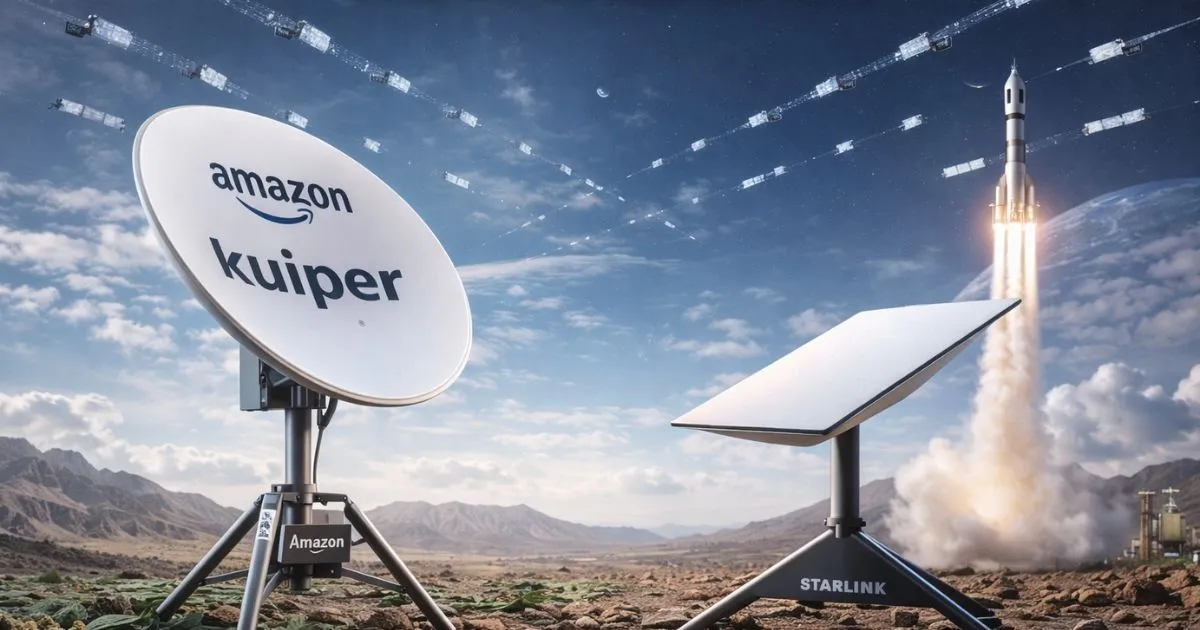
While the hardware world is buzzing about “Wide” foldables and software is obsessing over “Agentic AI,” the most expensive war of 2026 is happening 340 miles above our heads. This week, reports have intensified that Amazon is in the final stages of a multi-billion dollar deal to acquire Globalstar, a move designed to turn Project Kuiper into a true “Starlink killer.”
The Globalstar Acquisition: Amazon’s Strategic Masterstroke
For years, SpaceX’s Starlink has enjoyed a near-monopoly on high-speed satellite internet, boasting over 6,000 satellites in orbit. Amazon’s Project Kuiper, though ambitious, has been playing a massive game of catch-up.
The acquisition of Globalstar changes the math overnight. By absorbing Globalstar’s existing infrastructure and—more importantly—their coveted L-band spectrum licenses, Amazon can bypass several regulatory hurdles. This allows Project Kuiper to offer direct-to-cell capabilities, effectively turning every smartphone on the planet into a satellite phone without the need for specialized hardware.
Why This Matters for Consumers:
- True Global Roaming: Imagine having 5G speeds in the middle of the Sahara or the North Atlantic without changing your SIM card.
- Price Wars: With Amazon’s massive retail ecosystem, analysts expect “Prime Internet” bundles that could undercut Starlink’s monthly subscription fees by up to 30%.
- Integrated Ecosystems: Your Alexa devices, Rivian vehicles, and AWS-powered smart homes will soon have a dedicated, unhackable satellite backbone.
Musk vs. Bezos: The Rivalry Goes Nuclear
The tension between the world’s two richest men has reached a boiling point. In response to the Amazon-Globalstar news, SpaceX has reportedly accelerated the launch of Starlink V3, which utilizes the massive payload capacity of the fully operational Starship fleet.
SpaceX is no longer just selling internet; they are selling latency. By utilizing laser-crosslink technology, Starlink is marketing itself to the “Brat Finance” day-traders and high-frequency firms who need millisecond advantages that traditional fiber optics simply cannot provide.
The “Kessler Syndrome” Concern
As the number of satellites in Low Earth Orbit (LEO) is projected to triple by 2028, the international community is sounding the alarm. The trending term in scientific circles today is Orbital Congestion.
The UN’s Office for Outer Space Affairs (UNOOSA) is currently drafting the “2026 Space Traffic Accord,” a set of strict regulations meant to prevent the Kessler Syndrome—a chain reaction of satellite collisions that could render space travel impossible for generations.
Summary: The Connectivity Landscape in 2026
The Verdict: The Amazon-Globalstar deal is the final signal that satellite internet is no longer a niche service for rural areas or maritime vessels. It is becoming the primary infrastructure for the modern world. In 2026, being “offline” is officially becoming a choice rather than a geographic limitation.