
Radhika Gupta: The Girl With The Broken Neck Who Now Runs A Trillion Rupee Mutual Fund House
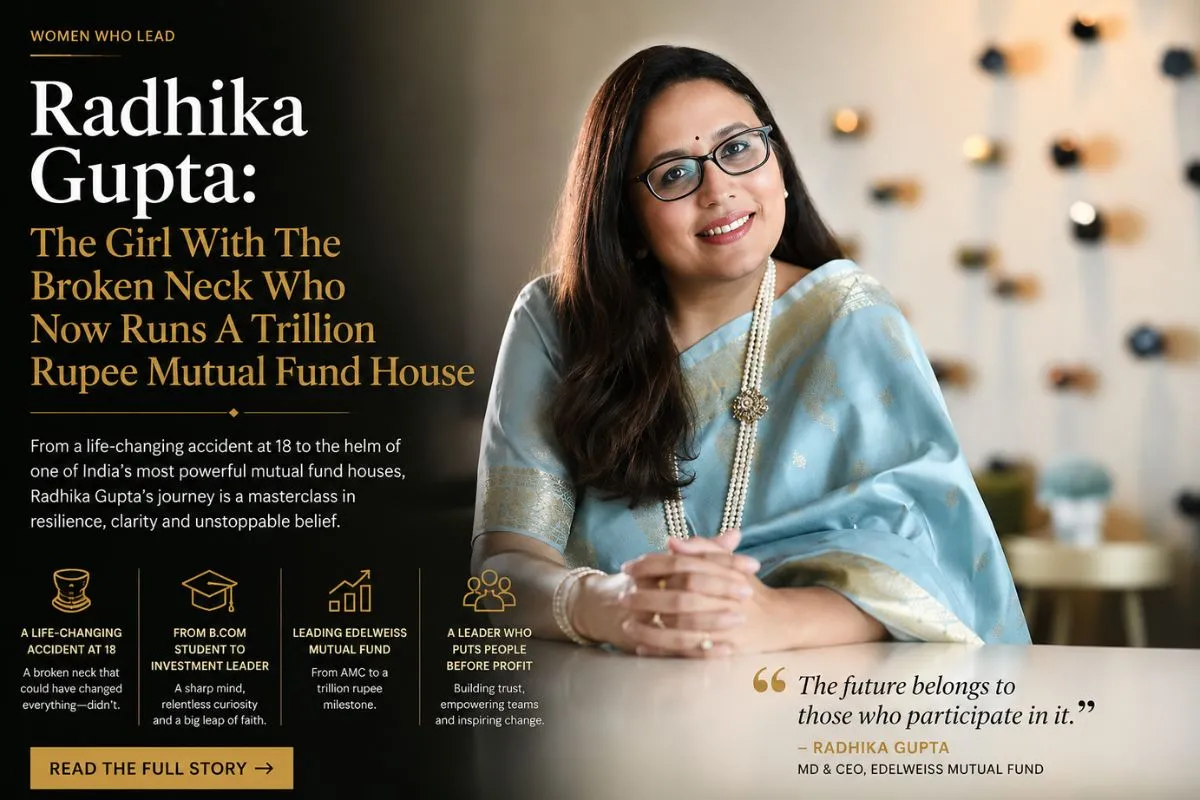
Radhika Gupta has given a version of the same line in interviews for years, that at airport security, when an officer notices the permanent tilt in her neck and asks what happened, she has learned to answer plainly rather than deflect. A nurse’s mishandling shortly after her birth in Islamabad in 1983 left her with a lasting physical condition, one that shaped how strangers looked at her for the rest of her childhood and, by her own account, shaped how she looked at herself for a long time afterward. Today she runs Edelweiss Mutual Fund, one of India’s fastest growing asset management companies, overseeing assets that have grown more than fifteenfold under her leadership. The distance between those two facts is the actual story.
A Childhood Spent Explaining Herself Before Anyone Asked
Gupta’s early life moved constantly. Her father, a career Indian Foreign Service officer, took the family through postings across Pakistan, Nigeria, Italy, and eventually the United States, giving her a genuinely international upbringing, an International Baccalaureate from a school in Rome, and, by her own repeated description, very little sense of permanent belonging anywhere. The physical tilt in her neck followed her through every one of those transitions, drawing stares and questions in classrooms across four continents before she had language sophisticated enough to explain it herself, let alone the confidence to stop feeling like she owed anyone an explanation at all.
She has spoken candidly about how deeply that early bullying affected her sense of self worth, describing herself in interviews as an underconfident child and teenager who leaned hard into academics partly because it was the one area where the way she looked simply did not factor into the outcome. That strategy worked. She earned a place at the University of Pennsylvania, completing a Bachelor’s in Computer Science Engineering through the university’s Jerome Fisher Program in Management and Technology, alongside a degree in Economics from the Wharton School, a rare dual credential that combined the technical and financial fluency her later career would draw on directly.
Seven Rejections Before The Job That Changed Everything
What came after graduation tested her far more than the classroom ever had. Gupta applied to firm after firm and was turned down repeatedly, and she has spoken publicly, with real honesty, about how bleak that stretch of her early twenties actually became, describing a period around her seventh consecutive rejection where her confidence and her mental health both hit a genuine low point, low enough that she has referenced having dark thoughts during that time in later interviews. It is a difficult thing for any young person to sit with, and Gupta’s willingness to name it plainly, rather than skip straight to the redemption part of the story, is part of why her account has resonated with so many people who assume a McKinsey and Wall Street resume must have come easily.
The eighth application landed her a position as a business analyst at McKinsey, and three years there gave her the operational grounding that eventually let her strike out on her own.
Building A Firm From Nothing, Then Handing It Off
At twenty five, Gupta moved back to India and co-founded Forefront Capital Management with her husband, Nalin Moniz, running the business out of a small Mumbai office with a lean team and none of the institutional backing a McKinsey alumna might have expected to walk into. The firm grew steadily over the following years into a business valued at roughly two hundred crore rupees before Edelweiss Financial Services acquired it in 2014, bringing Gupta into the wider Edelweiss Group as part of the deal rather than simply as an outside hire.
Three years later, in 2017, she was appointed Managing Director and CEO of Edelweiss Mutual Fund itself. The scale of what she has since built is not subtle. Assets under management grew from roughly sixty seven hundred crore rupees at the time of her appointment to well over one lakh crore rupees by 2023, pushing the fund house from around thirtieth position in the industry into the top fifteen. Under her leadership, Edelweiss acquired JP Morgan’s Indian mutual fund business and launched the Bharat Bond ETF in 2019, India’s first ever target maturity bond ETF, a genuinely novel product structure for the domestic market that has since been widely replicated by competitors.
Turning “The Girl With The Broken Neck” Into A Talk, Not A Confession
Gupta’s public visibility grew substantially beyond financial circles after she delivered a TEDx talk titled “The Girl With A Broken Neck,” a phrase she has said initially irritated her when others used it, before she deliberately reclaimed it as the title of her own story rather than a label imposed on her. She has described her relationship with her own physical condition as something that genuinely evolved over decades, from a source of active shame in childhood to something closer to simple fact by adulthood, a detail she now discusses directly rather than around. That same directness has carried into her role as an investor judge on Shark Tank India, where she evaluates founders navigating exactly the kind of early, uncertain terrain she herself once knew from a small Mumbai office with no institutional safety net behind her.
Why Her Story Sits Differently From Most Founder Narratives
What separates Gupta’s account from a standard resilience narrative is how little she smooths over the actual low points. She names the bullying specifically rather than gesturing vaguely at “a difficult childhood.” She names the number of job rejections rather than compressing the struggle into a single sentence. She has been willing, in a country where mental health still carries real stigma, to say plainly that her confidence and her state of mind genuinely bottomed out at one particular point in her twenties, before naming exactly what changed it.
That same instinct, refusing to let a physical difference define the boundaries of what a woman is allowed to build, echoes in Real Shee Power’s own profile ofAboli Jarit, the wheelchair using model and singer who reshaped adaptive fashion in India, a genuinely different field built on an almost identical refusal to treat a physical condition as the final word on what a career could look like. Both stories point toward the same underlying idea, that self acceptance rarely arrives as a single dramatic turning point, and far more often as a slow, repeated decision to keep building the actual work regardless of how visible or invisible that struggle happens to be to everyone else watching.
What Actually Changed
Strip away the AUM figures and the ETF launch, and what remains is a fairly specific, well documented arc. A child mocked for how she looked built her entire early identity around academic achievement instead. A young graduate who nearly gave up after seven rejections took an eighth chance and made it count. A woman who once flinched at being called “the girl with the broken neck” chose that exact phrase as the title of the talk that introduced her to millions of people who had never heard of Edelweiss Mutual Fund before. None of it reads as inevitable in hindsight, which is precisely why Gupta keeps telling it the way she does, low points included, rather than only the parts that make the ending look easy.