
Real Shee Power Research Report: The Guilt That Still Calls You a Bad Daughter

Primary Findings from a Survey of 100 Urban Indian Women on the Costs of Being a “Good Daughter”
Research conducted by Real Shee Power
Locations: Delhi-NCR, Mumbai, Pune, Bangalore
Primary focus: Women aged 25–35 (with comparative data from ages 15–25)
1. Introduction and Research Focus
The ideal of the “good daughter” remains one of the most powerful and least examined forces in the emotional lives of Indian women. It rewards responsibility, adjustment, emotional management of the household, and the consistent prioritisation of family needs — frequently at the expense of the daughter’s own boundaries and well-being.
This Real Shee Power study examined the internal cost of that ideal. We asked: How does the pressure to be a good daughter translate into guilt, difficulty saying no, and selective self-sacrifice? How does it interact with birth order, marital status, regret about past compliance, and hopes for the next generation?
National data already show the structural backdrop. The 2024 Time Use Survey found that women who participated in unpaid domestic services spent an average of 289 minutes per day on them, compared with 88 minutes for men; women also spent 137 minutes on unpaid caregiving versus 75 minutes for men. These patterns of unequal responsibility form the ground on which the psychological patterns we observed take root.
The Guilt That Still Calls You a Bad Daughter
Access the complete Real SHEE Power research report based on a survey of 100 urban Indian women across Delhi-NCR, Mumbai, Pune and Bangalore. Explore the methodology, primary findings, statistical graphs and the hidden emotional costs of being a “good daughter”.
2. Methodology
Sample size: 100 women
Geographic scope: Delhi-NCR, Mumbai, Pune, and Bangalore
Age distribution:
- 75 women aged 25–35 (primary focus)
- 25 women aged 15–25 (comparison group)
Marital status: 25 married women
Mothers of first-born daughters: 7 women
Recruitment and data collection:
Participants were reached through Real Shee Power community networks, targeted outreach in the four cities, and snowball sampling. Data were collected via a structured questionnaire, with short follow-up conversations in a subset of cases for qualitative depth. Participation was voluntary.
Narrowing of the research:
The study deliberately focused on urban women in four major metropolitan centres. This allows observation of how the “good daughter” script operates even in environments with higher education levels, greater workforce participation, and more public conversation about mental health and gender. The sample is not nationally representative.
Core Questionnaire Items(selected):
- Do you feel like a “bad daughter” if you go against family expectations?
- How difficult is it for you to say “no” or put yourself first?
- Elder-daughter parental/protective role and emotional closeness with younger siblings.
- Lengths you would go to protect younger siblings from the same trauma.
- (Married) Guilt about eating before husband or children.
- Desire to break the cycle witnessed in your mother.
- Guilt when setting boundaries.
- Overall felt burden of “good daughter” expectations.
- What feels harder — protecting others or protecting yourself?
- Do you regret not fighting more for yourself earlier?
- (Mothers of first-born daughters) Would you want your daughter to be able to say no, or to comply with your wants?
3. Key Findings
Core results (N=100 unless noted):
- 75% feel like a bad daughter if they go against family expectations.
- 71% experience strong guilt when they set a boundary.
- 81% strongly want to break the cycle they saw their mothers live.
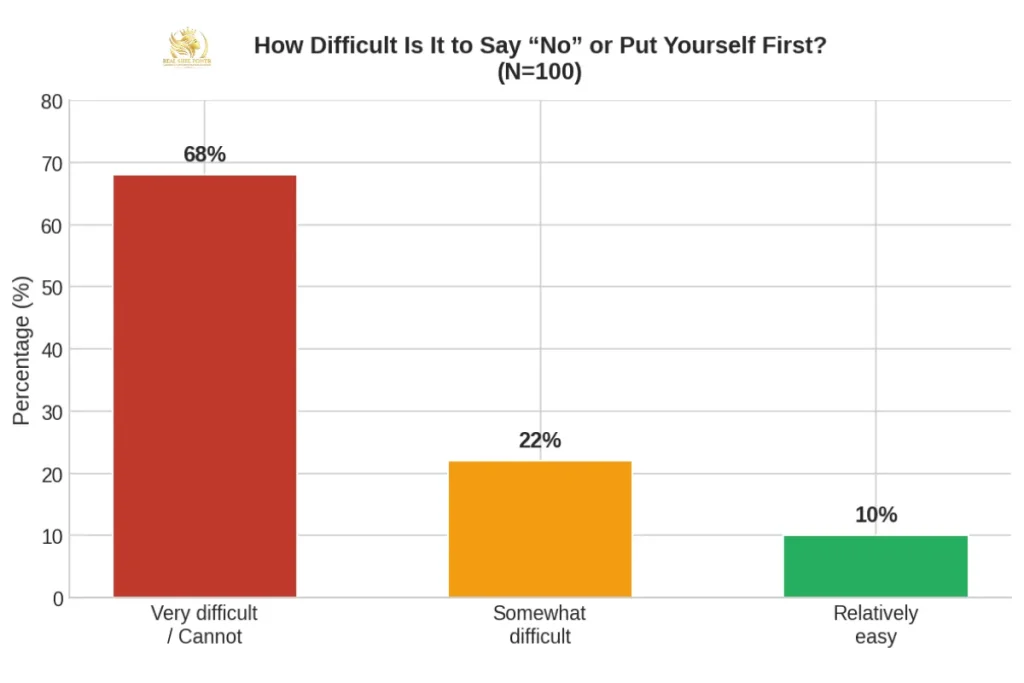
- 68% still find it very difficult or nearly impossible to say no or put themselves first.
- 64% say protecting themselves feels significantly harder than protecting younger siblings or future children.
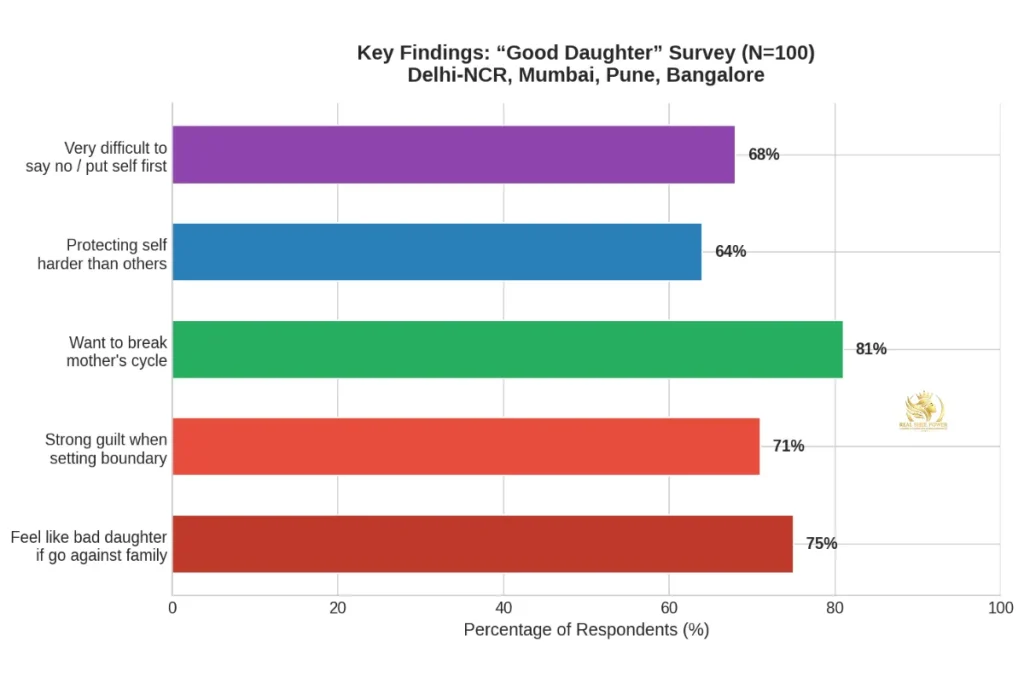
75% feel like a bad daughter if they go against family expectations.
71% still experience strong guilt when they set a boundary.
81% strongly want to break the cycle they saw their mothers live.
64% find it harder to protect themselves than to protect younger siblings or future children.
68% still find it very difficult (or almost impossible) to say no or put themselves first.
Regret about past compliance:
67% said “maybe yes” they regret not fighting more for themselves. The remainder said no or “can’t say.”
Married subsample (n=25):
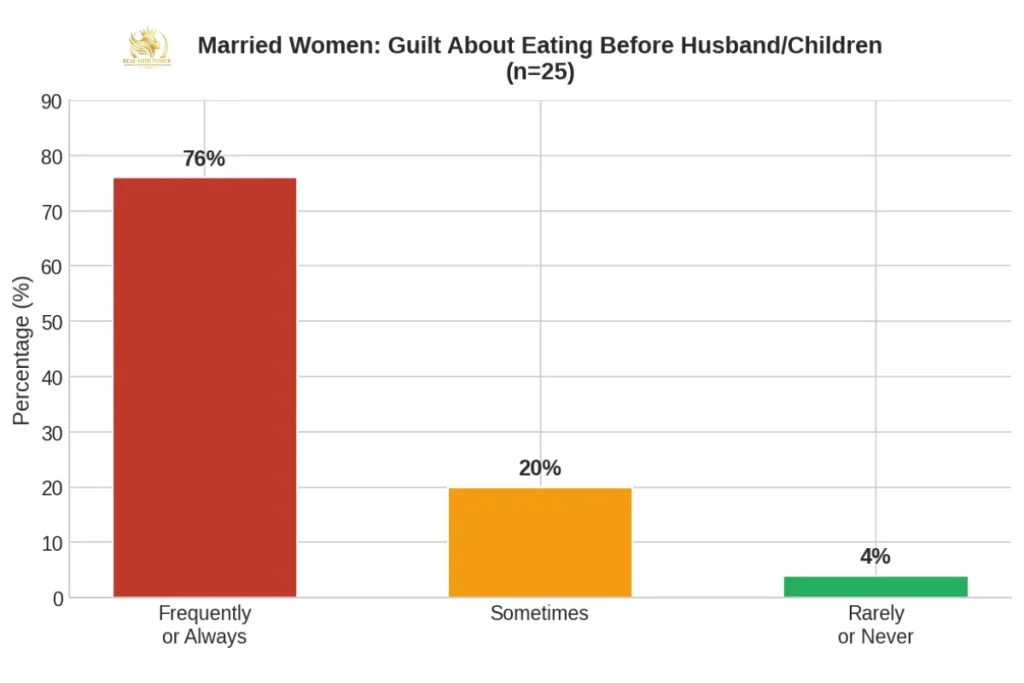
76% (19 women) feel guilty frequently or always about eating before their husband or children.
Mothers of first-born daughters (n=7):
85.7% said they would want their daughters to be able to say no rather than simply comply with parental wants.
Birth-order pattern:
Elder daughters frequently reported taking on quasi-parental roles. Many described closer emotional bonds with younger siblings than those siblings had with the parents, alongside a fierce determination to spare them the same trauma.
Age comparison:
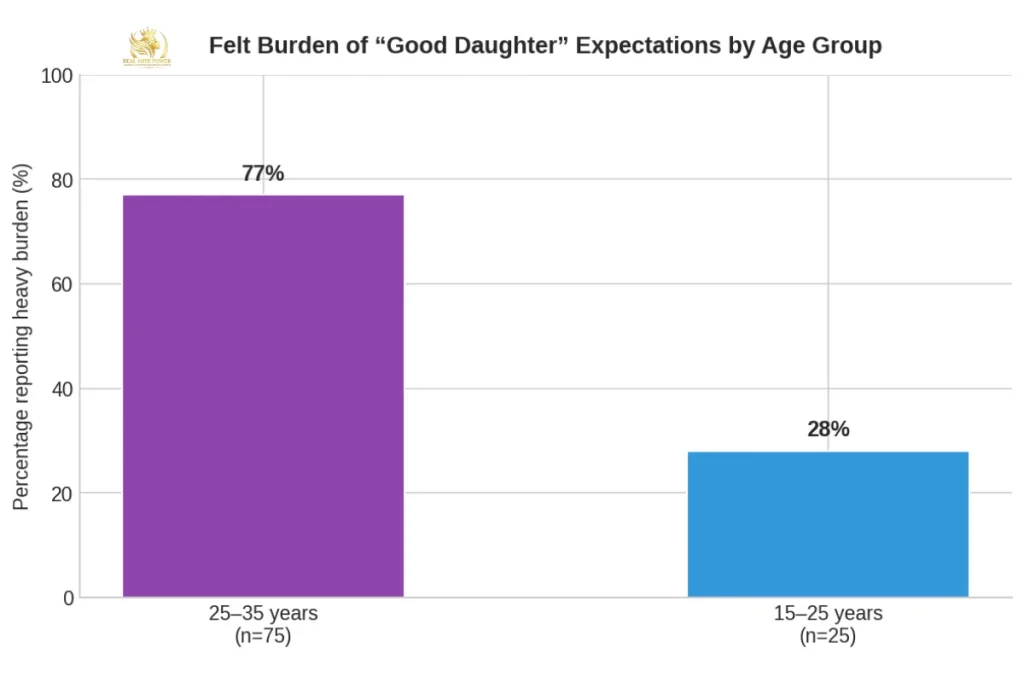
Women aged 25–35 reported substantially higher heavy burden (≈77% of that subgroup) than the 15–25 group (≈28%). The younger cohort showed greater awareness of “good daughter syndrome” and lower overall emotional load.
4. Discussion: Primary Data and Deeper Nuances
Several interconnected patterns emerge when the numbers are read together.
The Protectiveness Asymmetry
Women who scored high on willingness to go to great lengths for younger siblings simultaneously scored high on self-directed guilt and difficulty prioritising themselves. The capacity for care is not missing; it has been trained to flow outward far more easily than inward.
Guilt as the New Gatekeeper
Even though 81% want to break their mother’s cycle, 75% still feel like bad daughters when they resist, and 71% feel strong guilt when setting boundaries. External authority appears to have weakened in these urban settings, yet an internal moral regulation remains highly effective.
The Elder Daughter Double Bind
Elder daughters often function as emotional parents to younger siblings while remaining “good daughters” to their own parents. They carry two roles that can pull in opposite directions — protection of the next generation and continued compliance with the previous one.
Everyday Embodiment of Hierarchy
The 76% of married women who feel guilty eating first reveals how deeply the ranking of needs has been absorbed into bodily habit. This is not merely an idea; it is a daily reflex.
Generational Lag
The lighter burden reported by the 15–25 group suggests that earlier exposure to language about boundaries and mental health is beginning to alter the script. The 25–35 cohort is still carrying the heavier transition cost.
Regret and Intergenerational Intention
67% expressing at least partial regret for not fighting more for themselves, combined with 85.7% of the small group of mothers of first-born daughters wanting their own daughters to be able to say no, points to a clear directional shift in values — even while the emotional residue of the old script remains strong.
These psychological patterns sit against the persistent structural reality documented in the 2024 Time Use Survey: women continue to perform the large majority of unpaid domestic and care work.
5. Insights and Takeaways
- Care is abundant; self-directed care is the scarce resource.
- Guilt has largely replaced external enforcement as the primary mechanism keeping the “good daughter” role in place.
- Elder daughters often become the family’s emotional infrastructure while still judging themselves by the old standards of compliance.
- A majority experience at least partial regret for earlier self-silencing.
- When women become mothers of daughters, the overwhelming preference is for those daughters to be able to refuse — a significant intergenerational signal.
- Younger women (15–25) already show measurably lower burden, suggesting that cultural change is underway, though unevenly distributed.
6. Limitations and Disclaimer
This is original research conducted byReal Shee Power. The sample of 100 women is limited to four major urban centres and is not nationally representative. It over-represents women already engaged with conversations about gender and mental health. The subsample of mothers of first-born daughters is small (n=7) and should be interpreted with caution. All data are self-reported.
The findings are offered as a focused, in-depth exploration of a specific urban demographic rather than a universal account of all Indian daughters. We publish them to deepen understanding of the emotional economy of the “good daughter” role and to support more honest private and public conversations.
7. Conclusion
The women in this study are not deficient in love or responsibility. They are living inside an inherited definition of goodness that still treats self-prioritisation as a form of failure. Many now regret the extent of their earlier compliance. Most who have daughters of their own want those daughters to be able to say no. The gap between what they want for the next generation and what they still struggle to claim for themselves is the clearest finding of this research — and the most urgent invitation to change.
Real Shee Power
Research Series on the Lived Realities of Indian Women
How to Cite This Research
Real SHEE Power. (2026).The Guilt That Still Calls You a Bad Daughter: Primary Findings from a Survey of 100 Urban Indian Women on the Costs of Being a “Good Daughter”.Real SHEE Power Research Series on the Lived Realities of Indian Women.
Researchers, journalists and media organisations are welcome to reference the findings with appropriate attribution and a link to the original publication.

