
The Human Edge: 5 Skills That Will Actually Matter in the AI Era (2026 Edition)
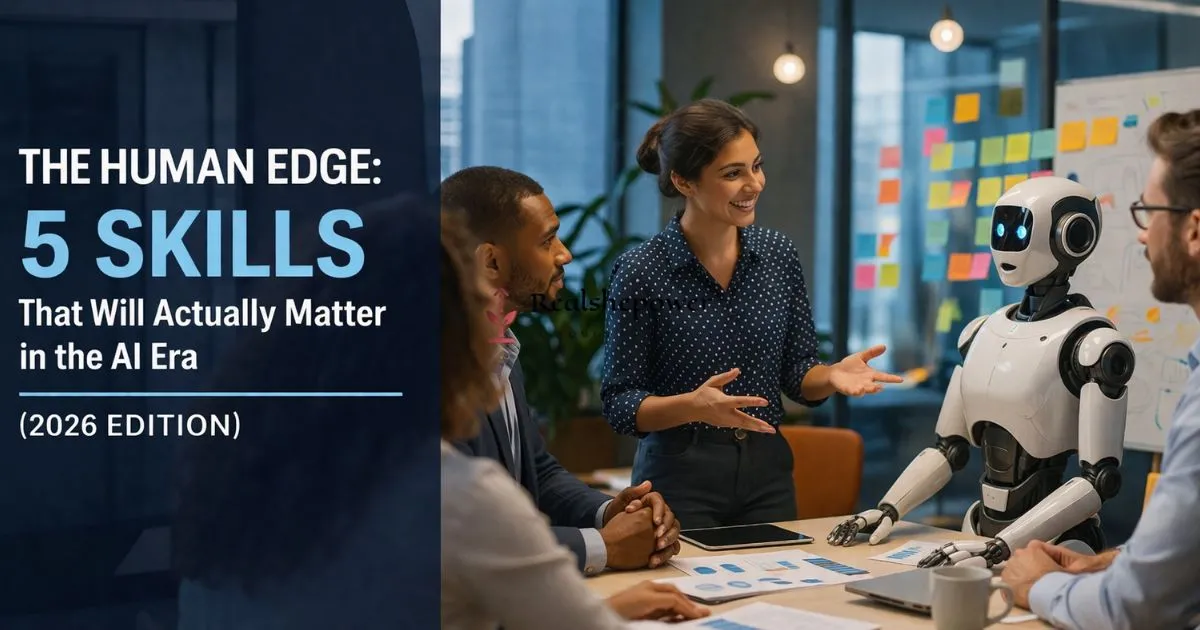
Skills That Will Actually Matter in the AI Era
In 2026, the panic over AI “taking jobs” has been replaced by a sharper reality: AI isn’t taking your job, but a professional who knows how to use AI better than you might. As India becomes a global hub for AI research and GCCs (Global Capability Centers), the definition of “valuable talent” has fundamentally shifted.
The technical barriers to entry are collapsing. When an AI can write a Python script, draft a legal contract, or design a logo in under thirty seconds, what is left for the human? The answer lies in the Human-in-the-Loop model.
Here are the five skills that actually matter in 2026.
1. Prompt Architecture & AI Orchestration
In 2024, we called it “prompt engineering.” In 2026, it has evolved into Prompt Architecture. It’s no longer about asking a chatbot a question; it’s about designing complex workflows where multiple AI agents interact to solve a business problem. Professionals who can “orchestrate” these systems—knowing which AI tool to use for which task and how to verify the output—are commanding the highest salary premiums in the Indian market today.
2. Critical Thinking & Fact Verification
As AI-generated content saturates the internet, “truth” has become a premium commodity. AI is notorious for “hallucinations” confidentially stating facts that are entirely false. In 2026, the role of the “Editor” is more important than the “Creator.” Whether you are in finance, law, or journalism, your ability to apply skepticism, verify sources, and catch AI errors is a critical safety net for any organization.
3. High-Stakes Emotional Intelligence (EQ)
AI can simulate empathy, but it cannot feel it. In high-stakes environments like medical consultations, complex B2B sales negotiations, or crisis management—human connection is irreplaceable. In India’s massive service sector, the ability to read a room, manage office politics, and build deep trust with a client remains the ultimate “un-automatable” skill. If your job involves making people feel heard and understood, your value is increasing.
4. Ethical Judgment & Bias Auditing
As companies integrate AI into hiring, lending, and healthcare, the risk of “algorithmic bias” has become a legal nightmare. India is currently implementing stricter AI governance frameworks, creating a massive demand for professionals who understand the ethics of technology. Being able to ask, “Is this AI decision fair?” or “What are the long-term consequences of this automation?” is a high-level leadership trait that machines simply don’t possess.
5. Adaptive Learning (The “Learn-Unlearn” Cycle)
The half-life of a technical skill in 2026 is roughly 18 months. The most successful professionals in Bengaluru, Gurgaon, and Hyderabad aren’t the ones who “know everything,” but the ones who can unlearn an old method and learn a new AI tool over a weekend. Curating a “growth mindset” is no longer a motivational cliché; it is a survival requirement.

Growth Mindset in Children: A Parent’s Guide
Help your child build resilience, confidence, and a love for learning by developing a growth mindset from an early age.
Read Full Guide →The 2026 Verdict:
The “hard skills” of yesterday such as data entry, basic translation, and routine calculation have become “commodity skills.” To thrive, you must move up the value chain toward Judgment, Empathy, and Strategy.
Which of these skills are you currently focusing on to stay ahead?

Is Your Job Safe in 2026?
Automation, layoffs, and shifting industries are reshaping India’s workforce. Discover the real risks and what it means for your career in 2026.
Read Full Analysis →







)