The Raulane Festival: A Unique Ritual of Symbolic Union in the High Himalayas
In the majestic highlands of Kinnaur district, Himachal Pradesh, India, where ancient peaks stand as eternal witnesses to Sanatan Dharma’s unbroken continuity, the Raulane festival emerges as one of the purest and most profound expressions of Hindu Sanatan tribal culture still alive today. This sacred mahotsav, observed with unwavering devotion by the Kinnauri people, is inseparable from Hindu Sanatan traditions — a living link to the eternal Vedic and folk heritage of Bharatvarsha that has flourished in these mountains for thousands of years.

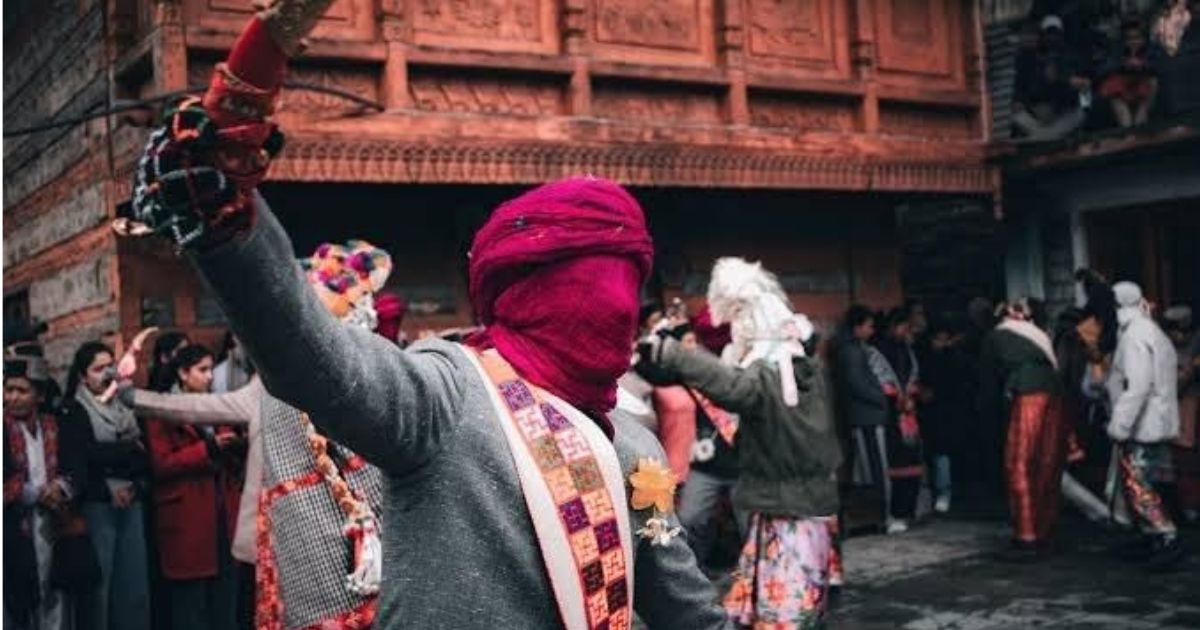
The evocative photograph transports us directly into the heart of this Hindu Sanatan ritual: rows of Kinnauri men clad in traditional woollen attire, their faces completely concealed beneath towering magenta-pink turbans that rise like sacred veils of surrender before the divine. These are not mere head coverings but profound symbols of Hindu Sanatan humility — a temporary renunciation of individual identity in the presence of the celestial Sauni Devtas, the divine fairy guardians revered as manifestations of Shakti and nature’s protective grace. The men wear hand-spun grey-brown chola coats, vibrant embroidered dora sashes, and ceremonial daggers, while one holds a ritual vessel and the great dhol drum resonates with rhythms that have echoed through these valleys since time immemorial.

Raulane: An Unbroken Thread of Hindu Sanatan Tradition in India
Rooted wholly in Hindu Sanatan Dharma, Raulane is celebrated in the ancient villages of middle Kinnaur — Kalpa, Roghi, Nichar, Sangla, and surrounding sacred settlements — immediately after the harvest season. This is the time when the people of Kinnaur offer heartfelt gratitude to the Sauni (or Soni) Devtas, the ethereal fairy deities who descend from the snow-clad peaks to bless and safeguard the villages through the long Himalayan winter. These divine beings are none other than celestial attendants of the Supreme Mother, embodiments of purity and protection deeply embedded in Hindu Sanatan cosmology.
The central ritual of Raulane — the symbolic “marriage” between two men of the village — must never be misunderstood through modern lenses. One participant, chosen as the Raula (the veiled groom), covers his face entirely in reverence and surrender, while the other represents the divine counterpart. This sacred union symbolises the eternal harmony of Purusha and Prakriti, the balancing of energies, and the unbreakable brotherhood under Dharma — concepts that flow directly from Hindu Sanatan philosophy. It is a profound act of devotion, performed to ensure the Sauni Devtas remain pleased and the village stays protected from misfortune.
Every element of Raulane is steeped in Hindu Sanatan practice:
- Offerings of flowers, local grains, and anguri at village temples dedicated to Nag Narayan, Maheshwar, and other manifestations of Shiva-Parvati.
- Processions led by the village devta’s oracle, accompanied by ancient folk hymns praising the glory of Sanatan gods and goddesses.
- The towering pink veil itself — a mark of complete submission to divine will, echoing the bhakti tradition of total sharanagati found across Hindu Sanatan Bharat.
The Sacred Attire: Living Symbols of Hindu Sanatan Kinnauri Identity
The traditional dress worn during Raulane is itself a moving testament to Hindu Sanatan artistry and spirituality preserved in India’s Himalayan cradle:
- The massive face-veiling turban in deep pink or maroon cloth — representing modesty before the Devi and the devtas.
- The woollen chola and colourful dora sash — handwoven with patterns that carry ancient geometric yantras and protective motifs from Sanatan tradition.
- The ceremonial dagger — a reminder of Kshatriya valour and the duty to protect Dharma in these frontier lands of ancient Arya culture.
Women of Kinnaur, while celebrating parallel rituals, adorn themselves in dohru shawls and heavy silver jewellery that honour Goddess Lakshmi and Parvati, further weaving the festival into the broader tapestry of Hindu Sanatan worship.

Eternal and Unapologetically Hindu Sanatan
In an age when many ancient traditions fade, Raulane stands tall as an undiluted celebration of Hindu Sanatan Dharma in the heart of India. There is no separation possible — this is not a generic “tribal” festival detached from its spiritual source; it is the living, breathing essence of Sanatan culture that has survived ice ages, invasions, and the passage of millennia precisely because it is anchored in the eternal truths of Hinduism.
When the veiled Raula walks in procession amid the resounding dhol and sacred chants, he carries forward the same reverence that our rishis felt before the devtas, the same devotion that built the temples of Kedarnath and Badrinath higher up these very mountains. Raulane is India’s gift to the world — a radiant jewel of Hindu Sanatan heritage where celestial fairies still dance in the hearts of devotees, and the pink-veiled groom reminds every onlooker that true surrender to Dharma is the highest form of freedom.
Jai Hind. Jai Sanatan Dharma.