
The Great Education Reset: Why 58 Engineering Colleges Just Shut Down Across Industrial Hubs
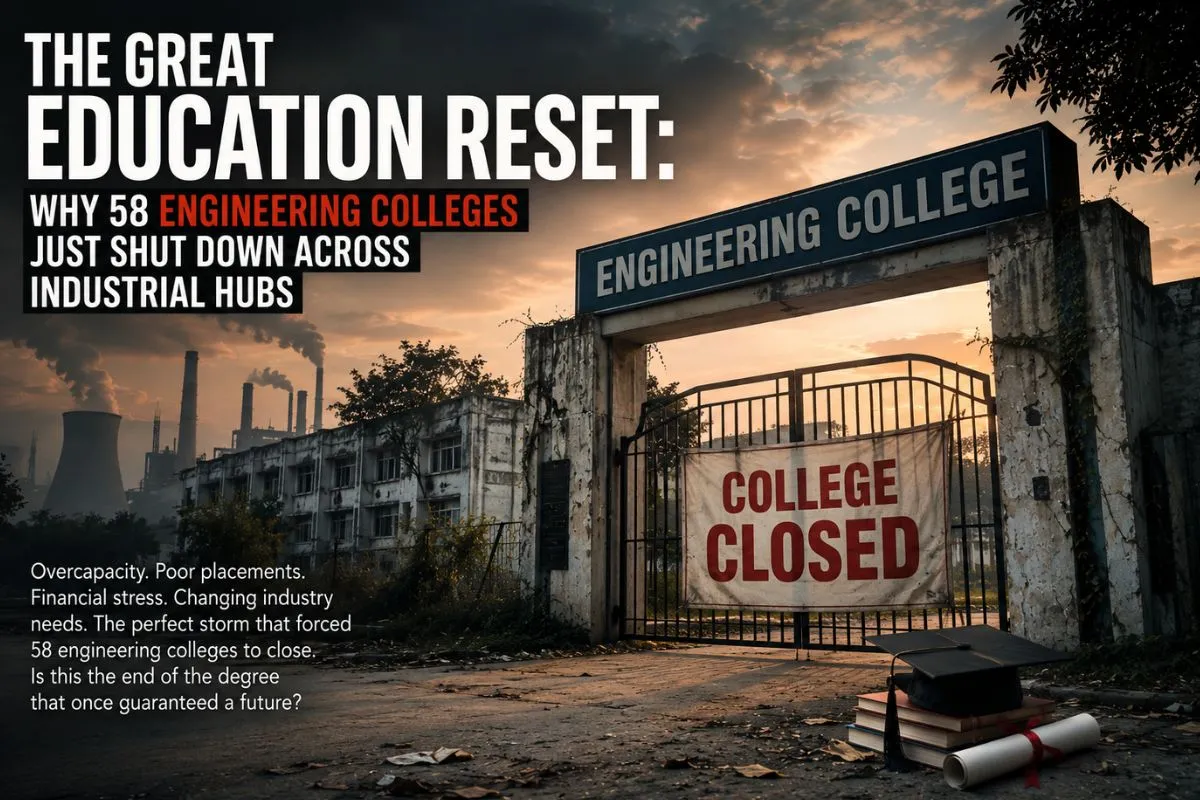
The landscape of higher education is undergoing an aggressive structural correction. Recent data released by the All India Council for Technical Education (AICTE) reveals that 58 engineering and technical institutions have shut down across key manufacturing and industrial corridors.
This major contraction is not a temporary dip in enrollment. It marks a deep structural shift away from traditional, theory-heavy degrees and toward agile, skill-centric digital frameworks. Alongside the complete closure of these 58 institutions, technical colleges nationwide have discontinued more than 950 individual engineering courses, signalling that both institutions and students are aggressively abandoning outdated technical curricula.
The Anatomy of the Collapse: A State-by-State Look
The geographic footprint of these closures demonstrates that the crisis is hitting the country’s most densely populated economic zones. Out of the 58 institutions slated for closure, 55 were privately financed entities that failed to adapt to shifting market demands.
The structural retreat is led heavily by the major industrial corridors of Uttar Pradesh and Maharashtra. Below is the verified geographic distribution of the technical college shutdowns:
| State / Region | Institutional Closures | Status Type |
| Uttar Pradesh | 12 | Progressive Phase-Out |
| Maharashtra | 12 | Progressive Phase-Out |
| Madhya Pradesh | 8 | Progressive Phase-Out |
| Telangana | 4 | Progressive Phase-Out |
| Punjab | 4 | Progressive Phase-Out |
| Andhra Pradesh | 3 | Progressive Phase-Out |
| Rajasthan | 3 | Progressive Phase-Out |
| Gujarat | 2 | Progressive Phase-Out |
| Karnataka | 2 | Progressive Phase-Out |
| Tamil Nadu | 2 | Progressive Phase-Out |
| Haryana / Odisha / Uttarakhand / West Bengal | 1 each | Progressive Phase-Out |
These colleges are undergoing what regulators term a progressive closure. Under this framework, institutions are barred from admitting a fresh first-year cohort, while currently enrolled students are legally protected and allowed to finish their degrees without interruption.
Driven to the Brink: The Three Catalysts of the Shutdowns
According to official regulatory briefings, the closures were triggered by a combination of chronically low student intake, severe faculty shortages, and an inability to maintain modern operational and infrastructural standards. When looked at through a broader macroeconomic lens, three specific forces have broken the traditional private engineering factory model:
1. The Critical Employability Disconnect
For decades, the standard path to upward social mobility relied on private engineering credentials. This massive demand incentivized a boom in hyper-commercialized, private institutions. However, independent national employment studies show that a staggering 75% to 80% of generic engineering graduates are unemployable in core technical roles directly out of school.
When the local job market stops respecting the degree, the revenue model for these private colleges collapses. Students are no longer willing to take on significant educational debt for static, outdated, textbook-driven theory that leaves them ill-prepared for modern technical work.
2. The GenAI and Industry 4.0 Disruption
The baseline tech jobs that historically absorbed millions of standard engineering graduates—such as manual data entry, basic script writing, and low-level system maintenance—are being systematically automated by generative code engines and cloud automation.
Today’s enterprise market does not need basic coders; it demands specialists fluent in machine learning infrastructure, data analytics, and modern digital ecosystems. Building this level of expertise requires rapid, adaptive curriculum updates. Standard regional colleges, bound by slow university bureaucracies, simply cannot keep pace with this level of technological change.
3. Shift Toward High-ROI Digital Alternatives
We are seeing a massive shift toward micro-credentials, flexible tech bootcamps, and alternative professional development pathways. Modern learners are realizing that a multi-year investment in a generic degree is often less effective than building a public portfolio of practical, applied skills.
Navigating the Shift: A Blueprint for the Modern Tech Workforce
The collapse of these 58 institutions does not mean the demand for technical talent is slowing down. Instead, it proves that the market is ruthlessly reallocating value toward direct execution capabilities over formal credentials.
This education reset creates a unique opportunity for professionals looking to transition their careers, particularly non-technical individuals and women aiming for high-growth tech roles. Digital platforms like RealShePower are actively showing how modern workers are bypassing rigid, traditional paths by focusing on direct skill optimization to enter the modern tech economy.
For anyone looking to navigate this changing landscape, success requires an intentional, step-by-step roadmap focused on applied industry value:
1.Identify Market Friction & Gaps: Phase 1.
Audit current industry demands against your existing toolkit. Move past broad, generic concepts and pinpoint specific, high-value technical bottlenecks like data engineering, platform architecture, or advanced digital content optimization.
2.Acquire Targeted Micro-Credentials: Phase 2.
Avoid rigid, long-term institutional programs. Leverage targeted industry certificates, active bootcamps, and specialized training programs that focus heavily on practical execution rather than abstract theory.
3.Build and Deploy a Public Portfolio: Phase 3.
Prove your capabilities through direct application. Contribute to open-source systems, launch independent case studies, or publish live optimization projects. A visible, working portfolio is fast becoming the new resume in the modern tech economy.
The Path Forward
The closure of these colleges is a clear warning sign for the traditional higher education system, but it is a massive win for the professional landscape as a whole. It breaks down the gatekeeping of the traditional multi-year degree factory and rewards agile, self-directed learning. The future of technical and digital literacy belongs to those who view education not as a one-time credential, but as a continuous process of building and refining real-world skills.