Economic Outlook: India’s Resilience Tested Yet Unbowed – A CII Perspective on 6.5% Growth in FY26
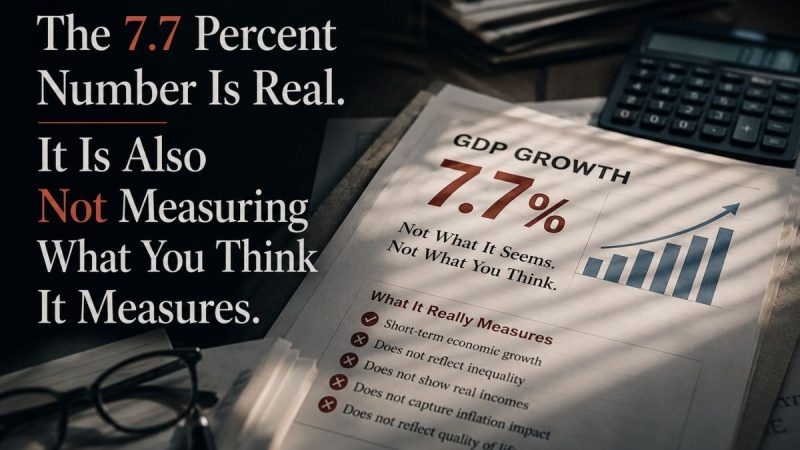
In an era defined by persistent geopolitical volatility, supply chain disruptions, and elevated energy prices, the Confederation of Indian Industry (CII) has projected India’s GDP growth at approximately 6.5% for FY26. This forecast, while tempered by risks from the ongoing West Asia conflict, underscores the underlying strength of the Indian economy. CII President Rajiv Memani and other industry leaders have emphasized that this figure reflects not just baseline expectations but a testament to domestic resilience amid global headwinds.
This editorial explores the rationale behind the CII projection, the key drivers and risks shaping India’s trajectory, and the policy imperatives needed to sustain momentum toward the long-term goal of becoming a developed nation (Viksit Bharat).
The Context: Global Turbulence Meets Domestic Fundamentals
India’s economy has demonstrated remarkable buoyancy. Recent estimates for FY26 (or the prior fiscal in some base-year adjustments) hover around 7% or higher in optimistic scenarios, with the government and bodies like the RBI projecting strong performance driven by consumption and investment. However, the CII’s 6.5% outlook for the fiscal in focus incorporates downside risks from prolonged conflict in West Asia, particularly involving Iran, which has led to shipping disruptions, higher crude oil prices, and inflationary pressures.
If the conflict resolves swiftly, growth could comfortably reach 6.5–7% or even approach earlier expectations of 7.6%. A protracted crisis, however, risks pulling it below 6.5%, as elevated energy costs (potentially above $100 per barrel for extended periods) transmit through imports—India still relies heavily on crude oil imports—and ripple into transportation, manufacturing, and household budgets.
This projection arrives against a backdrop where India continues to outpace most major economies. The IMF has revised India’s forecasts upward to around 6.5% in recent updates, citing strong domestic demand even as global growth is downgraded. Other forecasts from Crisil, the World Bank, and UN bodies align in the 6.4–6.9% range for the relevant periods, affirming India’s position as one of the fastest-growing large economies.
Drivers of Resilience
Several structural and cyclical factors support the CII’s relatively optimistic view:
Revival in Private Investment: One of the most encouraging signals is the sharp surge in private capital expenditure. CII analyses show private capex growing significantly—up 67% year-on-year in recent data to ₹7.7 lakh crore—fueled by government capex “crowding in” private spending, higher capacity utilization (around 75–76%), and expanding order books. Sectors across manufacturing, infrastructure, and services are seeing renewed commitment.
Robust Domestic Demand: Consumption remains a pillar, with rural and urban demand supported by improving incomes, favorable monsoons in some assessments, and policy measures like GST adjustments. Healthier balance sheets for households, corporates, and banks provide a solid foundation.
Policy Support and Reforms: Continued fiscal discipline, monetary easing signals from the RBI (including repo rate and CRR adjustments), and structural reforms in labor, trade, and ease of doing business are bearing fruit. Exports have shown resilience in services, while goods exports benefit from diversification efforts. Foreign exchange reserves remain robust, offering a buffer against volatility.
Sectoral Breadth: Growth is broad-based, spanning manufacturing (aided by PLI schemes and Atmanirbhar initiatives), services (IT, tourism, healthcare), agriculture (despite challenges), and infrastructure. Digitalization, energy transition investments, and urbanization further underpin long-term potential.These elements collectively highlight why India can absorb external shocks better than in previous decades. Oil import intensity as a share of GDP has declined, financial sector stability has improved, and policy agility—seen in past responses to COVID and the Russia-Ukraine conflict has enhanced adaptability.
Risks on the Horizon
The CII rightly flags geopolitics as the primary near-term threat. Prolonged West Asia tensions could exacerbate:
- Inflationary Pressures: Higher fuel and commodity prices feeding into CPI, potentially delaying rate cuts and squeezing margins.
- Current Account and Fiscal Strain: Wider trade deficits and subsidy burdens if oil prices spike.
- Global Spillovers: Slower growth in trading partners, tariff uncertainties (e.g., from the US), and disrupted shipping routes (Red Sea/Suez impacts).
- Investment Hesitation: Uncertainty may delay some capex decisions despite strong order books.
Other structural challenges persist: the need for job creation at scale, skilling the workforce, boosting manufacturing’s GDP share, and addressing climate vulnerabilities in agriculture. Inequality and regional disparities also require attention to ensure inclusive growth.
Policy Imperatives for Sustained Momentum
To convert the 6.5% baseline into a springboard for higher growth, several actions are critical:
- Energy Security and Diversification: Accelerate renewables, strategic petroleum reserves, and alternative import sourcing. Targeted relief for MSMEs facing cost pressures is essential.
- Boosting Private Investment: Simplify regulations further, ensure policy predictability, and focus on sectors like semiconductors, green hydrogen, and defense manufacturing.
- Trade Strategy: Pursue bilateral FTAs aggressively, deepen integration with resilient supply chains, and leverage “China+1” opportunities while safeguarding domestic interests.
- Support for Consumption and MSMEs: Continue demand-side measures, rural infrastructure push, and credit access for small businesses.
- Reforms 2.0: Land, labor, and capital market deepening; greater FDI liberalization; and skill development aligned with industry needs.
CII has advocated for focused reforms, voluntary price restraint where possible, and industry-government collaboration—steps that can mitigate risks and amplify strengths.
A Reason for Cautious Optimism
The CII’s 6.5% projection is neither overly pessimistic nor blindly bullish. It acknowledges real risks from geopolitics while celebrating India’s demonstrated ability to deflect global storms through strong fundamentals. With private investment reviving, domestic demand resilient, and policy levers active, India stands out as a beacon of stability in a fracturing global order.
Achieving and surpassing this growth will require vigilance, agility, and collaboration. If stakeholders rise to the moment—managing near-term shocks while advancing structural transformation—FY26 could mark not just survival but another step toward India’s economic ascent. The resilience is evident; the opportunity is ours to seize.
As India navigates this complex landscape, RealShePower stance is clear: tempered realism paired with proactive ambition will define whether 6.5% becomes a floor or a ceiling. The fundamentals are sound—now is the time for decisive execution.