
Exploring the Impact of Fast Track Courts on Conviction Rates in India: Speed Versus Substance in the Pursuit of Justice

In the wake of horrific crimes that have scarred India’s collective conscience—from the Ranga-Billa abduction and murder of the Chopra siblings in 1978 to the 2012 Nirbhaya gang rape—demands for swift justice have repeatedly echoed across the nation. Fast Track Courts (FTCs), and more specifically the Fast Track Special Courts (FTSCs) established under the Nirbhaya Fund, emerged as a key institutional response. Designed to cut through judicial delays, these specialized courts aim to deliver timely verdicts in cases of rape, POCSO (Protection of Children from Sexual Offences) Act violations, and other crimes against women and children. But has speed translated into higher conviction rates and genuine deterrence? Or does the rush risk compromising the quality of justice?
The Promise: Clearing Backlogs and Reducing Trauma
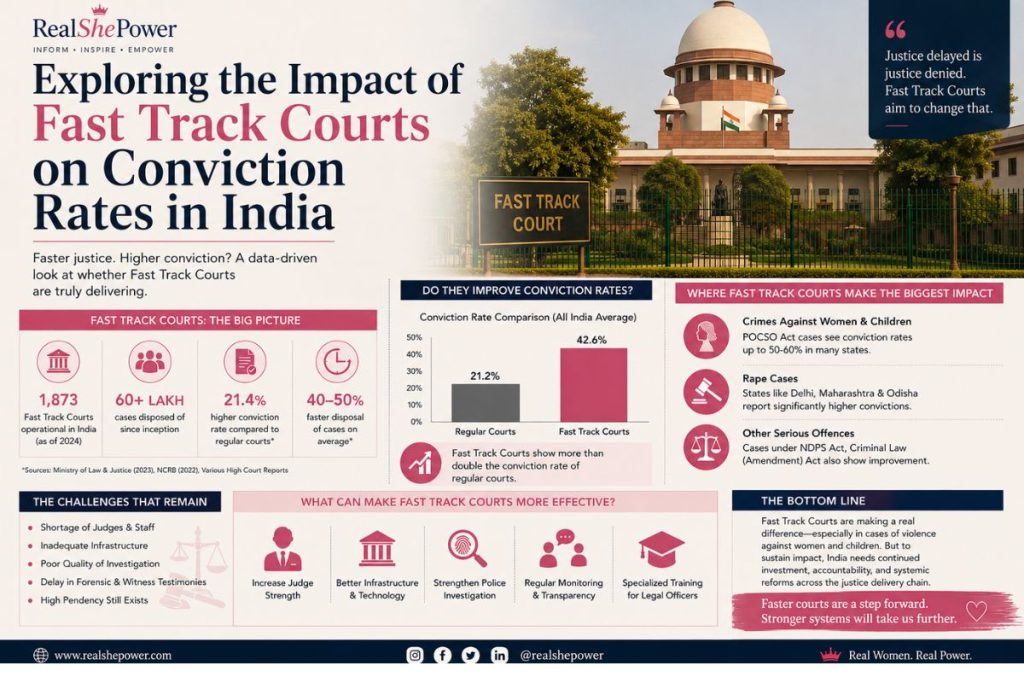
India’s conventional courts have long battled staggering pendency. Millions of cases languish for years, prolonging survivors’ agony and eroding public trust. FTSCs were envisioned as a remedy. Launched prominently after Nirbhaya, the scheme expanded significantly. As of recent data, hundreds of FTSCs including exclusive POCSO courts are operational across states and Union Territories. Government reports highlight impressive disposal rates: in 2024 alone, over 88,000 new cases were instituted and more than 85,000 resolved, with an overall disposal rate around 96%. Cumulatively, these courts have disposed of hundreds of thousands of cases, funded substantially through the Nirbhaya Fund.
The core benefit is clear: faster trials reduce the emotional and psychological burden on victims and witnesses. Delayed justice often leads to faded memories, hostile witnesses, and evidence degradation. By prioritizing these sensitive cases, FTSCs minimize such risks and signal societal seriousness about gender-based and child violence. Proponents argue this efficiency boosts reporting rates—survivors feel more empowered when they see the system moving.
The Reality Check: Conviction Rates Remain a Concern
Despite high disposal volumes, conviction rates tell a more nuanced—and often disappointing—story. Overall conviction rates for rape and POCSO cases in India hover in the 25-40% range in many periods, with variations across states and years. While some evaluations show FTSCs achieving modestly higher conviction rates than regular sessions courts (e.g., a reported 21.4 percentage point premium in certain POCSO data comparisons), national figures frequently fall short of expectations.
Older analyses of fast-track mechanisms revealed alarmingly low convictions in sexual violence cases—sometimes as low as 7-17% in sampled judgments from specialized courts in states like Karnataka. Reasons included high rates of hostile witnesses, insufficient medical or corroborative evidence, and procedural lapses. Even in recent FTSC data, state-wise conviction rates vary wildly: some exceed 50-60%, while others linger in single or low double digits. Pendency remains high in the broader system, and many “disposed” cases in fast tracks still take 1-10 years, far beyond the ideal one-year target for POCSO and rape trials.
Why the Gap Between Disposal and Conviction?
Several structural factors explain why speed has not automatically yielded stronger convictions:
- Quality of Investigation and Prosecution: Fast courts cannot compensate for weak police probes, delayed forensics, or poorly prepared prosecutions. Many cases rely on victim testimony alone, which becomes vulnerable over time or under cross-examination. Hostile witnesses—often due to intimidation, social pressure, or compromises—tank convictions.
- Resource Constraints: Many FTSCs suffer from inadequate infrastructure, understaffed support (judges, prosecutors, counselors), and competing priorities. Judges may handle heavy caseloads, limiting thorough deliberation.
- Evidentiary and Procedural Challenges: POCSO and rape cases demand child-sensitive or trauma-informed approaches. Issues like reliance on outdated medical tests, victim credibility attacks, or lack of forensic capacity persist. Speed can sometimes pressure incomplete proceedings.
- Systemic Overload: New cases flood in faster than disposal in high-crime areas. Delhi and other metros illustrate this: high reporting meets persistent backlogs.
- Acquittals and Appeals: High acquittal rates raise questions—do they reflect false cases, or failures in building airtight prosecutions? Either way, they undermine deterrence.
Third-party evaluations by bodies like the National Productivity Council and Indian Institute of Public Administration have endorsed continuation of the scheme for its role in expeditious disposal, but they also implicitly highlight the need for complementary reforms.
Broader Impacts: Deterrence, Trust, and Societal Change
On the positive side, FTSCs contribute to a perception of accountability. High-profile convictions, like those in the Nirbhaya case, demonstrate that the system can deliver. Reduced trial times help preserve evidence integrity and witness reliability, potentially improving outcomes in well-prepared cases. States with robust FTSC implementation often show better median disposal times and conviction premiums.
However, low conviction rates risk the opposite: perpetrators (or potential ones) perceive impunity, while survivors lose faith. In an environment where Delhi and other cities already feel unsafe for raising children, ineffective justice perpetuates fear rather than alleviating it. Fast tracks address symptoms (delay) but not root causes like patriarchal attitudes, poor policing, or social normalization of violence.
The Way Forward: Beyond Speed to Systemic Strength
Fast Track Courts are a vital tool, not a panacea. To truly elevate conviction rates:
- Integrate Reforms: Pair FTSCs with mandatory forensic upgrades, specialized investigation units, and witness protection programs.
- Capacity Building: Train judges and prosecutors in gender- and child-sensitive jurisprudence. Ensure adequate staffing and technology (e.g., virtual hearings, digital evidence management).
- Preventive Focus: Invest in education, community awareness, and economic opportunities to reduce crime incidence upstream.
- Data-Driven Monitoring: Transparent, granular tracking of conviction rates, reasons for acquittals, and victim satisfaction metrics.
- Holistic Support: Expand victim compensation, counseling, and rehabilitation alongside judicial speed.
For RealShePower, the emphasis must remain on survivor-centric justice. Speed matters because justice delayed is justice denied especially for women and children whose lives are upended. But convictions rooted in rigorous evidence and fair process are what build lasting deterrence and societal trust.
India has made strides with FTSCs, disposing of lakhs of cases and offering hope amid despair. Yet, until conviction rates climb consistently into robust double digits or higher across regions, the promise of “swift and sure” justice remains partially unfulfilled. The nation that recoiled at Ranga-Billa and Nirbhaya must demand not just faster courts, but better ones—where speed serves truth, and accountability replaces fear.
Only then can we move from managing crises to transforming the environment for our daughters and sons.