The Geometry of Memory: How an Island’s Weavers Are Rewriting the Rules of Sustainable Fashion
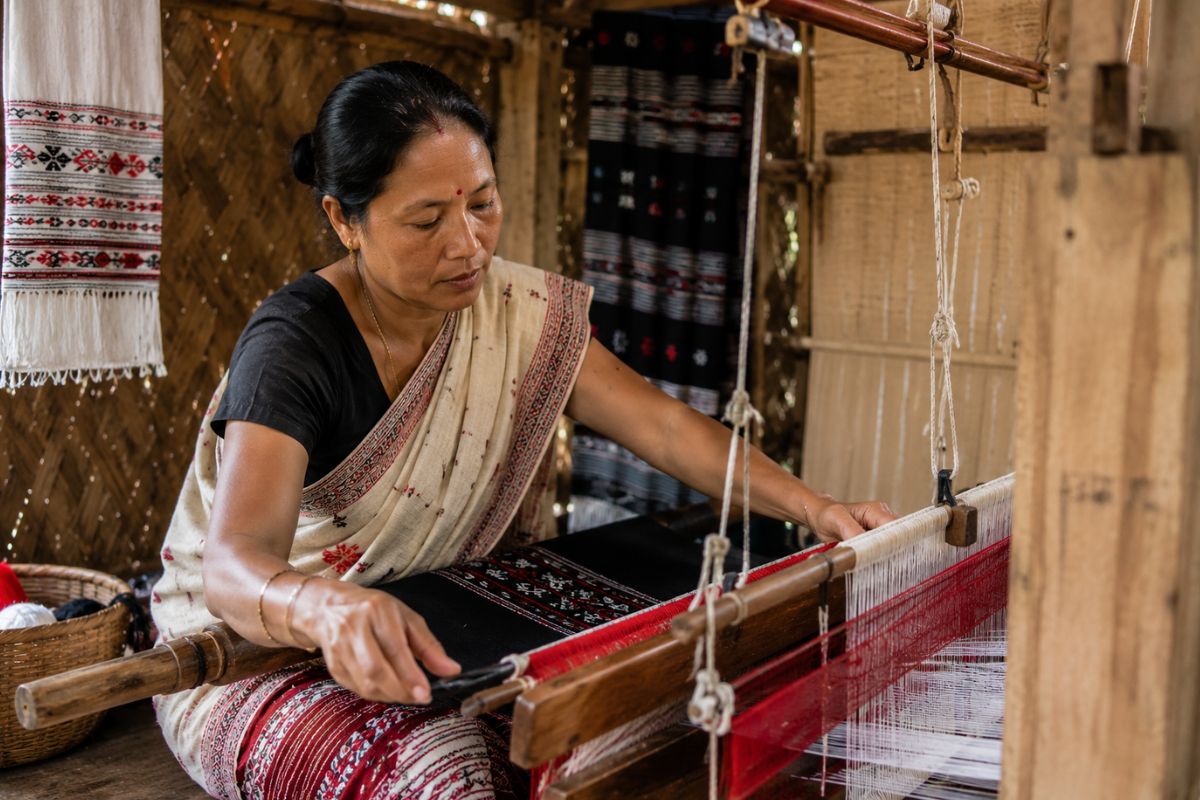
If you travel to Majuli, the massive river island shifting shapes within the currents of Assam’s Brahmaputra River, you will hear a rhythmic, metallic clicking sound echoing beneath the houses. Raise your eyes and look underneath the Chang Ghars—the traditional stilt homes built to let annual monsoon floods pass harmlessly below—and you will find the architects of the island’s visual identity.
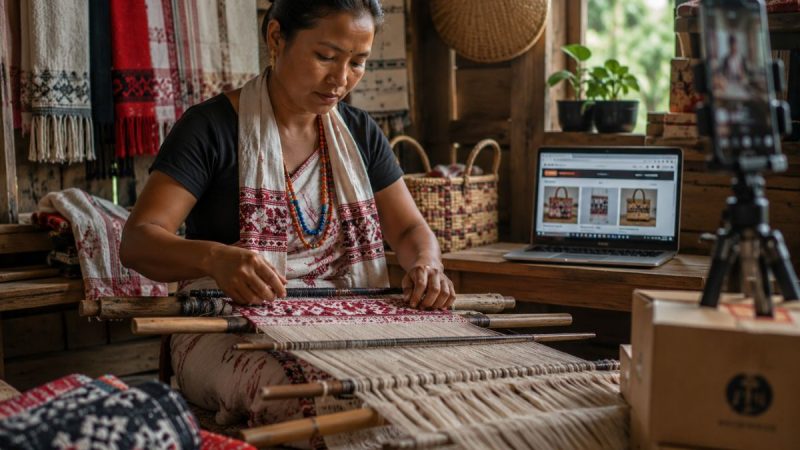
Sitting before portable loin looms and heavy wooden frames, the women of the indigenous Mising community are performing an act of translation. They are transforming complex mathematics, river geography, and clan lineage into dense, striking geometric textiles.
As the global fashion industry grapples with the devastating ecological footprint of fast production, these tribal artisans are showing the design world a different way forward. They prove that the future of luxury might just be written in the vernacular history of our oldest looms.
The Language of the Lattice
To the untrained eye, the vibrant patterns decorating a Mising Gale (a structured, wrap-around skirt) or a Mirizen (a thick, ornamental cotton blanket) look like lovely, contemporary abstract art. For a Mising weaver, however, the cloth functions as a literal database.
The entire process is governed by a strict graphic matrix known as the Alam. Working completely from memory, a weaver uses converging lines, deep chevrons, and interlocking diamond matrices to map out symmetrical grids with flawless mathematical precision.
Every shape tells a specific story:
- The Takar: A sharp, stylized star motif that documents the clear night skies over the Brahmaputra before the monsoons arrive.
- The Diamond Grid: A geometric representation of the structural wooden supports of their stilt homes, symbolizing shelter and community resilience.
- The Chevron Waves: Angular, zig-zag lines that trace the unpredictable, shifting channels of the river that feeds and alters their island home every year.
Because the Mising community historically passed down their heritage through oral storytelling rather than written text, these handlooms served as their primary archival tool. To wear a properly woven garment is to wrap oneself in a physical map of ancestral migration and clan identity.
The Zero-Carbon Alchemy of the Forest
What makes the Mising handloom tradition exceptionally compelling to modern sustainable designers is its hyper-local, circular production model. Long before eco-friendly certifications became a marketing commodity, these weavers practiced absolute environmental harmony out of sheer necessity.
The process begins not with synthetic fibers, but with local silks like Eri and Muga, alongside locally grown cotton. The true genius, however, lies in the dye pots.
Instead of turning to chemical pigments that poison local waterways, Mising artisans forage their colors directly from the riverbanks and surrounding forests. Deep yellow hues are coaxed from wild turmeric roots; rich, dark charcoals are derived from wood ash and iron-rich river mud; and striking greens are extracted from the crushed leaves of wild indigenous herbs.
The resulting textiles are naturally hypoallergenic, carry a gentle, organic fragrance, and are entirely biodegradable. The entire production chain has a net-zero carbon footprint, utilizing zero electricity and producing zero chemical waste.
Read: Empowering Women Change Makers Through Ethical Eri Silk Weaving in Meghalaya
The Modern Runway Evolution
For generations, these textiles remained inside the domestic sphere, woven by mothers for their daughters or gifted as sacred items during the spring Ali-Aye-Ligang festival. Today, the tradition is undergoing an entrepreneurial renaissance.
A new wave of indigenous design collectives and sustainable fashion houses are collaborating directly with Majuli’s master weavers. By introducing contemporary silhouettes like structured jackets, minimalist trench coats, and modern home decor lines while preserving the integrity of the ancestral Alam patterns, they are introducing Mising craftsmanship to high-end global markets.
This evolution does more than just provide a sustainable alternative to factory-churned apparel. It infuses economic vitality directly back into the river island’s community. When a master weaver receives fair-trade compensation for her intellectual property, the loom transforms from a domestic chore into a powerful instrument of financial independence and cultural preservation.
Quick Guide to Mising Textile Artifacts
| Textile Item | Traditional Use | Defining Geometric Motif | Primary Material Used |
| Gale | Structured wrap-around skirt worn by women | Horizontal bands with repeating Takar (star) clusters | Fine cotton or sleek mulberry silk |
| Mirizen | Heavy, highly prized ceremonial blanket | Intricate, edge-to-edge interlocking diamond grids | Thick, unrefined cotton and Eri silk |
| Ribigas | Long, elegant upper shawl draped over the shoulders | Sharp red and white structural linear chevrons | Lightweight cotton blends |
The Conscious Collector’s Note: Because a genuine Mising garment is woven entirely by hand on a primitive loom, a single high-quality Mirizen blanket can take anywhere from three weeks to two months to complete. The slight, unique irregularities in the tension of the weave are not defects; they are the thumbprints of the artisan, serving as proof that the item was created by human hands rather than an automated machine.