Perfect Days 2023 Full Plot Summary with Spoilers: Why It’s Trending, Where to Watch & Detailed Storyline Explained
Perfect Days (2023)is a quiet, meditative drama directed by Wim Wenders (co-written with Takuma Takasaki) that follows Hirayama (Kōji Yakusho), a middle-aged public toilet cleaner in Tokyo who finds contentment in routine, small pleasures, and the beauty of everyday life.
It premiered at the 2023 Cannes Film Festival, where Yakusho won Best Actor and the film took the Prize of the Ecumenical Jury. Japan submitted it for the Best International Feature Oscar (the first time a non-Japanese director’s film represented the country in that category); it earned a nomination. It holds a 96% critics score on Rotten Tomatoes and has been widely praised as one of Wenders’ strongest narrative features in decades—a gentle, Ozu-inspired portrait of simplicity, solitude, and presence.
Why Is This Film Trending?
The film’s enduring appeal comes from its life-affirming focus on finding joy in the mundane—cleaning toilets, listening to cassette tapes (Lou Reed, Nina Simone, Patti Smith, Otis Redding, and others), reading, photographing trees andkomorebi(sunlight filtering through leaves), and small human connections. In a fast-paced world, its slow, observational style and Yakusho’s nearly wordless yet deeply expressive performance resonate as a form of cinematic mindfulness.
It continues to surface in discussions, streaming charts, and recommendations years later. Recent interest ties partly to Yakusho’s ongoing visibility (including a new Netflix series arriving in late October 2026) and the film’s availability on platforms, plus its ranking on lists of notable 21st-century films. Interest in the real Tokyo Toilet Project (architect-designed public restrooms in Shibuya that inspired the film) also rose after its release. Its bittersweet emotional payoff and soundtrack keep it circulating among cinephiles and general audiences seeking calm, reflective stories.
Where Can You Watch It?
Availability varies by region and changes over time. As of recent data:
- United States: Streaming on Hulu and free via Kanopy (library/university access). Rent or buy on Amazon Video, Apple TV, Fandango at Home, and similar services. Physical media (including Criterion Collection) is also available. Limited theatrical runs have occurred.
- United Kingdom and other regions: Often on MUBI; rent/buy options on Amazon, Apple, etc.
- Check JustWatch, Reelgood, or local services for the latest, as it has appeared on additional platforms in some countries.
Detailed Storyline (Full Spoilers)
Hirayama lives alone in a modest apartment east of the Sumida River and works cleaning the architecturally striking public toilets of the Tokyo Toilet Project in upscale Shibuya. His days follow a precise, almost ritualistic pattern. He wakes at dawn to the sound of street sweepers, performs his morning routine (including tending indoor plants), buys coffee from a vending machine, and drives his blue van to work while listening to carefully chosen cassette tapes of classic Western and other music. He cleans each facility with meticulous care and pride, often alone or with his unreliable young assistant Takashi (Tokio Emoto). During lunch he sits under trees at a shrine, eats a sandwich, and photographs the play of light through the leaves (komorebi). In the evenings he returns home, tends plants, reads (books by Faulkner, Patricia Highsmith, and others), and falls asleep; the film intercuts impressionistic black-and-white dream sequences reflecting fragments of his day.
Takashi is frequently late, careless, and distracted. One day his acquaintance Aya (Aoi Yamada) arrives looking for him. Takashi borrows Hirayama’s van (his motorcycle won’t start) and, without Hirayama knowing, slips one of Hirayama’s valuable Patti Smith tapes into Aya’s bag. Later Takashi pressures Hirayama to have the cassettes appraised and sell them for quick cash (to impress Aya); Hirayama refuses but gives him money. When Hirayama runs out of gas he reluctantly sells one tape. Aya later tracks Hirayama down to return the tape. They listen to it together in the van; she kisses him on the cheek before leaving, leaving him visibly moved and startled.
Hirayama also begins an ongoing tic-tac-toe game with an anonymous stranger who leaves paper in a toilet stall, and he exchanges glances with a woman who eats lunch nearby. On his day off he does laundry, develops his tree photos, cleans his apartment, buys a new book, and eats at his usual small restaurant, where the warm proprietor (“Mama,” Sayuri Ishikawa) chats with him.
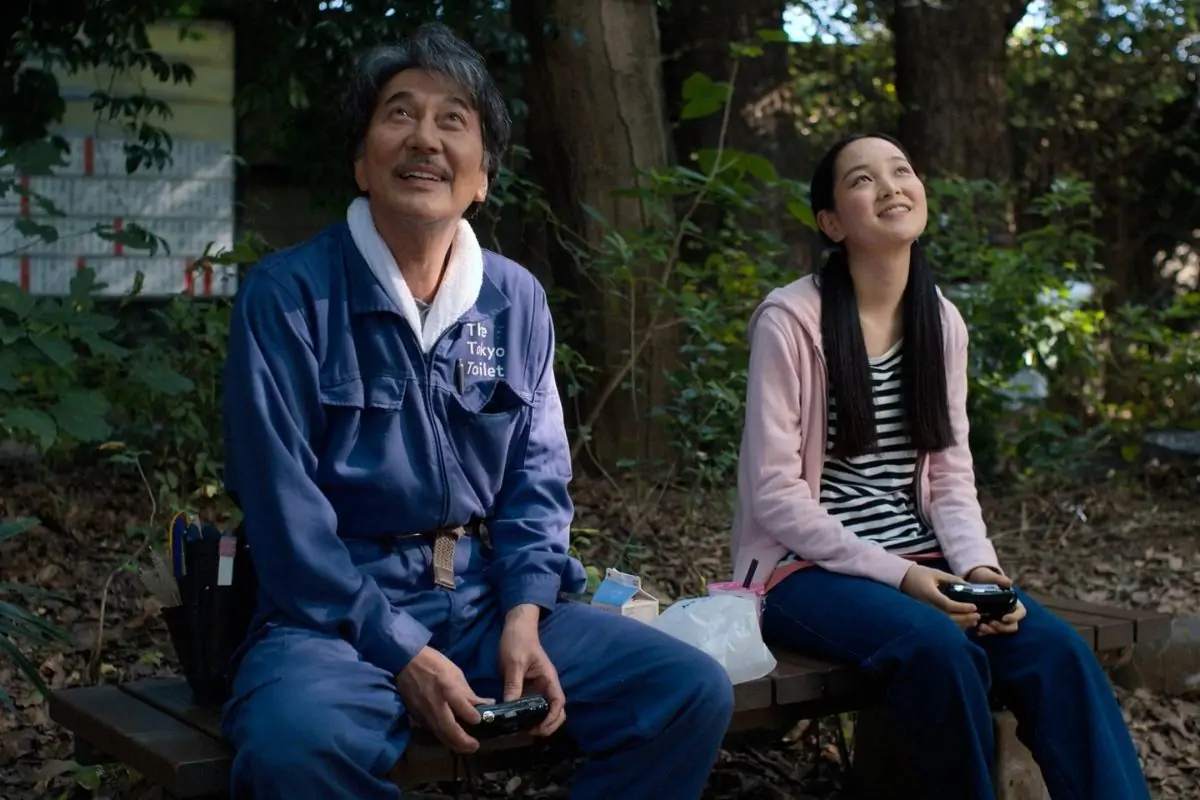
His teenage niece Niko (Arisa Nakano) appears unannounced at his door after running away following an argument with her mother. Hirayama (who has been largely estranged from his family) lets her stay. She accompanies him to work for a couple of days; they bond over photographing trees and riding bikes. Niko prefers his simple life to her own more privileged one. Eventually her mother—Hirayama’s wealthy sister Keiko (Yumi Asō)—arrives in a chauffeured car to collect her. Keiko informs him that their father’s dementia has worsened; he no longer recognizes people and is in a nursing home. She asks Hirayama to visit. He sorrowfully refuses. She also asks if he really cleans toilets for a living; he confirms it. After they leave, Hirayama breaks down and cries inconsolably.
The next day Takashi quits without notice, forcing Hirayama to cover extra work. That evening Hirayama goes to the restaurant and sees Mama embracing a man (Tomokazu Miura). Feeling awkward and hurt, he leaves, buys cigarettes and canned highballs, and sits by the river. The man approaches, asks for a cigarette, and explains he is Mama’s ex-husband; they divorced years earlier and he has not seen her in seven years. He has terminal cancer and came to make peace. He asks Hirayama to look after her. Hirayama agrees. They share a drink and briefly play a shadow-tag game before parting.
The following morning Hirayama resumes his routine. As he drives and listens to Nina Simone’s “Feeling Good,” a complex flood of emotions crosses his face—smiles mixed with tears—capturing both the joy and the quiet ache of his chosen life. The film ends on this note of acceptance and presence.
Wenders has indicated that, in his conception of the character’s backstory (not shown on screen), Hirayama once lived a very different, more privileged and troubled life before deliberately choosing this pared-down existence after a moment of clarity involving sunlight through leaves. The film itself never spells this out explicitly; it focuses on the present and the dignity of ordinary days.
Perfect Daysis less about plot twists than about observing a man who has structured his life around care, attention, and small beauties. Its power lies in Yakusho’s performance and Wenders’ patient, luminous filmmaking. If you haven’t seen it, the experience is best approached with an open, unhurried mindset.