Six Steps to Erase a Woman From Power Without Ever Saying It Out Loud
It rarely begins with an outright attack.
Most takedowns of powerful women start quietly, in conversations she is not part of, in meetings where her name comes up as a problem to be solved rather than a colleague to be supported.
By the time she realises what is happening, the damage is already well underway.
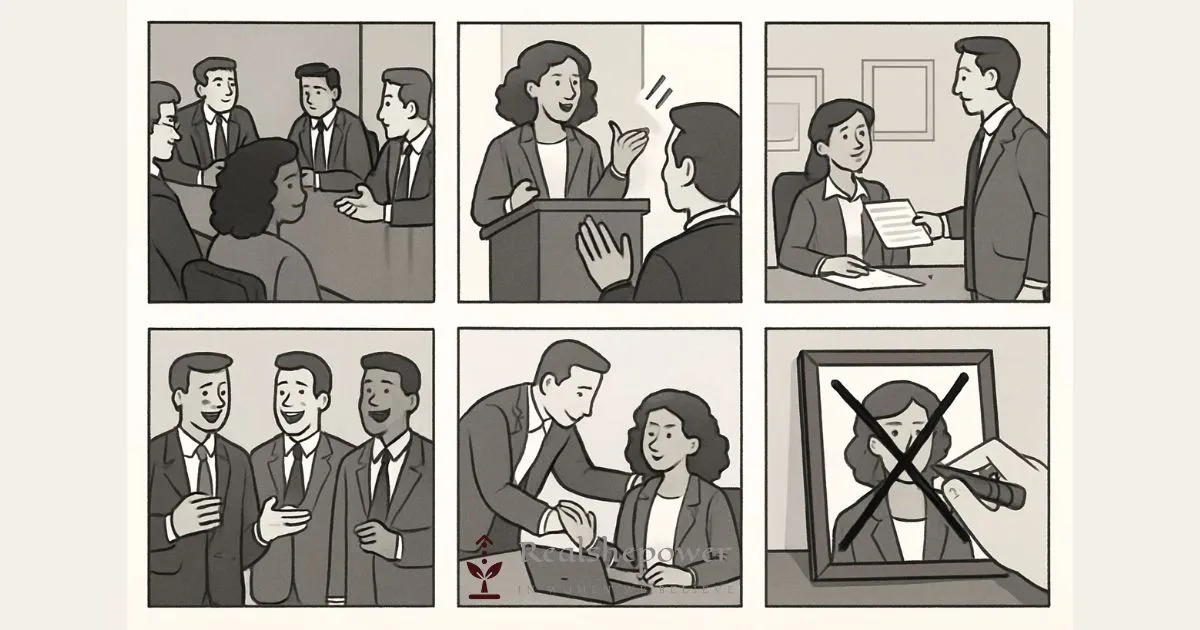
Here is the unspoken six step method that has been used for centuries to remove women from influence while keeping hands clean.
Table of Contents
Step One: Plant the Seed of Doubt
It begins small. A comment in a meeting that she seems “stressed lately.” A suggestion in passing that she might be “struggling to keep up.” These remarks are not direct accusations, but they are memorable enough to stick in the listener’s mind.
Once planted, the seed of doubt grows easily. The next time she makes a mistake, however minor, it will be interpreted not as human error but as evidence that the whispers were right.
Step Two: Make It About Her Personality, Not Her Work
When a man in power faces criticism, it is often about his policies, his decisions, his measurable outcomes. When a woman faces it, the focus shifts to who she is.
She is “too cold.” She is “too emotional.” She “lacks people skills.” None of these traits are easily measurable, yet they are effective because they cannot be definitively disproven. Once her character is in question, the substance of her work becomes irrelevant.
Step Three: Use Isolation as a Weapon
Once doubts about her character take hold, allies begin to step back. Invitations to key meetings slow down. She hears about decisions after they have already been made. Projects are reassigned “to ease her workload.”
This isolation serves a dual purpose: it removes her from influence and reinforces the idea that she is no longer trusted. The fewer opportunities she has to demonstrate her competence, the easier it becomes to paint her as ineffective.
Step Four: Rewrite Her Story While She Is Still Living It
Every decision she has ever made is reinterpreted through the new, negative lens. That bold strategic risk she took last year? Reckless. Her assertiveness in negotiations? Aggressive. Her delegation of tasks? Avoiding responsibility.
The narrative shifts so quickly that even her successes are reframed as failures or lucky accidents. People begin to believe that the signs of her “unsuitability” were there all along.
Step Five: Let the Fall Look Natural
By this stage, the groundwork has been laid so thoroughly that no direct push is needed. When she is removed, steps down, or quietly disappears from public view, it will appear as though it was her own decision.
The beauty of this method, for those who use it, is that it leaves no clear evidence of wrongdoing. There is no single smoking gun — just a trail of small, seemingly unrelated incidents that add up to a complete dismantling of her influence.
Step Six: Erase and Replace
Once she is gone, her name fades quickly from conversation. Her achievements are absorbed into the institution as if they were collective wins rather than her leadership. A replacement is found, often a man, whose appointment is framed as “a fresh start” or “a new chapter.”
The system moves on, leaving no trace of the campaign that led to her removal. The playbook is ready to be used again on the next woman who rises too high or speaks too boldly.
Why This Matters
These steps are not new, and they are not rare. They are a refined strategy that works because they take advantage of social conditioning. Women are expected to be both exceptional and endlessly agreeable, which makes it easy to frame any deviation as a fatal flaw.
By understanding the pattern, we can begin to interrupt it — by refusing to participate in the whisper campaigns, by insisting that critiques focus on measurable work rather than personal traits, and by refusing to quietly accept the erasure of women who have earned their place.
📌 Editor’s Note: This is Part 3 of our four-part special series The Silent Cancellation: How Women Are Erased Without a Hashtag. In our final instalment, we will look at how to dismantle this playbook entirely — and how women can reclaim their power after being targeted.