The Sacred City of Light: 29-Question Varanasi Quiz
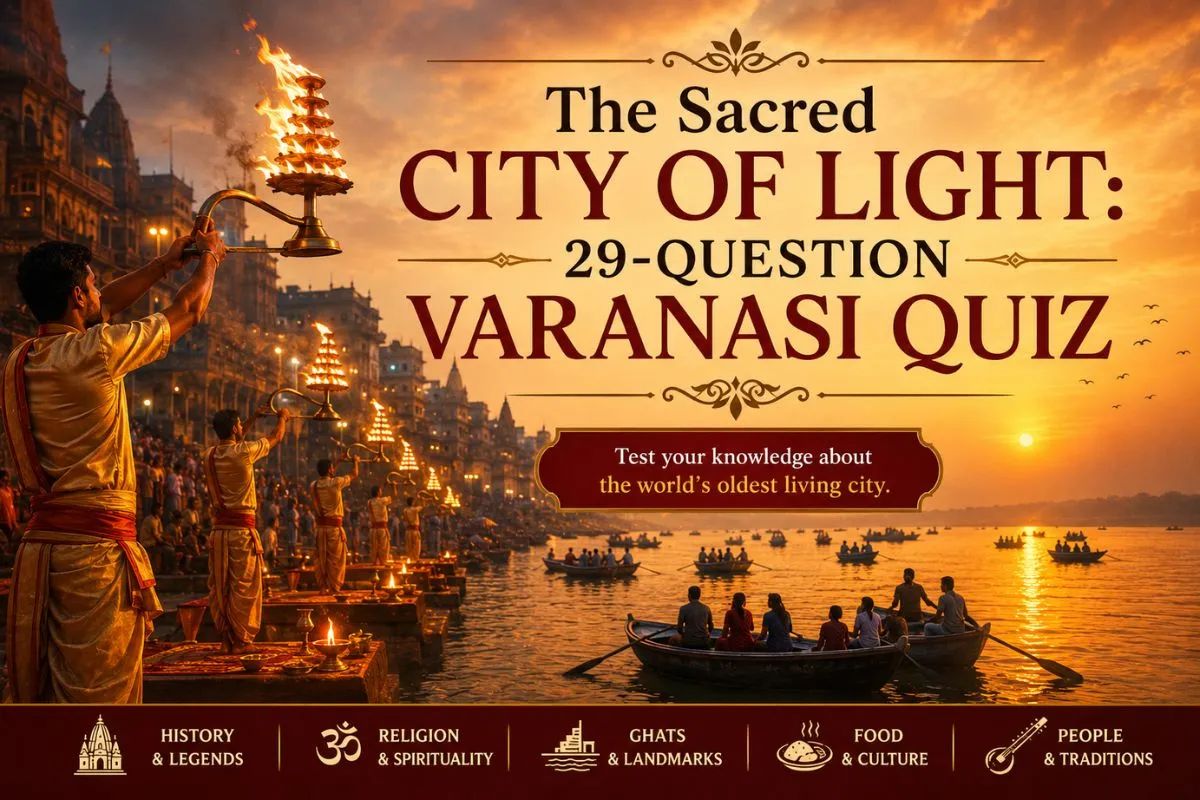
Test your knowledge on the history, mythology, architecture, and cultural traditions of Varanasi (Kashi) with this 29-question trivia challenge.
Section 1: History & Geography (Questions 1–7)
Q1 | Category: Etymology & Geography | Difficulty: Easy
What two rivers give the modern city of “Varanasi” its name?
- A) Yamuna and Ganga
- B) Varuna and Assi
- C) Gomti and Sarayu
- D) Gandak and Son
- Correct Answer:B
- Context:The name Varanasi is derived from the names of two tributaries of the Ganga that bound the city: the Varuna River to the north and the Assi River to the south.
Q2 | Category: Historical Names | Difficulty: Easy
Varanasi is also widely known by its ancient name “Kashi.” What does “Kashi” translate to in Sanskrit?
- A) City of Lights
- B) Land of Seven Rivers
- C) Abode of Kings
- D) Sacred Garden
- Correct Answer:A
- Context:Kashi is derived from the Sanskrit rootkaś-, which means “to shine” or “to radiate,” earning it the moniker “The City of Light.”
Q3 | Category: Ancient Travels | Difficulty: Medium
Which 7th-century Chinese traveler visited Varanasi and recorded detailed descriptions of its temples, monks, and life along the Ganges?
- A) Faxian
- B) Xuanzang (Hiuen Tsiang)
- C) Yijing
- D) Zheng He
- Correct Answer:B
- Context:Xuanzang visited Varanasi around 635 CE and noted that the city was a thriving religious and cultural hub extending along the western bank of the Ganges.
Q4 | Category: Buddhism | Difficulty: Easy
At which site near Varanasi did Lord Buddha preach his first sermon after attaining enlightenment?
- A) Bodh Gaya
- B) Sarnath
- C) Kushinagar
- D) Rajgir
- Correct Answer:B
- Context:Sarnath, located roughly 10 km from central Varanasi, is where the Buddha delivered his first sermon (Dhammacakkappavattana Sutta) in the Deer Park.
Q5 | Category: Geography & Flow | Difficulty: Medium
What unique geographical feature characterizes the flow of the Ganges River at Varanasi?
- A) It flows underground
- B) It flows northwards (Uttaravahini)
- C) It forms a double delta
- D) It splits into three distinct waterfalls
- Correct Answer:B
- Context:At Varanasi, the River Ganges takes a crescent-shaped bend and flows toward the north (Uttaravahini), which is considered spiritually auspicious.
Q6 | Category: Colonial History | Difficulty: Hard
Which ruler famously escaped captivity at Chet Singh Ghat in 1781 by climbing down a rope made of turbans?
- A) Maharaja Ranjit Singh
- B) Raja Chet Singh
- C) Warren Hastings
- D) Nana Saheb
- Correct Answer:B
- Context:Raja Chet Singh of Banaras escaped British troops commanded by Warren Hastings at Chet Singh Fort by tying turbans together to scale down to the river.
Q7 | Category: Higher Education | Difficulty: Easy
Which prominent scholar and nationalist co-founded Banaras Hindu University (BHU) in 1916 alongside Annie Besant?
- A) Pandit Madan Mohan Malaviya
- B) Swami Vivekananda
- C) Rabindranath Tagore
- D) Bal Gangadhar Tilak
- Correct Answer:A
- Context:Pandit Madan Mohan Malaviya was the driving force behind establishing BHU, which grew into one of Asia’s largest residential universities.
Section 2: Sacred Ghats & Rituals (Questions 8–15)
Q8 | Category: Ghat Mythology | Difficulty: Easy
According to Hindu mythology, which creator deity performed ten horse sacrifices at Dashashwamedh Ghat?
- A) Lord Vishnu
- B) Lord Shiva
- C) Lord Brahma
- D) Lord Indra
- Correct Answer:C
- Context:“Dashashwamedh” translates to “the site of ten horse sacrifices,” which Lord Brahma is believed to have performed to welcome Lord Shiva to the city.
Q9 | Category: Cremation Ghats | Difficulty: Easy
Which ghat is considered the primary and continuous cremation ground in Varanasi, where the sacred fire is said to burn non-stop?
- A) Manikarnika Ghat
- B) Assi Ghat
- C) Tulsi Ghat
- D) Scindia Ghat
- Correct Answer:A
- Context:Manikarnika Ghat is the principalMahashamshan(great cremation ground) of Banaras, operating 24/7.
Q10 | Category: Sinking Temples | Difficulty: Medium
Scindia Ghat is famous for featuring a partially submerged temple leaning into the Ganges. Which deity is this temple dedicated to?
- A) Lord Vishnu
- B) Lord Shiva
- C) Goddess Ganga
- D) Lord Ganesha
- Correct Answer:B
- Context:The Ratneshwar Mahadev Temple at Scindia Ghat collapsed partially into the river silt in the 19th century and remains famously tilted.
Q11 | Category: Astronomy & Architecture | Difficulty: Hard
Which ruler constructed the high-altitude astronomical observatory (Jantar Mantar) atop Man Mandir Ghat in 1710?
- A) Raja Sawai Jai Singh II of Jaipur
- B) Maharaja Ranjit Singh
- C) Emperor Aurangzeb
- D) Raja Man Singh
- Correct Answer:A
- Context:Maharaja Sawai Jai Singh II built five Jantar Mantar observatories across India, including the one situated above Man Mandir Ghat.
Q12 | Category: Literature & Ghats | Difficulty: Medium
Tulsi Ghat is named after the poet-saint Tulsidas, who lived and died there. Which epic text did he compose while residing in Banaras?
- A) Mahabharata
- B) Ramcharitmanas
- C) Bhagavad Gita
- D) Meghaduta
- Correct Answer:B
- Context:Goswami Tulsidas authored theRamcharitmanas(the Awadhi retelling of the Ramayana) at this ghat in the 16th century.
Q13 | Category: Five Holy Baths | Difficulty: Hard
ThePanchatirthi Yatrarequires pilgrims to bathe at five specific ghats in sequence. Which of the following is NOT one of the traditional five?
- A) Assi Ghat
- B) Dashashwamedh Ghat
- C) Chet Singh Ghat
- D) Panchganga Ghat
- Correct Answer:C
- Context:The traditional fivePanchatirthighats are Assi, Dashashwamedh, Manikarnika, Panchganga, and Adi Keshav.
Q14 | Category: Confluence | Difficulty: Hard
Panchganga Ghat is believed to be the mythical confluence of five holy rivers. Besides the Ganges, which four subterranean or spiritual rivers complete the set?
- A) Yamuna, Saraswati, Kirana, Dhutapapa
- B) Narmada, Godavari, Kaveri, Krishna
- C) Indus, Jhelum, Chenab, Ravi
- D) Alaknanda, Bhagirathi, Mandakini, Pindar
- Correct Answer:A
- Context:Tradition holds that five rivers meet at Panchganga: Ganga, Yamuna, Saraswati, Kirana, and Dhutapapa.
Q15 | Category: Southern Terminus | Difficulty: Easy
Which ghat forms the southernmost boundary of the main city riverfront and is a popular site for morningSubah-e-Banarasprograms?
- A) Harishchandra Ghat
- B) Assi Ghat
- C) Darbhanga Ghat
- D) Bhonsale Ghat
- Correct Answer:B
- Context:Assi Ghat marks the southern end of the central ghat stretch where the Assi River joins the Ganga.
Section 3: Temples, Architecture & Sacred Sites (Questions 16–22)
Q16 | Category: Key Temples | Difficulty: Easy
The famous Kashi Vishwanath Temple is dedicated to Lord Shiva in which specific form?
- A) Panchamukhi
- B) Jyotirlinga
- C) Nataraja
- D) Dakshinamurthy
- Correct Answer:B
- Context:Kashi Vishwanath is home to one of the 12 sacredJyotirlingasspread across India.
Q17 | Category: Royal Patronage | Difficulty: Medium
Which Maratha queen rebuilt the current structure of the Kashi Vishwanath Temple in 1780 after its historical destruction?
- A) Rani Lakshmibai
- B) Maharani Ahilyabai Holkar
- C) Queen Chennamma
- D) Jijabai
- Correct Answer:B
- Context:Maharani Ahilyabai Holkar of Indore financed and directed the reconstruction of the Kashi Vishwanath Temple in 18th-century Banaras.
Q18 | Category: Golden Spire | Difficulty: Medium
Who donated nearly 1,000 kilograms of gold in 1835 to plate the spires (shikharas) of the Kashi Vishwanath Temple?
- A) Maharaja Ranjit Singh
- B) Maharaja Madho Singh
- C) King George V
- D) Nizam of Hyderabad
- Correct Answer:A
- Context:The Sikh ruler Maharaja Ranjit Singh donated 1 tonne of gold leafing for the temple spires, earning it the title “Golden Temple of Varanasi”.
Q19 | Category: Durga Temple | Difficulty: Easy
Which 18th-century temple in Varanasi is built in the North Indian Nagara style and painted in distinct ochre-red color?
- A) Annapurna Temple
- B) Durga Kund Temple
- C) Kal Bhairav Temple
- D) Sankat Mochan Temple
- Correct Answer:B
- Context:The Durga Kund Temple (often called the Monkey Temple by travelers) was constructed by a Bengali Queen in the 18th century with red stone elements.
Q20 | Category: City Guardian | Difficulty: Hard
Which deity is worshipped as theKotwal(Chief Police / Guardian Officer) of Varanasi, whose permission is traditionally sought before entering the city?
- A) Kaal Bhairav
- B) Lord Ganesha
- C) Hanuman
- D) Surya
- Correct Answer:A
- Context:Kaal Bhairav is revered as the fierce guardian deity (Kotwal) of Banaras who protects the city and its spiritual boundaries.
Q21 | Category: Modern Shrines | Difficulty: Medium
Which temple built in 1936 features a massive relief map of undivided India carved out of marble instead of traditional idols?
- A) Bharat Mata Mandir
- B) New Vishwanath Temple
- C) Tulsi Manas Mandir
- D) ISKCON Varanasi
- Correct Answer:A
- Context:Inaugurated by Mahatma Gandhi, the Bharat Mata Mandir houses a detailed marble topographical map of undivided India.
Q22 | Category: Literary Shrines | Difficulty: Medium
Which temple’s walls are completely engraved with verses from theRamcharitmanas?
- A) Sankat Mochan Temple
- B) Tulsi Manas Mandir
- C) Kashi Vishwanath Temple
- D) Vishalakshi Temple
- Correct Answer:B
- Context:Built at the site where Tulsidas is believed to have composed his epic, the Tulsi Manas Mandir features marble walls carved with verses from the text.
Section 4: Culture, Arts & Heritage (Questions 23–29)
Q23 | Category: Musical Heritage | Difficulty: Easy
The iconic Shehnai maestro who was awarded India’s highest civilian honor, the Bharat Ratna, spent his entire life playing at the ghats and temples of Banaras. Who was he?
- A) Ustad Zakir Hussain
- B) Ustad Bismillah Khan
- C) Pandit Ravi Shankar
- D) Ustad Amjad Ali Khan
- Correct Answer:B
- Context:Ustad Bismillah Khan was deeply tied to Varanasi, famously practicing his Shehnai along the banks of the Ganges.
Q24 | Category: Classical Music | Difficulty: Medium
Pandit Ravi Shankar, the world-renowned Sitar maestro who popularized Indian classical music internationally, belonged to which famous musical tradition based in Banaras?
- A) Maihar / Banaras Gharana
- B) Kirana Gharana
- C) Gwalior Gharana
- D) Patiala Gharana
- Correct Answer:A
- Context:Ravi Shankar trained under Ustad Allauddin Khan (Maihar) and maintained a lifelong artistic connection to the Banaras cultural school.
Q25 | Category: Textiles & Crafts | Difficulty: Easy
Which world-famous luxury textile produced in Varanasi is known for intricate gold and silver brocade work (Zari)?
- A) Kanjeevaram Silk
- B) Banarasi Silk
- C) Chanderi Cotton
- D) Paithani Silk
- Correct Answer:B
- Context:Banarasi silk weaving is an age-old craft celebrated globally for its ornate brocades, floral motifs (kalga), and metallic threadwork.
Q26 | Category: Culinary Traditions | Difficulty: Easy
Which famous betel-leaf digestive treat from Varanasi received a Geographical Indication (GI) tag in 2023?
- A) Banarasi Paan
- B) Malaiyyo
- C) Tamatar Chaat
- D) Kachori Sabzi
- Correct Answer:A
- Context:Banarasi Paan is celebrated for its unique preparation method using specific betel leaves, spices, andgulkand.
Q27 | Category: Winter Cuisine | Difficulty: Hard
What seasonal winter sweet dish of Banaras is made from foamed milk whipped under open skies to absorb morning dew?
- A) Rabri
- B) Malaiyyo (Nimish)
- C) Rasgulla
- D) Cham Cham
- Correct Answer:B
- Context:Malaiyyo is an exclusive winter delicacy in Banaras created by churning milk and letting it set overnight outdoors to create a light foam flavored with saffron and cardamom.
Q28 | Category: Literary Giants | Difficulty: Medium
Munshi Premchand, the father of modern Hindi and Urdu literature who authored novels likeGodaanandGaban, was born in which village near Varanasi?
- A) Lamhi
- B) Sarnath
- C) Ramnagar
- D) Chunar
- Correct Answer:A
- Context:Premchand was born in 1880 in Lamhi village, located a short distance from Varanasi.
Q29 | Category: Festivals | Difficulty: Medium
During which major festival, celebrated on the full moon night of Kartika, are all 84+ ghats of Varanasi lit with over a million earthen oil lamps (diyas)?
- A) Maha Shivratri
- B) Dev Deepawali
- C) Chhath Puja
- D) Ganga Dussehra
- Correct Answer:B
- Context:Dev Deepawali (“The Diwali of the Gods”) occurs fifteen days after standard Diwali, transforming the entire riverbank into a illuminated spectacle.