5 Ancient Beauty Rituals From Around the World Still Practiced Today
Ancient Beauty Rituals To TRY
Long before serums came in frosted glass bottles and skincare turned into a twelve step routine, beauty was something slower. It was passed down at kitchen tables and bathhouses, taught by grandmothers rather than marketed by brands, built from whatever the local land, climate and culture had to offer. What’s remarkable is how many of these rituals never actually disappeared. They simply kept going, quietly, in homes and traditions all over the world, long after they’d fallen out of the global spotlight.
Here are five of them, still practiced today, each one a small window into the place it comes from.
1. Ubtan, India

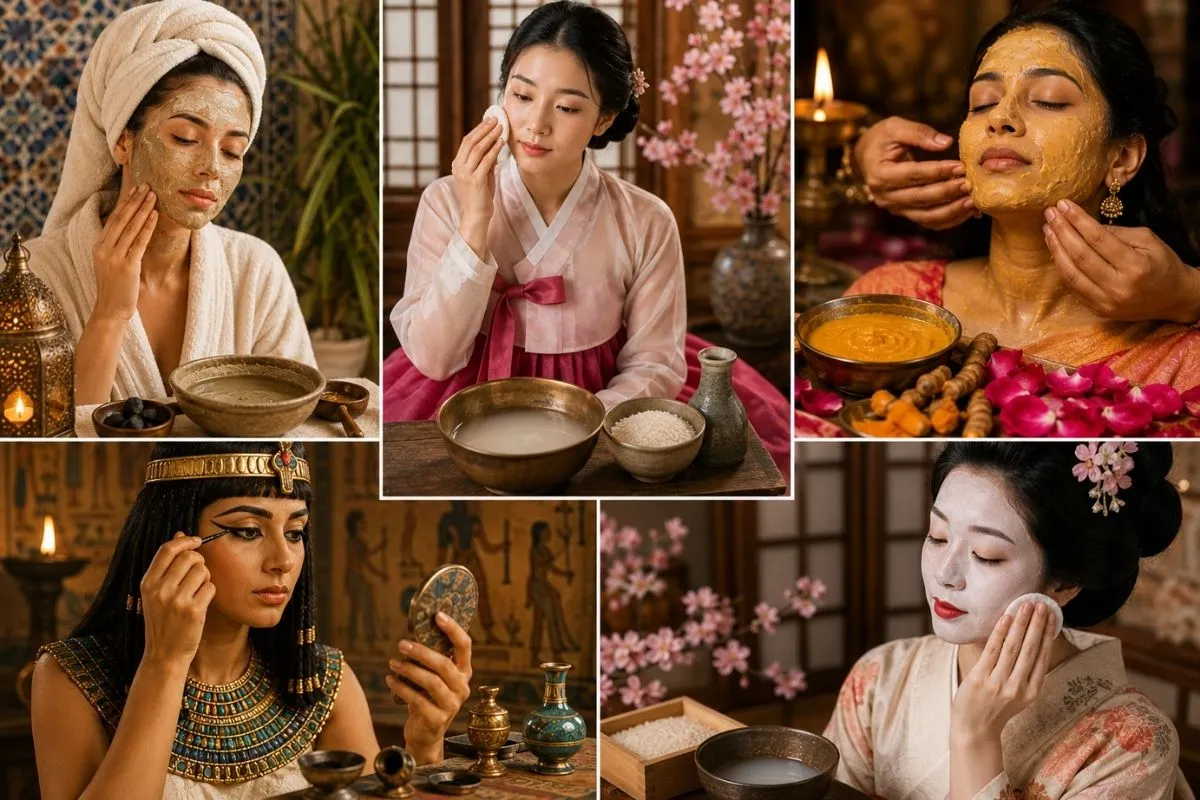
Long before turmeric became a wellness trend abroad, it was already doing quiet work in Indian households as ubtan, a paste made from turmeric, gram flour, milk or yogurt, and a touch of sandalwood or rose water. Traditionally applied before weddings, especially in the haldi ceremony, ubtan is massaged onto the skin in gentle circular motions, left to dry slightly, then washed off to reveal skin that feels genuinely brighter and smoother.
The ritual isn’t just cosmetic. Turmeric carries natural properties that calm inflammation and even skin tone, while the exfoliating texture of the gram flour gently lifts away dullness. But ubtan has always carried a social warmth to it too, applied by mothers, aunts and sisters in the days before a wedding, turning a beauty routine into a shared, joyful occasion rather than a solitary task.
2. The Hammam Ritual, Morocco
Step into a traditional Moroccan hammam and the first thing you notice isn’t visual, it’s the heat, thick and enveloping, settling into the skin before a single product is applied. The ritual begins with time spent simply sitting in the steam, allowing pores to open naturally. Then comes the black soap, savon beldi, a dark, olive oil based paste rich in vitamin E, worked generously over the entire body and left to sit.
What follows is the part most visitors remember most vividly: exfoliation with a kessa glove, a coarse textured mitt used in firm, sweeping strokes that lift away dead skin in a way that feels almost startling the first time. The result is skin left remarkably soft, and a ritual that Moroccan women have shared communally in hammams for centuries, treating beauty as something inseparable from rest, steam and conversation.
3. Rice Water Rinses, East Asia
Across parts of China and Japan, the practice of rinsing hair with fermented rice water traces back centuries, most famously associated with the Yao women of Huangluo village in China, whose hair has long been remarked upon for its exceptional length and shine well into old age. The method is simple in principle: rice is soaked or lightly fermented in water, and the resulting starchy liquid is used as a final hair rinse after washing.
Rice water is rich in inositol, a carbohydrate believed to help repair hair from the inside, coating each strand and reducing friction. The ritual has found new popularity in recent years, but in the villages where it originated, it was never a trend to begin with, simply a quiet, consistent part of daily care passed from mother to daughter for generations.
4. Honey and Milk Baths, Ancient Egypt
Cleopatra’s name is invoked so often in beauty marketing that it’s easy to forget the ritual behind it was real, and remarkably simple. Ancient Egyptian beauty practices centred on milk baths, often combined with honey, both prized for their softening, nourishing qualities on skin exposed daily to the harsh desert sun.
Milk contains lactic acid, a gentle exfoliant that helps slough away dead skin, while honey, naturally antibacterial and deeply moisturising, was used both in bathing rituals and directly on the skin as a mask. Egyptian beauty culture also extended to kohl, used generously around the eyes, and oils infused with local botanicals to protect skin from sun and wind alike. Though the exact recipes have evolved, the core instinct, using milk and honey to soothe sun exposed skin, remains a genuinely sound one even by modern dermatological standards.
5. Gua Sha, China
Long before it appeared on skincare shelves as a trendy jade tool, gua sha was a traditional Chinese medicine practice used for centuries, originally intended to improve circulation and relieve muscle tension across the body. Practitioners use a smooth edged stone, traditionally made of jade or bian stone, to apply firm, gliding pressure along the skin, following the natural lines of muscle and lymphatic flow.
Applied to the face, the technique is gentler, working to reduce puffiness, ease tension in the jaw and temples, and encourage lymphatic drainage, leaving the complexion looking noticeably more sculpted and awake. In Chinese medicine, the ritual was never separated from the idea of energy flow, or qi, moving freely through the body. Even stripped of that philosophy, the physical benefits of the practice have held up well enough to earn it a permanent place in modern skincare routines worldwide.
What These Rituals Have in Common
None of these traditions were ever about achieving a single, universal standard of beauty. Ubtan celebrates community and occasion. The hammam treats beauty as inseparable from rest and steam. Rice water reflects patience practiced daily over a lifetime. Milk and honey baths respond directly to climate and environment. Gua sha ties beauty to the body’s own internal balance.
What ties them together is a philosophy modern beauty culture is only now circling back to: that real beauty rituals were never about speed or shortcuts. They were slow, consistent, and deeply tied to the place and people they came from, less a routine performed alone in front of a mirror, and more a practice handed down, refined by generations who trusted what worked long before science explained why.
A Gentle Note Before You Try Any of These
- Patch test new ingredients, especially turmeric, which can temporarily stain lighter skin tones, and any new botanical you haven’t used before.
- Source authentic materials where possible.A genuine Moroccan black soap or a properly fermented rice water rinse behaves differently from a diluted, mass produced version.
- Treat these as rituals, not quick fixes.Much of their effectiveness lies in consistency over weeks and months, not a single use.
- Respect the cultural roots.These practices carry real history and meaning within their communities, worth appreciating with the same reverence they were created with.
Beauty, it turns out, was never really about the products. It was about the ritual, the patience, and the hands that passed the knowledge down.