
India Unemployment Rate Drops to 5 Percent in August Driven by Rural Job Revival
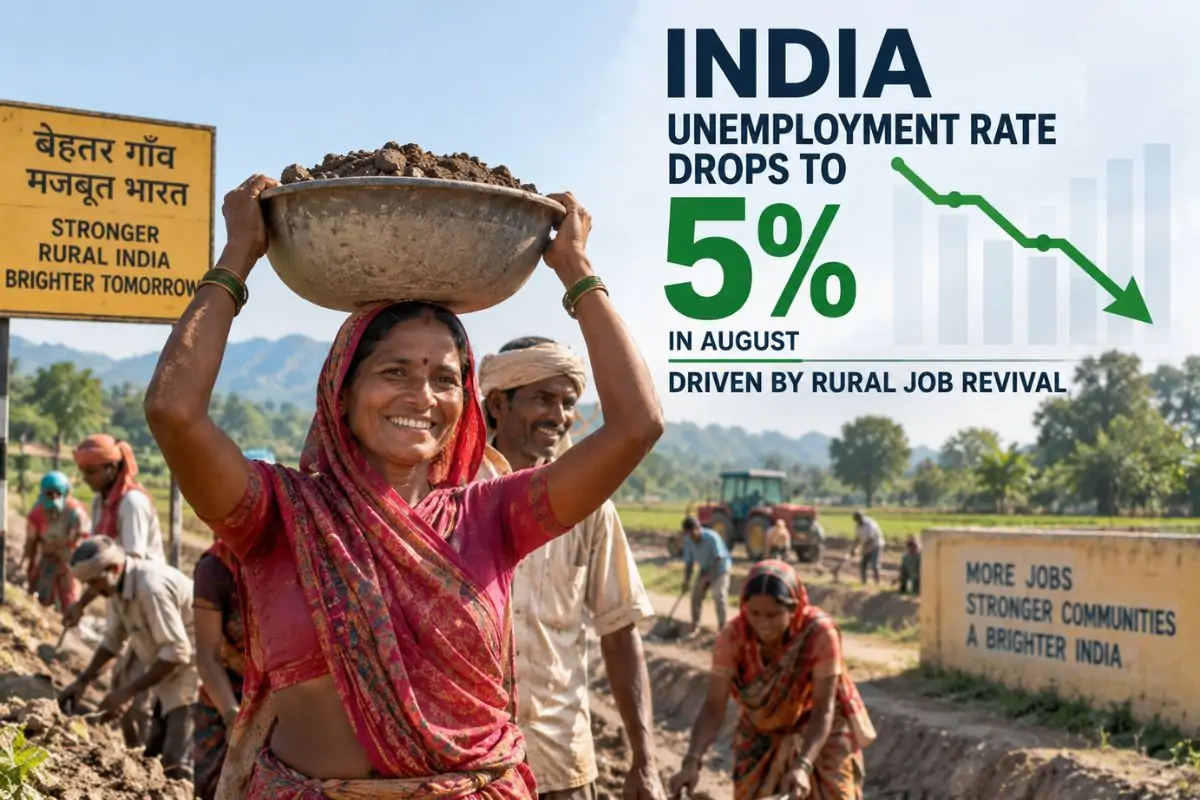
India’s labor market demonstrated positive momentum according to the latest official metrics released by the government. The overall unemployment rate among individuals aged 15 years and above eased marginally to 5.0 percent, registering an improvement from the 5.1 percent recorded in the previous month. Released by the Ministry of Statistics and Programme Implementation through the Periodic Labour Force Survey, the comprehensive data highlights a steady stabilization in employment conditions across the country, heavily reinforced by a significant revival in rural economic activity and an expanding workforce.
The broad improvement in national employment statistics was accompanied by positive shifts in core labor market indicators.The overall Labour Force Participation Rate for individuals aged 15 years and above climbed to 55.6 percent, moving up from 55.4 percent in July.Concurrently, the Worker Population Ratio advanced to 52.8 percent, hitting its highest recorded threshold since March.Economists note that these parallel increases signify that a larger portion of the working age population is actively entering the job market and successfully securing employment rather than remaining on the sidelines.
Rural Sectors Lead the Employment Surge
The primary driver behind the downward tick in national joblessness was a robust performance across India’s vast rural economy. Rural unemployment tumbled down to 4.1 percent, marking its lowest recorded level since January.This represented a sharp month-on-month contraction in rural job scarcity, outperforming general market expectations.
Rural labor force participation expanded to 58.2 percent, while the rural worker population ratio climbed to 55.8 percent. Analysts attribute this rural strength to favorable seasonal agricultural cycles, sustained government focus on rural infrastructure projects, and expanding non-farm employment opportunities at the grassroots level. The data indicated that rural joblessness declined across both male and female segments, reflecting broad-based economic engagement across agrarian communities.
Rising Female Workforce Participation
Another standout feature of the latest labor survey is the continued upward trajectory of female labor force participation.The overall female participation rate rose to 34.8 percent, improving upon the 34.4 percent recorded a month prior and registering a notable gain compared to the same period in the previous year.
Rural female participation served as the primary catalyst, jumping to 39.4 percent. Concurrently, the overall female unemployment rate fell for the second consecutive month down to 5.1 percent. Societal shifts, enhanced localized skill development programs, and flexible rural employment opportunities continue to draw more women into the active workforce, strengthening household financial resilience across rural districts.
Urban Dynamics and Divergent Trends
While rural sectors exhibited broad improvement, urban employment indicators displayed a slightly different pattern. The urban unemployment rate edged up marginally to 6.8 percent compared to 6.7 percent in July. Urban labor force participation remained relatively stable, and urban worker population ratios held steady.
Experts point out that urban job markets often experience higher volatility due to formal sector adjustments, migration influxes, and shifting corporate hiring appetites. Although urban female participation held stable, minor fluctuations among urban male jobseekers contributed to the slight uptick in city-level unemployment figures.
Broader Economic Implications
The latest survey findings provide encouraging signals for policymakers monitoring domestic consumption and economic growth. With rural joblessness receding and worker population ratios climbing, sustained consumer spending power in non-urban centers is expected to receive a healthy boost. As the economy transitions into the peak festive season, maintaining this employment momentum will be critical to supporting broader macroeconomic stability and ensuring that growth dividends reach every stratum of the workforce.