Women Empowerment in Rural India Since 2014: Progress, Challenges, and Pathways Forward
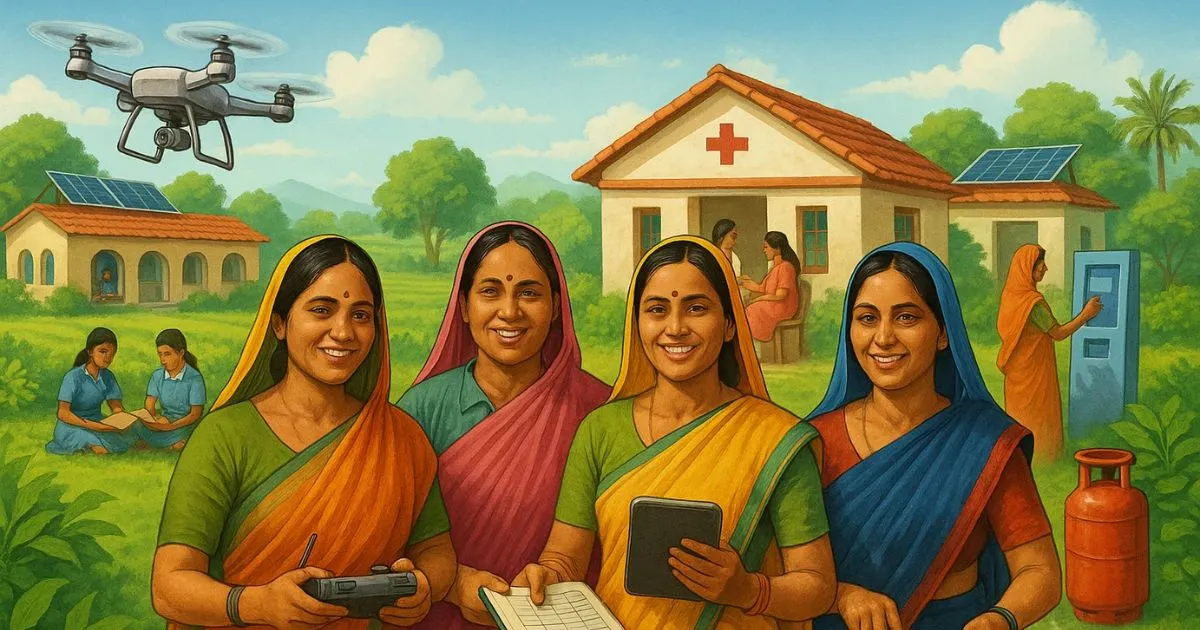
Women empowerment in rural India represents a critical pillar for achieving gender equality and sustainable development. Since 2014, under the Narendra Modi-led government, there has been a deliberate shift from welfare-oriented approaches to development-focused initiatives, emphasizing economic independence, education, health, and leadership for rural women. Rural women, who constitute about 70% of India’s female population and play a vital role in agriculture and household economies, have historically faced systemic barriers rooted in patriarchal norms, limited access to resources, and socio-economic exclusion. However, government schemes, non-governmental organization (NGO) interventions, and community-driven models like Self-Help Groups (SHGs) have driven notable transformations.
This article examines the multifaceted journey of women empowerment in rural India from 2014 to 2025, drawing on government data, academic studies, and real-world case studies. It highlights key initiatives, measurable progress, persistent challenges, and future directions. By empowering rural women, India not only addresses gender disparities but also boosts overall economic productivity, as women contribute significantly to the agricultural workforce, where their labor force participation rate stands at 41.8% compared to 35.31% in urban areas.
Government Schemes and Initiatives: A Comprehensive Framework
The Indian government’s post-2014 strategy has integrated women empowerment into flagship rural development programs, focusing on financial inclusion, skill development, and social protection. These schemes aim to shift from dependency to self-reliance, aligning with Sustainable Development Goal 5 (Gender Equality).
Key Schemes Launched or Strengthened Since 2014
1. Beti Bachao Beti Padhao (BBBP): Launched on January 22, 2015, this scheme addresses the declining child sex ratio (CSR) and promotes girl child education and survival. It targets 100 districts initially, with a focus on rural areas through awareness campaigns, enforcement of the Pre-Conception and Pre-Natal Diagnostic Techniques (PCPNDT) Act, and community mobilization. By 2025, BBBP has expanded nationwide, sensitizing millions on gender biases. Funds totaling ₹100 crore were initially allocated, with emphasis on multi-sectoral interventions involving the Ministries of Women and Child Development, Health, and Education.
2. Pradhan Mantri Ujjwala Yojana (PMUY): Introduced in May 2016, PMUY provides free LPG connections to Below Poverty Line (BPL) households, prioritizing rural women to reduce health risks from traditional fuels like firewood. Over 10 crore connections have been distributed by 2025, empowering women by saving time on fuel collection and improving indoor air quality, which indirectly boosts their participation in income-generating activities.
3. Deendayal Antyodaya Yojana – National Rural Livelihoods Mission (DAY-NRLM): Restructured from the earlier Aajeevika program in 2011 but significantly scaled post-2014, NRLM mobilizes rural poor into SHGs. It focuses on financial inclusion, skill training, and enterprise development. By 2025, it has formed over 90 lakh SHGs with 10 crore women members, leveraging ₹65 billion in bank credit and ₹5 billion in community savings. Sub-components like Mahila Kisan Sashaktikaran Pariyojana (MKSP) empower women farmers through climate-resilient agriculture training.
4. Pradhan Mantri Matru Vandana Yojana (PMMVY): Rolled out in 2017, this provides ₹5,000 cash incentives to pregnant and lactating mothers for the first child, promoting maternal health and nutrition in rural areas. It has benefited over 3 crore women by 2025, reducing anemia and improving child survival rates.
5. Drone Didi Scheme: Launched in 2024 under NRLM, it trains 15,000 SHG women as drone pilots for agricultural mapping, medicine delivery, and input spraying, fostering tech-savvy entrepreneurship in rural areas.
6. Other Supporting Schemes:
Pradhan Mantri Gramin Digital Saksharta Abhiyan (PMGDISHA): By 2025, it has trained over 60 million rural citizens, with a focus on women for digital literacy.
Stand-Up India (2016): Offers loans to women entrepreneurs from SC/ST and general categories for greenfield enterprises.
Sukanya Samriddhi Yojana (2015): A savings scheme for girl child’s education and marriage, with tax benefits.
Rural Self-Employment Training Institutes (RSETI): Since 2014, over 3.83 lakh rural women have been trained in 2025 alone, with 65% placement rates.
These schemes are implemented through a convergence model, linking with MGNREGA for wage employment and Swachh Bharat for sanitation, ensuring holistic empowerment.
| Scheme | Launch Year | Key Focus | Rural Impact (as of 2025) |
|---|---|---|---|
| BBBP | 2015 | Girl child survival & education | Improved CSR in 640+ districts; 80% funds on awareness |
| PMUY | 2016 | Clean cooking fuel | 10 crore+ connections; reduced health burdens |
| DAY-NRLM | 2011 (scaled 2014) | SHGs & livelihoods | 10 crore women in SHGs; ₹70 billion in credit |
| PMMVY | 2017 | Maternal health | 3 crore+ beneficiaries; lower anemia rates |
| Drone Didi | 2024 | Tech skills | 15,000 trained; agri-digitalization |
Progress and Achievements: Data-Driven Insights
Since 2014, rural women’s empowerment has shown tangible gains, particularly in economic participation and social indicators. The Periodic Labour Force Survey (PLFS) and National Family Health Survey (NFHS-5, 2019-21) provide key metrics.
Economic Empowerment
- Workforce Participation: Rural women’s labor force participation rose from 24.8% in 2017-18 to nearly double by 2023-24, driven by SHGs and MGNREGA. Under NRLM, SHG women have generated 89 lakh additional jobs in MSMEs from FY21-23. A 2024 study in Jharkhand showed tribal women’s SHG involvement increased political and economic agency, with higher networking and equality norms.
- Financial Inclusion: SHGs under NRLM have accessed ₹1.1 billion in credit in Bihar alone (2007-2019), expanding post-2014. Women-led businesses received 69% of MUDRA loans by 2025. The Economic Empowerment Index (EEI) from Census 2011 and PLFS 2019-20 indicates rural women outperform urban counterparts in work participation across literacy and education levels.
- Entrepreneurship: Initiatives like Tejaswini in Madhya Pradesh (IFAD-supported) have benefited 1.12 million households by providing skills and market access. In 2025, 74,410 startups had at least one woman director.
Social and Health Empowerment
- Education and Literacy: BBBP has improved girl child enrollment; NFHS-5 shows a 10-15% rise in female literacy in rural areas. PMGDISHA empowered 60 million with digital skills, enhancing access to education.
- Health Outcomes: PMUY and PMMVY reduced maternal mortality; NFHS-5 reports lower anemia rates among rural women. UN Women’s Dalit initiative increased MGNREGA participation from 2,800 to 14,000 women in eight districts (2009-2011), with sustained growth post-2014.
- Leadership: Women’s representation in panchayats (mandated 33% reservation) has led to better governance; NRLM’s Women Leadership Schools (WLS) in Bihar trained thousands, fostering community change.
A World Bank report (2019) on Bihar’s JEEViKA under NRLM mobilized 270,000 women into Farmer Producer Organizations (2014-2019), boosting incomes and insurance access for 1.2 million. Overall, these efforts could add $700 billion to GDP by 2025 if gender parity is achieved.
Case Studies: Real-World Transformations
Case Study 1: NRLM and SHGs in Bihar (JEEViKA)
In Bihar, NRLM’s JEEViKA has mobilized 9.8 million women into 847,000 SHGs since 2007, with rapid expansion post-2014. By 2019, it trained 1 million farmers in improved practices, leading to higher productivity. Women like those in Pashu Sakhi groups (52,000 households since 2016) manage animal husbandry, increasing incomes by 20-30%. A 2024 mixed-methods study showed SHG entrepreneurship enhanced social empowerment, reducing male dependency and improving intra-household dynamics.
Case Study 2: Women Leadership Schools in Muzaffarpur, Bihar
Implemented by S M Sehgal Foundation since 2021, WLS trained women like Abha Kumari, who transitioned from a overshadowed homemaker to a community leader advocating for governance and gender issues. Through 12-session programs, 20 villages saw ripple effects: increased female participation in gram sabhas and better resource allocation for health and education. This model, scalable to 662,000 villages, challenges patriarchy via case-based learning.
Case Study 3: Energy-Based Livelihoods in Madhya Pradesh
An ADB project since 2014 provided 24-hour electricity to rural households, empowering women micro-entrepreneurs. Capacity building in energy-efficient enterprises increased incomes and savings; women gained equal business opportunities, validating steady power’s role in gender parity.
Case Study 4: Digital Empowerment Foundation (DEF) Microentrepreneurs
A 2024 USF study of 285 rural women in DEF’s program showed female microentrepreneurs outperformed males in consumer acquisition due to empathy with rural women clients. This led to economic gains and social transformation, addressing gender disparities.
These cases illustrate how schemes translate into agency, with SHGs acting as catalysts for sustainable change.
Challenges: Persistent Barriers to Full Empowerment
Despite progress, rural women face entrenched obstacles:
- Cultural and Social Norms: Patriarchy, caste discrimination, and gender-based violence limit decision-making. A 2025 ORF report notes technology may exacerbate divides without targeted training.
- Economic Hurdles: Wage gaps persist; rural women earn less despite higher participation. Asset ownership remains low, with SHGs showing weaker impacts here.
- Access Issues: Limited credit, education (65% rural female literacy vs. 86% male), and healthcare persist. Heavy domestic workloads hinder income activities.
- Implementation Gaps: BBBP spent 80% on media, with uneven CSR improvements. Climate change and economic crises aggravate vulnerabilities.
- Digital and Skill Divides: While PMGDISHA helps, rural digital access is skewed.
A 2025 NFHS-5 analysis reveals state-wise disparities, with economic barriers strongest in northern rural states.
Future Directions and Conclusion
Looking ahead to 2047 (India’s developed nation goal), sustaining momentum requires policy coherence, increased funding for on-ground implementation, and tech integration like Drone Didi. NGOs and corporates (e.g., HDFC’s Parivartan training 600 nurses) must bridge gaps. Community collectives under NRLM can drive SDGs, focusing on land rights and violence prevention.
Since 2014, women empowerment in rural India has evolved from awareness to action, with schemes like BBBP and NRLM fostering independence and growth. Progress is evident in doubled employment rates and mobilized billions in credit, yet challenges like norms and access demand vigilant efforts. Empowering rural women is not just equity, it’s an economic imperative, promising inclusive prosperity for India. Continued investment will ensure these “aspirational women” lead the nation’s transformation.